Unterbacher See
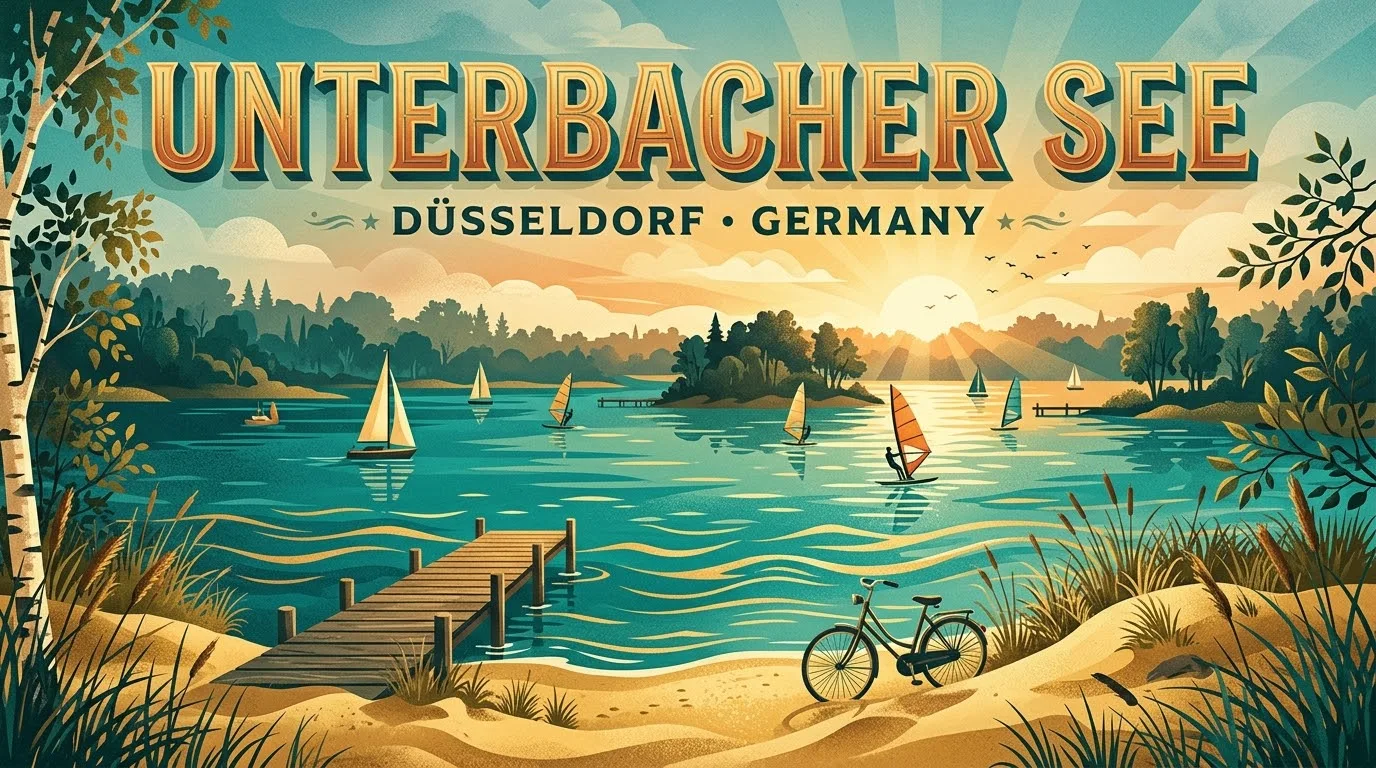
On the southeastern edge of Düsseldorf, right where the city blends into the neighbouring towns of Erkrath and Hilden, lies Unterbacher See, arguably the state capital's most popular leisure and swimming lake. Stretching roughly 2.5 kilometres and covering nearly 84 hectares, the lake has room for swimmers, sailors, rowers and anyone who simply wants to spend a day by the water without travelling all the way to the North Sea coast. Two separate beach facilities, Nordstrand and Südstrand, share the shoreline and offer fine sandy sunbathing lawns, supervised swimming zones and consistently excellent water quality, which has long earned the lake its nickname as "Düsseldorf's sea." Over the decades a complete leisure infrastructure has grown up around Unterbacher See, from sailing schools and boat rental to lakeside campsites, turning it into a lively meeting point for outdoor enthusiasts and families from across the wider region, and not only on the hottest days of summer.
History of Unterbacher See
Unterbacher See is not a naturally formed body of water but the result of decades of gravel and sand extraction carried out in the Unterbach heathland between 1926 and 1973. As the ground was systematically dug out, a deep lake gradually took shape, reaching a maximum depth of 13.4 metres and holding around 4.11 million cubic metres of water, fed mainly by groundwater rather than any natural inflow or outflow. A curious episode from the site's history dates back to the Second World War, when a decoy airfield was built on the still partially unexcavated land in an attempt to lure Allied bombers away from their actual targets in the nearby Rhine metropolis. After the war, as the gravel extraction drew to a close, the surrounding municipalities recognised the recreational potential of the emerging lake, and on 7 February 1956 Düsseldorf, Erkrath and Hilden jointly founded the Zweckverband Erholungsgebiet Unterbacher See, the special-purpose association that still manages and develops the site today. Strandbad Nord, complete with its own bathhouse, opened in 1959, and Strandbad Süd followed in 1966, launching from the start with its own area set aside for naturist bathing, a feature that continues to this day. In the decades that followed, an ever more extensive infrastructure grew up around the lake: sailing and rowing clubs settled on its banks, campsites appeared right on the shoreline, and an extensive network of hiking and cycling paths connected the lake to the surrounding countryside. What began as an industrial gravel pit has, over the course of nearly a century, turned into one of the most important recreation areas in the entire Rhineland, still jointly administered by the three founding municipalities.
Highlights of Unterbacher See
The heart of Unterbacher See lies in its two beach facilities, Nordstrand and Südstrand, which together offer several hundred metres of fine sandy sunbathing area and large, supervised swimming zones. Both beaches regularly receive the top rating for water quality from the relevant state environmental authority, making the lake one of the cleanest bathing waters in North Rhine-Westphalia. Nordstrand leans toward classic family-friendly bathing, with playgrounds and food and drink available right on the water, while Südstrand adds a hedge-enclosed naturist area along with sand pitches for beach volleyball and football. Water sports enthusiasts are especially well served here: several sailing clubs, including the Düsseldorfer Segelclub Unterbacher See and the Segel-Kameradschaft Unterbacher See, run sailing courses and boat licence training year-round, while a rowing association and a dragon boat club are regularly out on the water. Visitors who want to get out on the lake themselves can rent rowing boats, sailing boats and so-called party rafts and explore the water independently. For families with children there are playgrounds, a low-rope climbing course, and barbecue areas that can be reserved for a fee. A well-developed network of hiking and cycling paths, roughly 15 kilometres long, winds through the surrounding heath and woodland and makes for an ideal extended walk or bike ride before or after a swim. Two campsites with direct access to the shore allow for multi-day stays right by the water, setting Unterbacher See apart from many other inner-city swimming lakes. Cafés and restaurants overlooking the lake round out the offering, turning what might start as a simple swimming trip into a full day of activity on and around the water.
Opening Hours, Tickets & How to Get to Unterbacher See
The outdoor swimming season at Unterbacher See traditionally begins on 1 May and runs through the summer months into early autumn, though the exact closing date can shift slightly from year to year depending on the weather; in particularly warm years the season has been extended beyond its usual end date. Ticket counters generally close around an hour before the official closing time, while swimming itself ends half an hour earlier still, so visitors should factor in this buffer when planning a visit. Entry to both Nordstrand and Südstrand is charged via a day ticket, priced differently for adults and for children or other concession holders, with cheaper after-work tickets and multi-visit cards also available for regular visitors. Because exact prices can change from one season to the next, it is worth checking current rates on the official website of the Zweckverband beforehand or asking directly at the ticket counter. Parking right at the beaches also carries a daily fee, charged automatically through a number-plate recognition system at the barrier, with the first hour typically free of charge. By public transport, the lake is served by bus line 403, which stops separately at both Nordstrand and Südstrand, making it easy to get there without a car. An online booking system covers boat rental, barbecue area reservations and campsite stays, and also lists the current prices for boats and any additional services. Visitors arriving by bicycle benefit from the direct connection to the surrounding path network, which links Unterbacher See to several Düsseldorf districts as well as to Erkrath and Hilden.
Attractions Near Unterbacher See
Sitting right where Düsseldorf meets Erkrath and Hilden, Unterbacher See opens up plenty of options for further exploration nearby. The extensive heath and woodland surrounding the lake invites long walks and bike rides, offering quiet, natural corners to unwind away from the beaches themselves. Toward Erkrath, it is well worth visiting the Neanderthal Museum in the nearby Neandertal valley, dedicated to the history of the famous discovery site and to human evolution, and counted among the best-known natural history museums in the region. In Hilden itself, the historic town centre with its town hall and small half-timbered houses makes for a pleasant stroll that pairs well with a day trip to the lake. The neighbouring Düsseldorf districts of Gerresheim and Hubbelrath also offer rewarding destinations for anyone wanting a bit of history and culture after swimming, with their historic cores, churches and parks. Families with children will also find a nearby wildlife park where native animal species can be observed in natural enclosures, making an ideal complement to a day spent by the water. Anyone craving a taste of city life after the trip to the lake can reach central Düsseldorf, with its old town, Königsallee shopping boulevard and Rhine promenade, within a reasonable drive, making it easy to combine nature and city in a single day.
Where to stay in Dusseldorf, Germany
Compare current hotel prices and find the right place to stay.