Stadterhebungsmonument
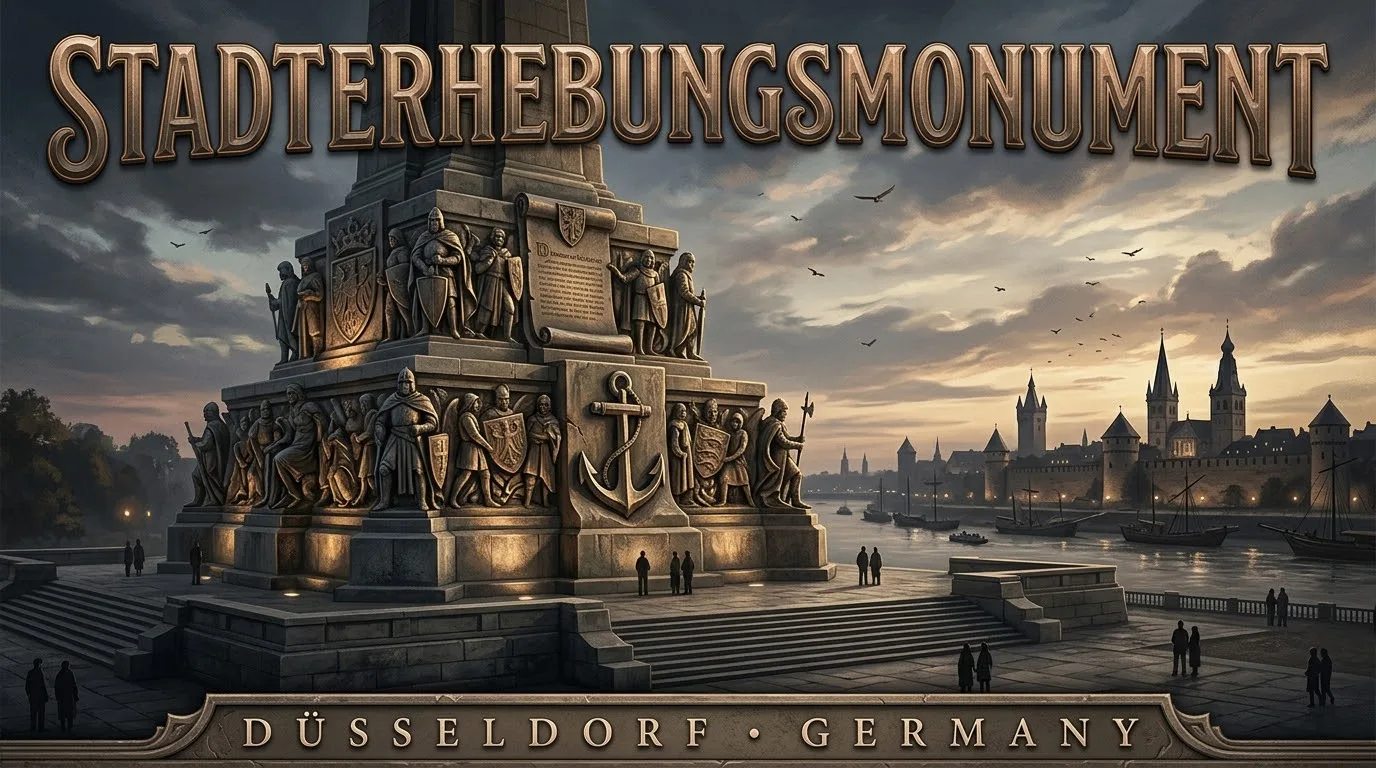
Right in the historic heart of the Altstadt, just a short walk from the Rhine promenade, the Stadterhebungsmonument rises as one of the most unusual monuments in Düsseldorf. Unlike a classical equestrian statue or a simple fountain figure, this bronze artwork does not depict a single scene but condenses an entire chapter of urban history into one dense composition: from the medieval battle that earned Düsseldorf its town charter to the bustling market life of past centuries. Visitors passing through Burgplatz almost inevitably stop in their tracks, drawn in by the sheer number of faces, figures, and symbols layered across the bronze surface, which at first glance appears almost puzzling and invites closer inspection. Far more than mere street decoration, the monument functions as a walkable history book cast in metal, fascinating locals and travelers alike and prompting reflection on the origins of this city on the Rhine.
History of Stadterhebungsmonument
The story behind the Stadterhebungsmonument begins in the year 1288, when the small settlement of Düsseldorf on the Rhine was granted town charter rights by Count Adolf V of Berg following his decisive victory at the Battle of Worringen. That battle, in which the Counts of Berg prevailed against the Archbishop of Cologne, is still regarded today as the founding myth of the city and is commemorated every year on the eve of its anniversary with the traditional Lambertus bonfire and firework salutes along the Rhine. To mark the 700th anniversary of this pivotal event in 1988, the city commissioned a monument that would keep this history visible for future generations. The task was given to Bert Gerresheim, a Düsseldorf-born sculptor who had already stirred considerable debate with his unconventional Heinrich-Heine-Denkmal unveiled at Schwanenmarkt in 1981. For the Stadterhebungsmonument, Gerresheim developed an entirely distinctive artistic language: rather than a single, harmonious heroic figure, he created a dense, collage-like composition of numerous interwoven scenes that only reveal their full meaning upon repeated viewing. Work on the piece spanned several years before it was finally unveiled in 1988 at the eastern edge of Burgplatz, on the corner of Joseph-Wimmer-Gasse and Müller-Schlösser-Gasse. Ever since, it has remained a fixed feature of the Altstadt and a recurring stop on guided tours dedicated to Düsseldorf's history.
Highlights of Stadterhebungsmonument
What sets the Stadterhebungsmonument apart is its unusual narrative density. Bert Gerresheim deliberately avoided a classical, easily legible heroic depiction and instead created a multi-layered bronze collage in which battle scenes, religious motifs, and everyday market life overlap and intertwine. Attentive visitors can pick out the symbolic sealing of the town charter document, mounted warriors locked in combat from the Battle of Worringen, and references to the elevation of the Lambertus church to a collegiate chapter, an event closely tied to the city's development at the time. A particular favorite among observant visitors is the so-called hidden image, or Vexierbild: viewed from one specific marked spot on the ground, individual lines and surfaces of the bronze sculpture align to form the number 1288, the year of the town's founding charter. This optical puzzle regularly produces a genuine moment of discovery for visitors and has made the monument a popular photo subject and talking point on guided walks through the old town. The surface of the piece is also deliberately uneven and richly textured, so that different qualities of daylight, from the soft light of early morning to the golden glow of evening in the Altstadt, bring out the contours of the figures in ever new ways. The monument's position directly on Burgplatz, one of the liveliest and historically most significant squares in the old town, amplifies its impact further: in the background rises the Schlossturm, the last remaining fragment of the former Düsseldorf electoral castle, while a glance in the other direction opens onto the Rhine and its riverside promenade. In this way, the Stadterhebungsmonument combines art, urban history, and one of Düsseldorf's finest views within a remarkably small space.
Opening Hours, Tickets & How to Get to Stadterhebungsmonument
As a freely accessible public artwork, the Stadterhebungsmonument has no fixed opening hours and no admission fee; it can be visited free of charge at any time of day or night, every day of the week. An evening visit is especially rewarding, when the surrounding gas lamps and the Altstadt's ambient lighting bathe the bronze figures in a warm glow. Burgplatz sits right at the center of Düsseldorf's old town and is within easy walking distance of virtually every central point in the city, usually reachable within a few minutes on foot. For visitors using public transport, the Heinrich-Heine-Allee stop, served by several underground lines, is the most convenient option, from which it is just a short walk through the narrow lanes of the Altstadt to Burgplatz. Düsseldorf's main railway station, Hauptbahnhof, is also well connected by train and tram and lies roughly 20 to 25 minutes away on foot, or just a few minutes by underground. Drivers will find several paid parking garages in the Altstadt and along the nearby Rhine embankment, since the old town itself is largely a pedestrian zone with restricted traffic. Cyclists can take advantage of the well-developed riverside promenade, the Rheinuferpromenade, which runs directly past Burgplatz and offers a pleasant, car-free approach to the monument.
Attractions Near Stadterhebungsmonument
Burgplatz itself makes an excellent starting point for exploring further sights of the Altstadt on foot. Just a few steps away stands the Schlossturm, the sole surviving remnant of the medieval Düsseldorf electoral castle and today home to a small maritime museum. Also close by is the Radschlägerbrunnen, a fountain dedicated to the Radschläger, the cartwheeling children who are one of Düsseldorf's best-known civic symbols. A short walk further, at the Marktplatz in front of the historic town hall, visitors will find the Jan-Wellem-Reiterstandbild, one of the city's most important Baroque monuments. The Basilika St. Lambertus, recognizable by its distinctively twisted spire, is also only a brief stroll away and closely tied to the history depicted on the Stadterhebungsmonument itself. Right along the Rhine, the riverside promenade invites a relaxed walk with views of the river, the Rheinturm tower, and the Oberkasseler Brücke bridge. Anyone feeling hungry or thirsty after sightseeing will find plenty of traditional brewery pubs tucked into the surrounding lanes of the Altstadt, serving the top-fermented Altbier that is such a central part of Düsseldorf's social life.
Where to stay in Dusseldorf, Germany
Compare current hotel prices and find the right place to stay.