St. Lambertus Basilika
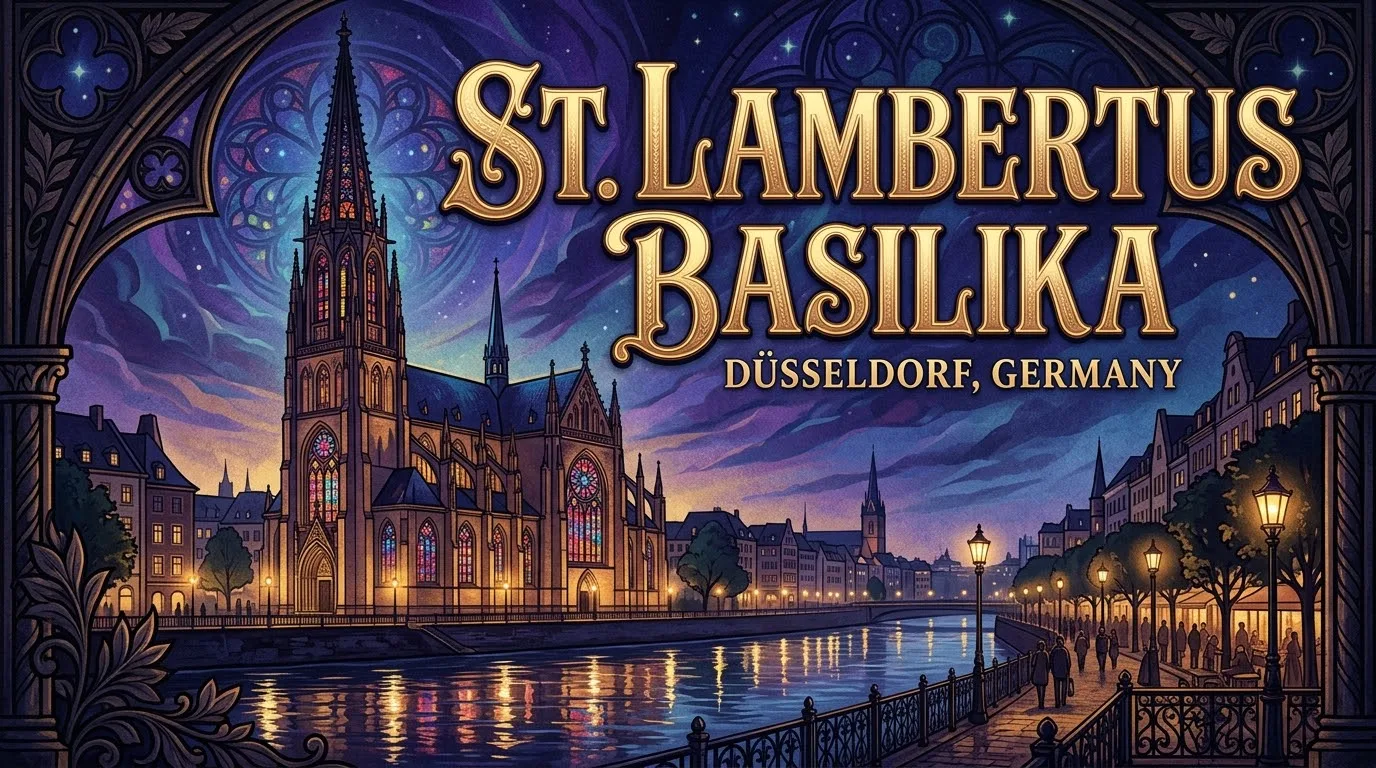
In the historic heart of Düsseldorf's Altstadt, just steps from the banks of the Rhine, St. Lambertus Basilika rises above the rooftops with its unmistakable crooked spire. For centuries this Gothic church has shaped the skyline of the North Rhine-Westphalian capital and counts among the oldest surviving buildings in Düsseldorf. Visible from afar, the distinctive twisted tower roof has long become an unofficial symbol of the city, inspiring countless legends about damp timber, storm damage, and divine intervention. Inside, visitors encounter a surprisingly rich blend of Gothic, Renaissance, and Baroque furnishings that tell the story of the church's long role as the court and burial church of the Dukes of Jülich-Berg. As the parish church of St. Lambertus, the basilica today offers both a place of quiet reflection amid the lively bustle of the Altstadt and a significant artistic and musical heritage that draws architecture and culture enthusiasts from around the world.
History of St. Lambertus Basilika
The roots of St. Lambertus Basilika reach deep into the Middle Ages. A papal document from 1159 already confirms the existence of an earlier structure on the site, and historians generally agree that the true origins of the church lie considerably further back in time. The current three-aisled hall church, built in the style of Lower Rhine brick Gothic, was constructed beginning around 1370 and was solemnly consecrated on July 12, 1394. The choir of the church rests on the foundation walls of its Romanesque predecessor, impressively demonstrating architectural continuity spanning several centuries. As the residence of the Counts of Berg moved to Düsseldorf, the church grew steadily in importance, and from 1592 onward it served as the burial site for members of the ducal family, a role that still lends it a distinguished rank among the sacred buildings of the city today. During the Second World War the building suffered severe damage, with the characteristic twisted tower roof destroyed and later rebuilt in the postwar years faithfully in its original tilted form. The Baroque interior furnishings, including altars dating from 1691 to 1698, bear witness to another formative building phase. In 1974, Pope Paul VI honored the historical and spiritual significance of the church by granting it the title of a minor basilica, a distinction awarded to only a handful of churches in Germany and one that underscores the special standing of St. Lambertus within the Catholic Church.
Highlights of St. Lambertus Basilika
The most striking feature of St. Lambertus Basilika is undoubtedly its crooked tower, whose twisted spire gives Düsseldorf one of the most unusual skylines anywhere in the Rhineland. Inside the basilica, the tomb of Duke Wilhelm V draws the attention of visitors and is regarded by many art historians as one of the most significant Renaissance artworks preserved in Düsseldorf. At the high altar, an impressive Madonna sculpture watches over the nave, a work by the celebrated Baroque sculptor Gabriel de Grupello, whose creations significantly shaped the city's artistic golden age in the seventeenth century. Another precious piece in the church's collection is the Apollinaris reliquary from 1665, which holds the relics of the church's patron saint and is regularly shown to visitors during guided tours. Musically, the basilica holds a particular rarity: two separate organs built by the renowned Rieger Orgelbau workshop, with the tower organ completed in 1999 and the choir organ in 2004, forming a twin instrument that is regularly used for concerts and the popular Sunday organ recitals. The tower is also home to seven bronze bells cast in 1987, whose sound fills the streets of the Altstadt. For visitors with a particular interest in Marian devotion, the parish offers a digital tour that focuses specifically on the numerous depictions of the Virgin Mary found throughout the basilica, allowing for a deeper appreciation of the church's rich iconography. The combination of Gothic architecture, Baroque furnishings, and vibrant church music makes St. Lambertus one of the most multifaceted sacred buildings in Düsseldorf.
Opening Hours, Tickets & How to Get to St. Lambertus Basilika
St. Lambertus Basilika is open to visitors during regular service times as well as for quiet visits outside of Mass, and admission to the church itself is free of charge. The parish office, located at Stiftsplatz 7, can be reached Monday through Friday from 10 a.m. to noon or by appointment, and also provides information about guided tours and special events held at the church. Visitors wishing to experience the basilica as part of a guided tour can check current dates on the parish website, lambertuspfarre.de, which also announces the popular Sunday organ concerts. As this is an active parish church, visitors are asked to be respectful during ongoing services. Thanks to its central location in the Altstadt, reaching St. Lambertus Basilika is straightforward: from Düsseldorf's main train station, Stiftsplatz is easily reached by tram or underground to the Heinrich-Heine-Allee stop, from where it is only a short walk through the narrow lanes of the old town. Burgplatz and the Rhine riverside promenade are both close by, making it easy to combine a visit to the basilica with a stroll along the river. Drivers will find several parking garages on the edge of the Altstadt, as the historic center itself is a pedestrian zone and cannot be accessed by car.
Attractions Near St. Lambertus Basilika
The location of St. Lambertus Basilika in the center of the Altstadt makes it an ideal starting point for exploring what locals fondly call the "longest bar in the world," a reference to the dense cluster of traditional breweries and pubs that fill the old town. Just a few steps away lies Burgplatz with the Schlossturm, the last surviving remnant of Düsseldorf's former castle, whose viewing platform offers a wonderful view over the Rhine. Immediately adjacent, the riverside promenade invites visitors to a relaxed walk or a boat trip on the river. On the nearby market square, the historic town hall stands beside the golden equestrian statue of Elector Jan Wellem, one of the city's best-known monuments. Art lovers will find the Kunstsammlung Nordrhein-Westfalen (K20) at Grabbeplatz, home to one of the most important collections of modern art in Germany, while fans of Baroque architecture can take a short detour to the nearby Maxkirche in the Carlstadt district. Visitors looking for refreshment after their visit will find traditional Altbier breweries such as Füchschen or Zum Schlüssel just around the corner, where Düsseldorf's distinctive top-fermented beer is served straight from the cask. The Hofgarten, the oldest public park in Germany, is also only a short walk from the basilica and offers a welcome green retreat after a day of sightseeing.
Where to stay in Dusseldorf, Germany
Compare current hotel prices and find the right place to stay.