St. Andreas Dominikanerkirche
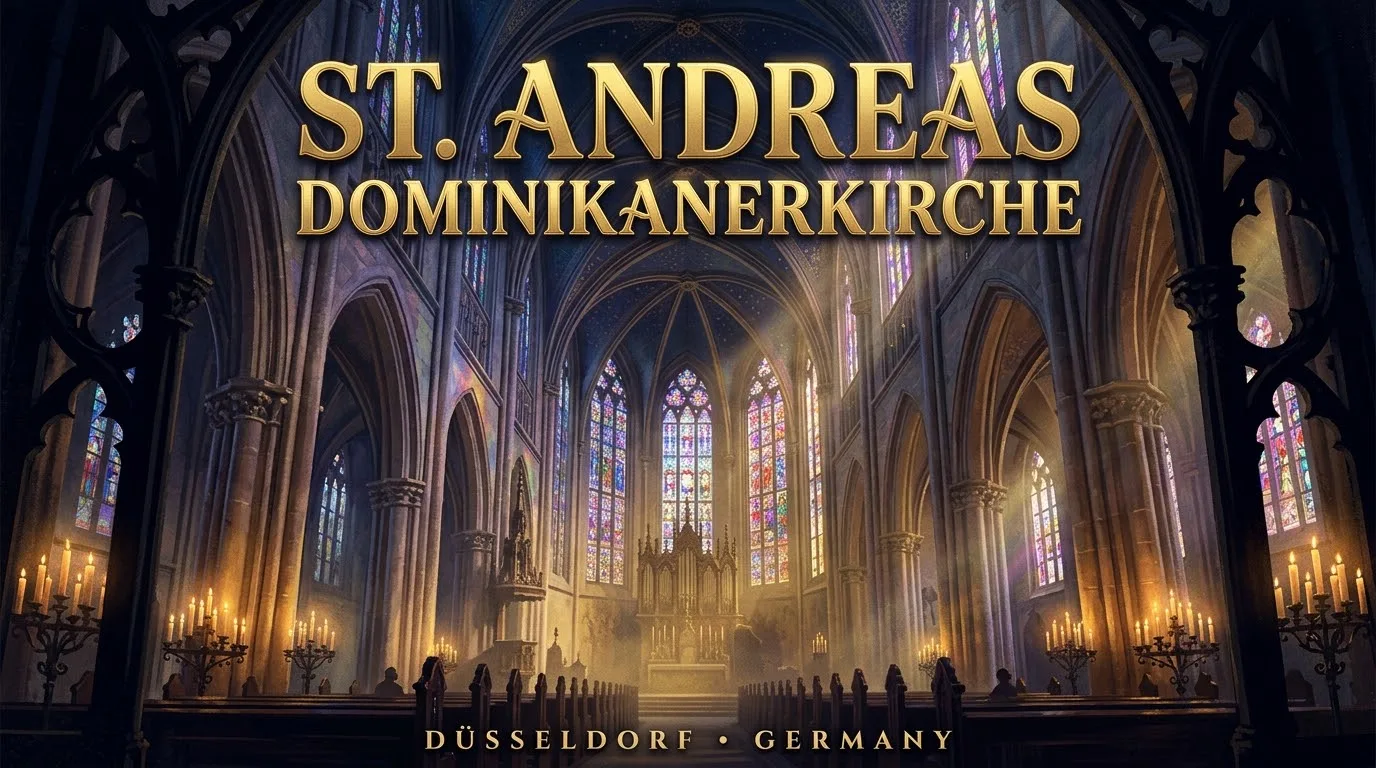
On Andreasstraße in the heart of Düsseldorf's Altstadt, a restrained brick facade conceals one of the city's most magnificent Baroque churches: St. Andreas Dominikanerkirche. What began in the 17th century as a Jesuit church modeled on Rome's Il Gesù developed over the centuries into one of the most important sacred art monuments on the Lower Rhine. Inside, visitors encounter a surprising contrast to the plain exterior: lavish stucco work, bright vaults, and an almost theatrical sense of space define the interior, telling the story of the artistic ambition of the Counter-Reformation. Today the church is cared for by Dominican friars and also serves as the final resting place for several members of the House of Pfalz-Neuburg, giving St. Andreas a dual significance as both a place of worship and a historic burial church.
History of St. Andreas Dominikanerkirche
The history of St. Andreas Dominikanerkirche begins in 1620, when Elector Wolfgang Wilhelm of Pfalz-Neuburg granted the Jesuits a plot of land in Düsseldorf's Altstadt for the construction of an order church. The foundation stone was laid on July 5, 1622, and as early as November 29, 1629, the first service was celebrated in the still not fully furnished church. While the main structure was completed by 1629, the elaborate interior work continued until 1661. In 1716, Elector Karl Philipp commissioned the architect Simon Sarto to build a mausoleum for the House of Pfalz-Neuburg, which was completed as early as 1717 and gave the church its status as a princely burial church. The Seven Years' War brought considerable damage to the church through bombardment in 1758, from which the building recovered only slowly. After the dissolution of the Jesuit order in 1773, the church went on to serve as a regular parish church. A decisive turning point in its more recent history came on March 1, 1972, when the Dominicans took over pastoral care of the church and relocated their monastery into the building. The parish merged with St. Lambertus in 2005, while extensive reconstruction work between 1960 and 1971 produced, among other things, a new altar designed by the important sculptor Ewald Mataré.
Highlights of St. Andreas Dominikanerkirche
Architecturally, St. Andreas Dominikanerkirche follows the characteristic "Jesuit style" modeled on Rome's Il Gesù church, with a five-bay nave and a two-bay choir with a five-eighths closure. Two prominent towers flank the choir area, while a polygonal mausoleum extends from the rear of the building, an architectural feature that distinguishes the church from many other Baroque churches in the region. The interior, designed as a hall church, impresses with cross-rib vaulted ceiling sections, surrounding galleries with arcades, and an extraordinarily rich stucco decoration, largely created by Johannes Kuhn from 1632 onward, which ranks among the most impressive examples of Baroque decorative art on the Lower Rhine. The side aisles are lined with life-sized statues of apostles and saints, further animating the church interior. Important altarpieces were created by the artists Ernst Deger and Julius Hübner, both prominent representatives of the 19th-century Düsseldorf School of painting. Musically, the church is home to an organ rebuilt between 1971 and 1973 by the von Beckerath workshop, featuring 42 registers and regularly used for concerts. Six bronze bells hang in the tower, the oldest of which was cast as early as 1643 by the famous Hemony brothers of Utrecht. The mausoleum, restored by Ewald Mataré in 1958 and containing the burial sites of the House of Wittelsbach-Pfalz-Neuburg, rounds out the church's extraordinary art-historical ensemble, which today stands under the protected monument status of the state of North Rhine-Westphalia. Visitors who take the time to wander slowly through the interior will also discover numerous smaller details, such as gilded capitals, elaborately framed side altars, and historic grave slabs set into the floor, which together form a dense tapestry of piety, courtly representation, and artistic ambition. Compared to the restrained exterior facade, this abundance of decoration feels especially striking, making St. Andreas one of the most impressive examples of Baroque spatial art anywhere in the Rhineland.
Opening Hours, Tickets & How to Get to St. Andreas Dominikanerkirche
As an active Dominican monastery church, St. Andreas Dominikanerkirche is regularly open for services and private prayer, and admission to the church is free of charge. Since the church is cared for by a religious order, its exact opening hours follow the monastic daily schedule and the Dominicans' prayer times, with current information available on the website dominikaner-duesseldorf.de. Groups with a particular interest in the church's art-historical highlights are advised to arrange a guided tour through the monastery in advance. The location on Andreasstraße in the middle of the Altstadt makes getting there remarkably simple: from the Heinrich-Heine-Allee stop, served by several tram and underground lines, the church is reached in just a few minutes on foot. Burgplatz and the market square with the historic town hall are also close by. Since the Altstadt is designated as a pedestrian zone, drivers are advised to use one of the numerous parking garages at the edge of the historic center, from where the church and surrounding attractions can be comfortably explored on foot.
Attractions Near St. Andreas Dominikanerkirche
The central location of St. Andreas Dominikanerkirche in the Altstadt opens up numerous opportunities for further exploration. Just a few steps away stands St. Lambertus Basilika with its distinctive crooked tower, which pairs perfectly with a visit to St. Andreas. Nearby Burgplatz with the Schlossturm offers a beautiful view of the Rhine, while the adjoining riverside promenade invites a walk along the river. On the market square, visitors will find the historic town hall and the golden equestrian statue of Elector Jan Wellem. Those interested in the eventful history of the Düsseldorf School of painting, to which several altarpieces in St. Andreas are attributed, should consider a visit to the Kunstsammlung Nordrhein-Westfalen at Grabbeplatz. After sightseeing, the Altstadt's traditional Altbier breweries, including Füchschen and Zum Schlüssel, invite visitors to rest with regional cuisine and freshly tapped Altbier. The Düsseldorf City Museum, which explores the history of the city in detail, is also within walking distance of the church.
Where to stay in Dusseldorf, Germany
Compare current hotel prices and find the right place to stay.