Rheinturm
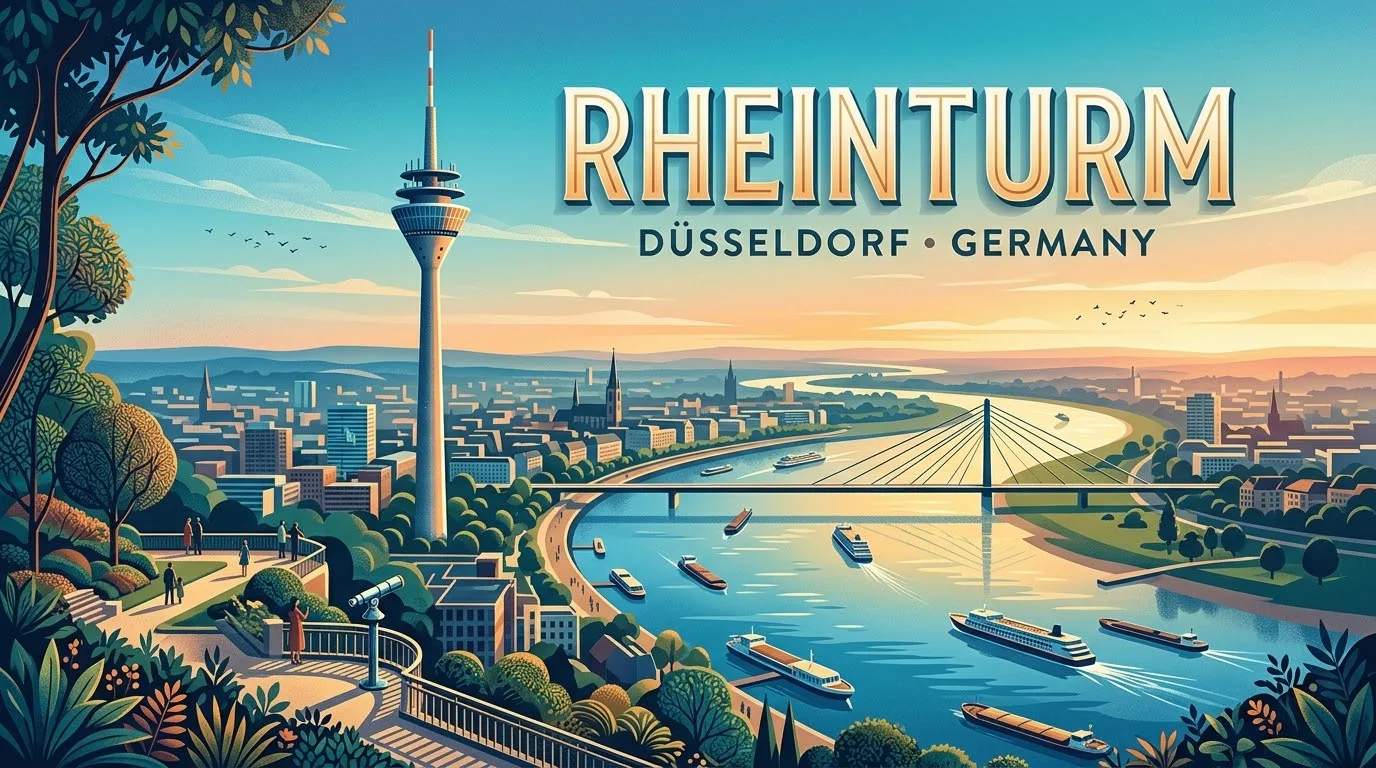
Few structures define the Düsseldorf skyline as unmistakably as the Rheinturm. With its slender silhouette tapering gently toward the top, this telecommunications tower has stood on the banks of the Rhine in the Medienhafen district for more than four decades and, at 240.5 metres, remains the tallest structure in the city. Anyone wanting to experience Düsseldorf from above will inevitably end up here: the observation deck at 168 metres offers an unobstructed panoramic view that, on clear days, extends far beyond the city limits into the neighbouring towns of the Rhineland. At the foot of the tower lies the Medienhafen with its striking architecture, while the Rhine winds through the cityscape in broad curves below. The Rheinturm is far more than a technical facility operated by Deutsche Telekom - it has become one of the state capital's most popular excursion destinations and photo subjects. The view is particularly striking during the blue hour, when the lights of the city and its bridges begin to glow, drawing in first-time visitors and lifelong Düsseldorf residents alike, again and again.
History of Rheinturm
Construction of the Rheinturm began in January 1979 to designs by architect Harald Deilmann and was completed in December 1981. The tower was officially inaugurated on 1 March 1982, and has since served as the central transmission site for radio, FM and television signals in the Düsseldorf region. Around 7,500 cubic metres of concrete went into its construction, and the total weight of the structure is estimated at roughly 22,500 tonnes - an impressive figure that illustrates just how massive a foundation is required to keep such a tall and slender building permanently stable. Originally, the tower reached a height of approximately 234.2 metres. In October 2004, an additional DVB-T antenna was installed at the tip, raising the overall height to today's 240.5 metres. This places the Rheinturm not only among Germany's tallest structures but also regularly on lists of Europe's tallest television towers. The tower gained particular fame through its unusual lighting concept, known as the "Lichtzeitpegel" or light-time display. Light artist Horst H. Baumann devised this concept, transforming the shaft of the tower into a gigantic, vertically readable digital clock: illuminated dots indicate hours, minutes and seconds, making the Rheinturm - by its own claim - the largest digital clock in the world. Over the decades, the tower has evolved from a purely functional telecommunications structure into a genuine symbol of the city, firmly anchored on postcards, in travel guides and in the collective memory of Düsseldorf's residents. The development of the adjacent Medienhafen during the 1990s and 2000s, with its spectacular architecture including buildings by Frank Gehry, further reinforced the Rheinturm's role as an orientation point and landmark. Today, the tower is inseparably linked to the image of a modern, ambitious Düsseldorf that bridges tradition and contemporary architecture.
Highlights of Rheinturm
The centrepiece of any visit is undoubtedly the observation deck at 168 metres, open daily from 10am until midnight. From here, an unobstructed 360-degree view opens up over Düsseldorf: to the west and north lies the glittering Rhine with its bridges, to the south stretches the Altstadt with its historic alleys, and on a clear day the silhouettes of Cologne or the hills of the Bergisches Land can even be made out on the horizon. Directly below the platform lies the Medienhafen with its unconventional, partly tilted facades - a contrast between industrial architecture and modern art that is especially striking when viewed from above. Another highlight is the QOMO revolving restaurant at roughly 172.5 metres, which completes one full rotation approximately every 72 minutes. Its 144 seats are positioned directly along the panoramic windows, so guests gradually watch the entire city pass by as they dine - an experience that is especially rewarding at sunset or once the city lights come on at night. The light sculpture mentioned earlier, which transforms the entire shaft of the tower into a functioning digital clock after dark, is visible from great distances across the city and makes the Rheinturm a living part of the nighttime skyline. Photographers particularly value the golden hour shortly before sunset, when the light bathes the Rhine in warm tones and the silhouette of the inner-city skyline stands out against the tower. Many visitors combine their ascent with a walk along the Rhine promenade or through the Medienhafen, either before or after visiting the deck. For couples and families, the view of the Rheinkniebrücke and the sweeping bends of the river is often the photographic highlight of the visit, while visitors interested in engineering appreciate the exhibition panels on the tower's architecture and broadcasting technology in the entrance area.
Opening Hours, Tickets & How to Get to Rheinturm
The observation deck of the Rheinturm is open year-round, daily from 10am until midnight, with the last admission typically shortly before closing. Adult admission costs around 12.50 euros, children between 6 and 13 years pay around 9 euros, while children under 6 enter free of charge. Seniors aged 65 and over receive a discounted rate of around 10 euros, and families with up to three children can purchase a combined ticket for around 30 euros. Visitors arriving early, before noon, or late, from 8pm onward, benefit from a reduced rate of roughly 9 euros. Tickets are sold exclusively online or on-site by card payment - cash is not accepted. It is advisable to reserve tickets in advance through the official website, especially on weekends and during the high season, in order to avoid waiting times. The QOMO revolving restaurant on the panoramic level is open Monday to Saturday from 6pm until midnight, with an additional lunch service on Sundays from noon to 4pm; reservations are strongly recommended. The Rheinturm is located at Stromstraße 20 in the Hafen district, right at the heart of the Medienhafen. By public transport, the tower is easily reached via tram line 709 to the "Stadttor" stop, or on foot in around 15 to 20 minutes from the main train station or from the Altstadt along the Rhine promenade. Several car parks within the Medienhafen offer parking close to the tower. The observation deck is accessible via a high-speed lift that reaches the top in under 20 seconds, making the tower accessible to visitors with reduced mobility as well.
Attractions Near Rheinturm
The Medienhafen surrounding the Rheinturm is itself an architectural attraction and invites visitors to an extended walk. In particular, the Neuer Zollhof buildings designed by architect Frank Gehry, with their characteristically warped facades, lie just a few minutes' walk away and form a fascinating contrast to the tower's clean, vertical lines. Along the Rhine promenade, a popular walking route leads directly beside the river toward the Altstadt, passing numerous cafés, bars and restaurants with water views. After roughly 15 to 20 minutes on foot, visitors reach Düsseldorf's historic Altstadt, with its narrow lanes, traditional breweries and the Burgplatz square. From there, the Oberkasseler Brücke, famous for its panoramic view of the Altstadt skyline, is also easily reached on foot. Culture enthusiasts will find the K21 Ständehaus with its contemporary art collection nearby in the harbour district, while Burgplatz, with the Schlossturm and its historic atmosphere, makes for another worthwhile stop on the way back into the city centre. The Rheinkniebrücke, which itself offers an impressive view back toward the Rheinturm, is also within walking distance and is especially popular among photographers looking to capture the tower as their subject.
Where to stay in Dusseldorf, Germany
Compare current hotel prices and find the right place to stay.