Rathaus Düsseldorf
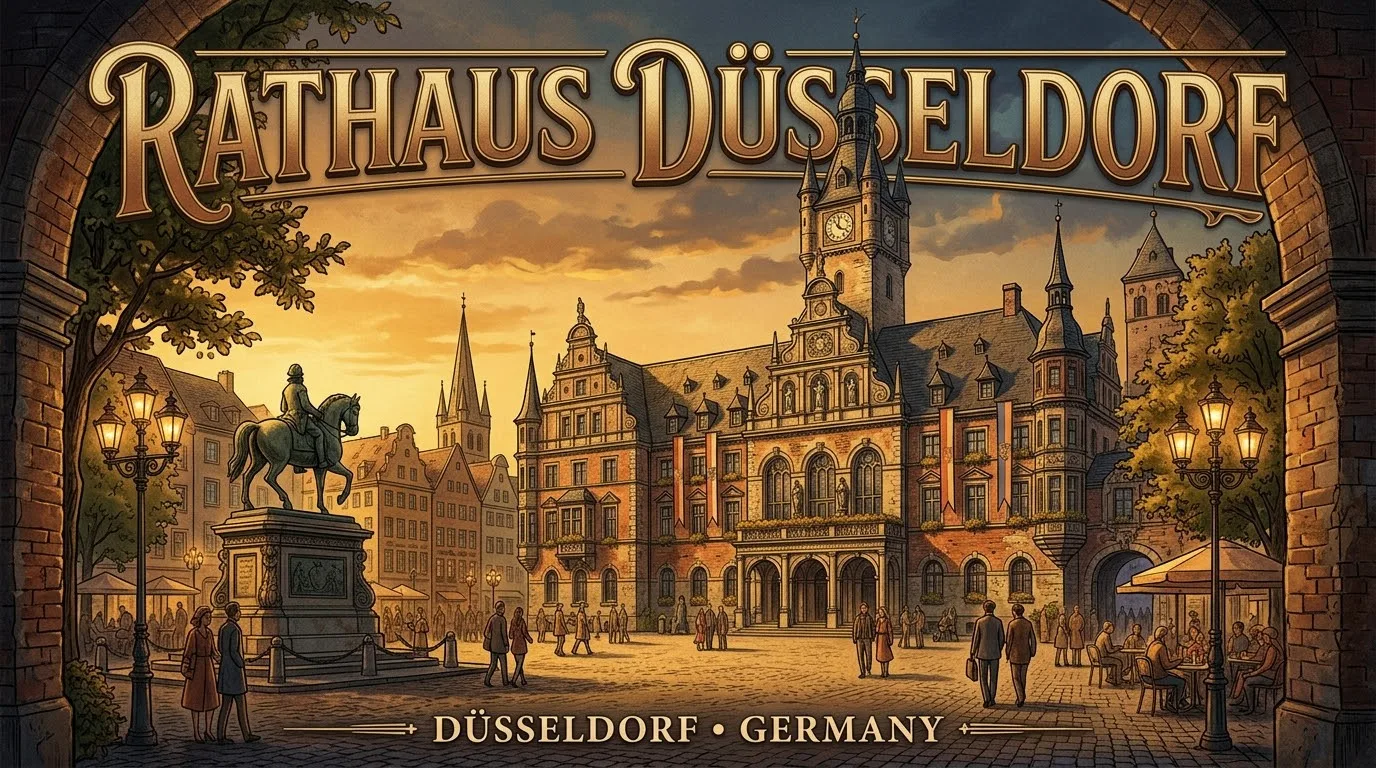
The Rathaus Düsseldorf on Marktplatz has been the political and symbolic heart of the North Rhine-Westphalian state capital for more than 450 years. Unlike many German town halls, the building is not a single uniform structure but several sections that grew together over the centuries, spanning styles from the Renaissance through the Baroque to postwar modernism. Directly in front of the historic Renaissance gable stands the bronze equestrian statue of Elector Jan Wellem, one of the city's best-known monuments. The Marktplatz in front of the Rathaus is a year-round stage for public life: it hosts Düsseldorf's Christmas market during Advent, and on Weiberfastnacht carnival groups traditionally storm the Rathaus to symbolically take over the city administration. For most visitors to the Altstadt, Marktplatz is the first orientation point from which the entire historic city center can be explored on foot.
History of Rathaus Düsseldorf
The building and usage history of Düsseldorf's city hall reaches back to the years 1570 to 1573, when the oldest surviving part of the structure on Marktplatz was erected - a two-story building in the Dutch-influenced Renaissance style with a characteristic stepped gable. Since that time, the building has served continuously as the seat of the city council and administration. In 1706, Elector Johann Wilhelm II, known as Jan Wellem, commissioned the adjacent Grupello-Haus according to plans by architect Matteo Alberti, named after court sculptor Gabriel Grupello, who also created the famous equestrian statue of the elector that has adorned Marktplatz since 1711. In the late 19th century, as the city grew rapidly, a Neues Rathaus in the Historicist style was added in 1888 under architect Eberhard Westhofen; its prominent tower was dismantled again in 1922 for structural reasons. During the Second World War, Düsseldorf's Altstadt suffered severe damage from air raids, and the Rathaus ensemble also sustained considerable damage to its roofs, facades, and interiors. During postwar reconstruction, the city placed great emphasis on preserving as much of the historic fabric as possible and rebuilding it faithfully. Between 1952 and 1956, an additional administrative building at Marktplatz 6 was constructed to plans by Julius Schulte-Frohlinde, which was extended once more in 1984. Today's Rathaus thus unites five interconnected wings spanning four centuries under a single administrative purpose. Despite the different construction phases, the ensemble feels remarkably coherent, since every extension deliberately matched the scale and eaves height of the existing buildings.
Highlights of Rathaus Düsseldorf
The centerpiece of the ensemble is the historic Renaissance building with its curved stepped gable, which remains largely original despite numerous alterations and wartime damage. Inside, the large Plenarsaal, where the city council meets and which is also used for official receptions on special occasions, is particularly impressive. Right next to it stands the Grupello-Haus with its Baroque facade articulation, still considered one of the most elegant buildings on Marktplatz. In front of the main entrance, the bronze equestrian statue of Jan Wellem dominates the square - one of the most significant Baroque sculptures in the Rhineland and a popular photo subject, especially when the figure is symbolically "dressed up" during carnival events. Since 2005, part of the Rathaus has also housed the Akademie-Galerie, which exhibits works by students and faculty of the Düsseldorf Art Academy. Architecturally, the contrast between the historic facades facing the market square and the functional postwar architecture of the administrative wings facing Mühlenstraße is also noteworthy. Several facade sections also feature historic coats of arms and inscriptions commemorating former city leaders and important events in the city's history. Once a year, on Weiberfastnacht, the Rathaus becomes the stage for a centuries-old ritual: carnival societies symbolically storm the building, and the mayor hands over the city's key to the carnival fools for the duration of the festivities - a custom that draws visitors from across Germany. In the run-up to Christmas, the Marktplatz transforms into one of the city's most atmospheric Christmas markets, set against the illuminated facade of the Rathaus.
Opening Hours, Tickets & How to Get to Rathaus Düsseldorf
The Marktplatz and the exterior facades of the Rathaus are freely and permanently accessible year-round at no charge. The administrative offices themselves are accessible during the city administration's usual office hours, generally Monday to Friday mornings into the early afternoon; visitors without an official appointment are mainly interested in the entrance area and occasional public guided tours, which can be requested through the city of Düsseldorf's citizen service office. The Plenarsaal can be visited during council sessions, which are open to the public unless a closed agenda item is being discussed. There is no fixed admission fee, as this is an administrative building rather than a classic museum-style tourist attraction. The Rathaus is easily reached on foot through the Altstadt, just steps away, as well as by light rail to the Heinrich-Heine-Allee stop or by several bus lines to Altstadt/Rathaus. Parking is available at, among other places, the Carlsplatz car park, just a few minutes' walk from Marktplatz. Current information on tours and appointments can be found on the official website of the city of Düsseldorf. Especially around Christmas and during street carnival, visitors should allow extra time, since Marktplatz and the surrounding lanes get very busy.
Attractions Near Rathaus Düsseldorf
Some of the Altstadt's most important sights cluster around Marktplatz. A short walk away stands the Basilika St. Lambertus with its distinctive twisted spire, right next to the Schlossturm, the last remaining remnant of Düsseldorf's former city castle and today home to a maritime museum. The Rhine promenade, with views of the river and the Medienhafen, is just a few minutes on foot and makes for a pleasant walk after visiting the Rathaus. Those interested in early 20th-century commercial architecture will find the Wilhelm-Marx-Haus on Heinrich-Heine-Allee, another significant listed building, close by. Not far away lies Carlsplatz with its popular daily market offering regional specialties. The Altstadt's many narrow lanes, lined with traditional breweries often referred to as "the longest bar in the world," also invite a stop after exploring the square.
Where to stay in Dusseldorf, Germany
Compare current hotel prices and find the right place to stay.