Radschlägerbrunnen
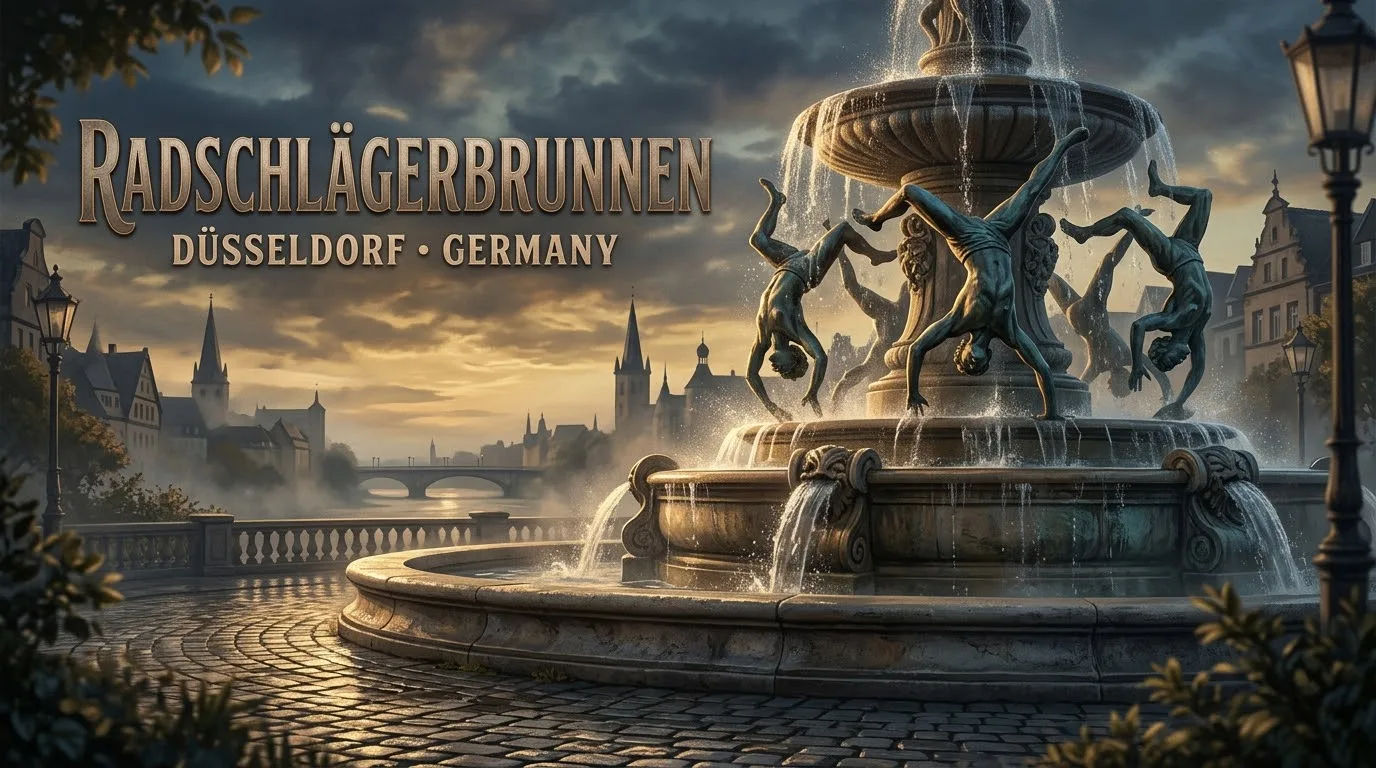
On Burgplatz in Düsseldorf's Altstadt, just a stone's throw from the Rhine, a fountain bubbles away that captures the soul of the city like almost no other monument: the Radschlägerbrunnen. Two bronze boys, frozen mid-motion in the act of a cartwheel, crown the waterwork and commemorate a centuries-old Düsseldorf tradition still kept alive by children and teenagers at numerous city festivals today. For locals, the fountain is far more than a pretty photo opportunity; it is considered one of the city's central landmarks and is fondly used as a meeting point and orientation marker in the Altstadt. Its location on the lively Burgplatz, right between the Rhine embankment and the historic lanes of the old town, makes the Radschlägerbrunnen a must-see stop for anyone wanting to get to know Düsseldorf and its legends more closely.
History of Radschlägerbrunnen
The story of the Radschlägerbrunnen begins in the early 1950s, when the long-established civic association Düsseldorfer Jonges decided to dedicate a monument of its own to the city's best-known symbol: the Radschläger, a child performing a sideways cartwheel, known locally as "Radschlagen," for the amusement of passers-by. According to legend, this custom dates back to the Middle Ages and is said to be connected to the decisive Battle of Worringen in 1288, when Düsseldorf's children supposedly turned cartwheels in the streets out of sheer joy over the victory and the town's newly granted charter. In more recent centuries, many Düsseldorf children genuinely earned a bit of pocket money with this skill, performing cartwheels for passers-by in exchange for a small coin, locally called a "Penning." To permanently anchor this tradition in the cityscape, the Düsseldorfer Jonges organized a competition in 1953, which was won by sculptor Alfred Zschorsch. His design convinced the jury through its dynamic, naturalistic depiction of two cartwheeling boys. The bronze figures were subsequently cast at the renowned Düsseldorf foundry Kunstgießerei Herbert Schmäke, before the completed fountain was ceremonially handed over to the city and installed on Burgplatz in 1954. Ever since, the Radschlägerbrunnen has remained one of the most photographed artworks in the Altstadt and is regularly used in official city branding as a symbol of Düsseldorf.
Highlights of Radschlägerbrunnen
The special charm of the Radschlägerbrunnen lies in its lively, almost playful depiction: the two bronze boys are frozen mid-acrobatic-motion in the cartwheel, arms and legs outstretched, creating an impression of constant movement despite being cast in rigid metal. Around the edge of the natural-stone basin, which measures more than three meters in diameter, is an inscription by the well-known Düsseldorf dialect poet Hans Müller-Schlösser, written in characteristic Rhenish dialect: "Radschläger wolle mer blieve, wie jeck et de Minsche och drieve," which loosely translates as "Cartwheelers we shall remain, however crazy people may behave." This saying sums up the down-to-earth, self-assured humor of Düsseldorf's residents and is still fondly quoted by locals today. Especially on warm days, families and children gather around the fountain, and some even attempt to imitate the bronze figures' famous cartwheel themselves, making for a popular photo opportunity among tourists. The immediate proximity to the Schlossturm and the Rhine also creates a particularly atmospheric setting, especially in the evening, when the fountain's water glitters in the light of the surrounding Altstadt illumination. Last but not least, the Radschlägerbrunnen is a fixed stop on numerous guided city tours dedicated to the legend and significance of cartwheeling for Düsseldorf's local identity.
Opening Hours, Tickets & How to Get to Radschlägerbrunnen
The Radschlägerbrunnen stands freely accessible in the public space of Burgplatz, so there are no fixed opening hours and no admission fee; the fountain can be visited free of charge around the clock, every day of the year. Only during very cold winter months is the water supply occasionally switched off temporarily for technical reasons, though the bronze figures themselves remain unaffected and well worth admiring at any time. Burgplatz sits centrally within Düsseldorf's Altstadt and is comfortably reachable on foot from almost any point in the city center. Visitors using public transport should get off at the Heinrich-Heine-Allee stop, served by several underground lines, from where a short walk through the old town's lanes leads directly to Burgplatz. Alternatively, the main railway station is also well connected by bus and train, though the walk from there takes roughly 20 to 25 minutes. Drivers should note that the entire Altstadt is largely car-free or subject to traffic restrictions; however, several paid parking garages on the edge of the old town and along the Rhine embankment provide ample parking options. The square is also easily reached by bicycle via the riverside promenade.
Attractions Near Radschlägerbrunnen
Right beside the Radschlägerbrunnen rises the Schlossturm, the last surviving remnant of the former Düsseldorf electoral castle, which today houses a small maritime museum as well as a viewing platform overlooking the Rhine. Just a few steps away stands the modern Stadterhebungsmonument, which recounts the story of Düsseldorf's founding in 1288 through a dense bronze collage, the very year closely tied to the legend of the cartwheeling children. At the nearby Marktplatz, in front of the historic town hall, visitors will find the Jan-Wellem-Reiterstandbild, one of the city's most important Baroque monuments. The Basilika St. Lambertus, with its distinctively twisted church spire, is also just a short walk away. Right along the Rhine, the riverside promenade invites a relaxed stroll with views of the river, the Rheinturm tower, and the Oberkasseler Brücke bridge. For refreshment after sightseeing, the numerous traditional brewery pubs tucked into the surrounding Altstadt lanes serve Düsseldorf's top-fermented Altbier straight from the barrel, an experience many visitors associate directly with the sight of the cartwheeling bronze boys.
For generations of Düsseldorf children, cartwheeling was a fixed ritual of growing up in the city, and the tradition is still kept alive today at school festivals, during Düsseldorf's carnival celebrations, and even at organized Radschläger competitions, where young participants demonstrate their skill. The fountain on Burgplatz is regarded as the official monument to this tradition and is regularly used in municipal events, anniversaries, and tourism campaigns as a symbol of the joy of life and the Rhenish sense of humor that defines Düsseldorf's residents. The city's coat of arms also incorporates a stylized version of the cartwheeling figure, further underlining the close link between the fountain and local identity. For anyone wishing to understand the story of the city, the Radschlägerbrunnen therefore offers a vivid starting point that uniquely combines art, legend, and a living local custom.
Where to stay in Dusseldorf, Germany
Compare current hotel prices and find the right place to stay.