Neanderkirche
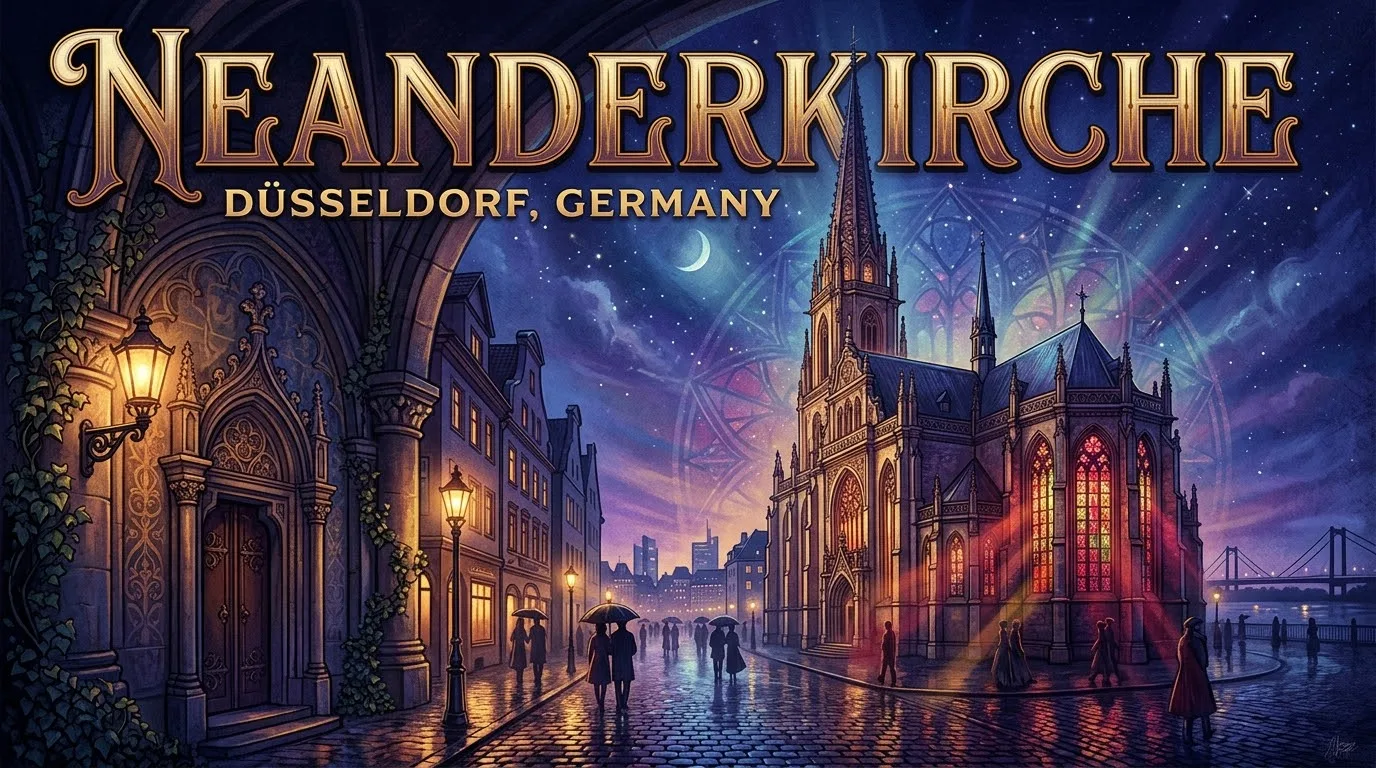
The Neanderkirche is one of the most unusual sacred buildings in Düsseldorf's Altstadt, since visitors wishing to see it must first find an inconspicuous passage off the bustling Bolkerstraße and step through a quiet courtyard before the modest Baroque façade comes into view. This hidden location is no accident, but rather the result of the religious tensions of the 17th century, when the Reformed congregation in predominantly Catholic Düsseldorf was not permitted to hold its services openly on a main street. In the midst of the Altstadt's lively bustle, just steps away from pubs, traditional brewery taverns and souvenir shops, the Neanderkirche has remained to this day a place of stillness and reflection, and at the same time a living testament to the complicated religious history of the Rhineland. The church is named after the Reformed theologian and hymn writer Joachim Neander, whose name also gave the nearby Neandertal valley its name, and thereby, indirectly, the Neanderthal discovered there.
History of Neanderkirche
The history of the Neanderkirche begins in the early 17th century, when Düsseldorf's Reformed congregation first erected a simple prayer house on the present site in 1610. Because the Dukes of Palatinate-Neuburg, who ruled Düsseldorf at the time, were aligned with Catholicism and later the Counter-Reformation, public Protestant worship was severely restricted; Reformed Christians were not permitted to build visibly on public streets. This restriction meant that, following a groundbreaking ceremony in 1683, the actual church was not completed until 1687, built as a so-called courtyard church hidden within a residential block and accessible only through a narrow passage from Bolkerstraße. Responsible for the construction was the master builder Michael Cagnon, who was commissioned to design a plain yet solidly built early Baroque hall church that met the Reformed congregation's need for a functional preaching space without violating the outward restraint expected of a suppressed denomination. The church only received its current name in 1916, when it was dedicated to Joachim Neander, who served as rector of the Reformed Latin school in Düsseldorf from 1674 to 1679. Neander, remembered today chiefly as the author of the well-known hymn "Praise to the Lord, the Almighty," spent much time in the valley near Mettmann later named after him, withdrawing there to meditate and compose his hymns; that valley became world famous when the remains of Neanderthal man were discovered there in 1856. During the Second World War, large parts of Düsseldorf's Altstadt were destroyed by air raids, including the buildings that had originally concealed the Neanderkirche completely. Through this paradoxical twist of destruction, the once deliberately hidden church became visible from Bolkerstraße for the first time, while the church building itself largely survived the bombing. To this day, the Neanderkirche belongs to the Evangelical Church Community of Düsseldorf-Mitte and continues to be used as an active house of worship by the Reformed congregation.
Highlights of Neanderkirche
Visitors stepping inside the Neanderkirche are struck by the simple yet dignified interior of the early Baroque hall church, deliberately different from the lavish interiors found in Catholic Baroque churches of the same period. The Reformed tradition eschewed ornate imagery in favor of clean lines, bright light and a functional layout that places the focus entirely on preaching and congregational singing. A particular highlight is the organ built by the Austrian organ maker Rieger in 1965, whose sound is still used today for services and occasional concerts and which provides a striking contrast to the restrained architecture surrounding it. Two historic bronze bells hang in the church tower, their sound carrying over the rooftops of the Altstadt on special occasions. The Baroque clock on the façade is a reminder of the building's long history and is one of the few exterior decorative elements visitors notice immediately upon entering the courtyard. Particularly appealing is the contrast between the lively bustle of Bolkerstraße, considered one of Germany's most visited pub streets, and the quiet seclusion of the churchyard just a few meters behind it; many visitors describe this sudden shift from urban hustle to contemplative calm as one of the most memorable experiences of an Altstadt visit. For enthusiasts of Reformation history, the Neanderkirche also offers the rare opportunity to see an almost unaltered example of an early Baroque Reformed courtyard church, of the kind built in the 17th century in Catholic-dominated territories of the Holy Roman Empire. Smaller concerts, readings or ecumenical events occasionally take place inside the church, reflecting the vibrant congregational life surrounding the historic building. The connection to its namesake Joachim Neander, and thereby indirectly to the scientifically significant discovery of Neanderthal man, makes the site an attraction for culturally and historically curious visitors that extends well beyond the church's purely architectural significance.
Opening Hours, Tickets & How to Get to Neanderkirche
Since the Neanderkirche is an active parish church rather than a museum with fixed opening hours, visiting times vary according to congregational life and the events calendar. As a rule, the church is open during the day for quiet visits and prayer, though it may be temporarily closed during services, rehearsals or private events; visitors hoping for a look inside are therefore best advised to come in the morning or early afternoon. Admission to the church is free, as it is an openly accessible sacred space rather than a ticketed tourist attraction, though donations toward the upkeep of the historic building are welcomed. Current service times and information about special events are available through the Evangelical Church Community of Düsseldorf-Mitte. Getting to the Neanderkirche is remarkably simple, as it sits right in the pedestrian heart of Düsseldorf's Altstadt at Bolkerstraße 36, just a short walk from the Rhine promenade, Burgplatz and the Marktplatz with its town hall. The nearest tram stop is Heinrich-Heine-Allee, served by several light-rail lines and roughly a five- to seven-minute walk from there. Düsseldorf's main train station is also reachable by tram or on foot in about 20 to 25 minutes. Since the entire Altstadt is a traffic-calmed pedestrian zone, the final stretch to the church is always covered on foot; drivers will find parking in several garages at the edge of the Altstadt, for instance at Schadowplatz or along the Rhine promenade.
Attractions Near Neanderkirche
The central location of the Neanderkirche in the heart of Düsseldorf's Altstadt makes it an ideal starting point for exploring one of the city's densest clusters of sights. Just a few steps away lies Burgplatz with its striking Schlossturm, the last surviving remnant of Düsseldorf's former city castle, offering lovely views over the Rhine from its viewing platform. Also within walking distance is the historic Marktplatz with the town hall and the famous equestrian monument of Elector Jan Wellem, one of the city's best-known photo spots. Right along Bolkerstraße, directly in front of the church, stands the birthplace of the poet Heinrich Heine, which today houses a small memorial exhibition honoring one of Germany's most important writers. Walking from the Neanderkirche toward the Rhine takes visitors within minutes to the Rhine promenade, with views of the distinctive Rheinturm tower and the Oberkassel Bridge. In the other direction, narrow Altstadt lanes lined with traditional brewery taverns serving the local top-fermented Altbier lead toward Königsallee, the city's famous luxury shopping boulevard. The Kunstsammlung Nordrhein-Westfalen, with its K20 and K21 museum buildings, as well as the Kunsthalle Düsseldorf, are also within comfortable walking distance and combine well with a visit to the Altstadt.
Where to stay in Dusseldorf, Germany
Compare current hotel prices and find the right place to stay.