Maxkirche
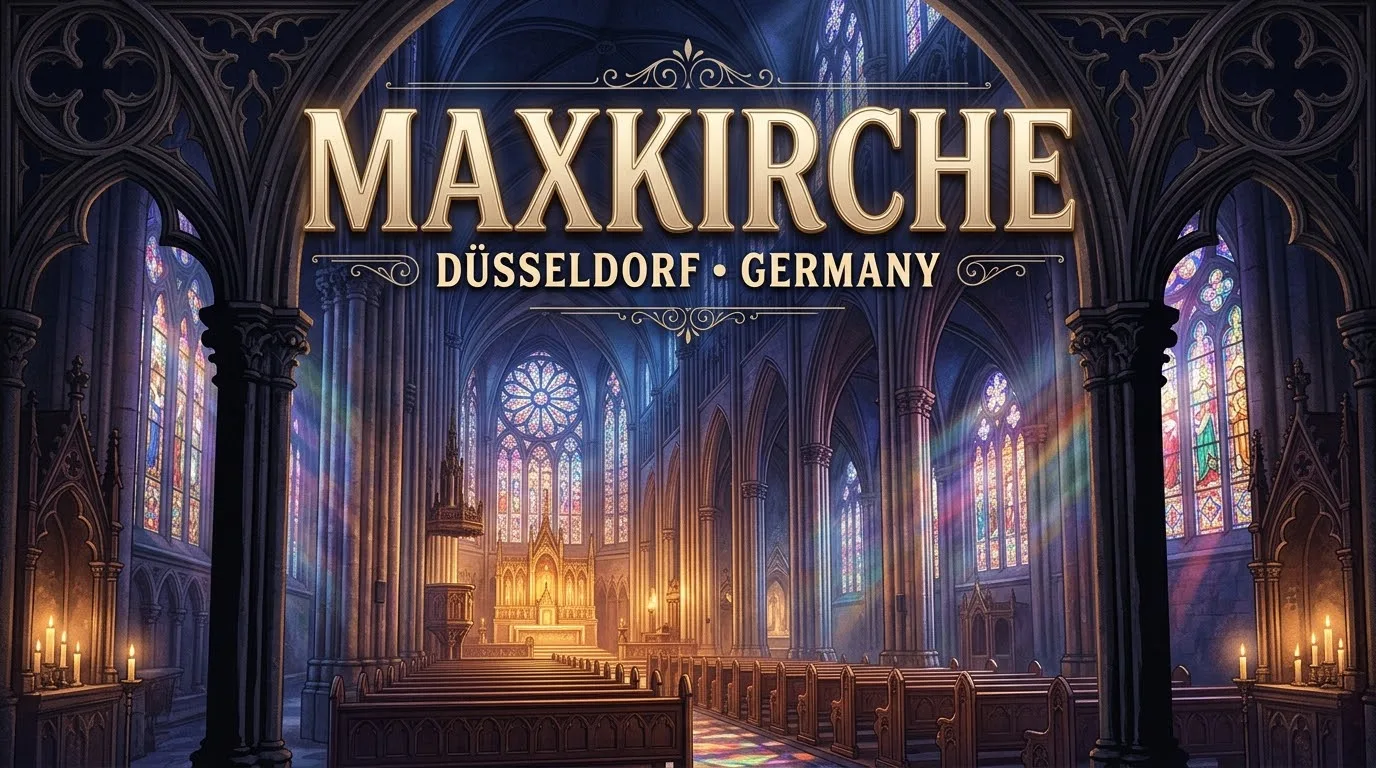
In the classicist Carlstadt district, just a short stroll from the Rhine riverside promenade, Maxkirche rises as one of the finest examples of late Baroque architecture in Düsseldorf. The church, originally built as a Franciscan monastery church and dedicated to Saint Anthony of Padua, owes its commonly used name today to a later rededication in honor of Saint Maximilian of Celeia. Far beyond the borders of Düsseldorf, Maxkirche is especially well known for its exceptional acoustics, which have made it one of the most popular concert venues for sacred music in the entire region. With its elegant, two-toned facade of brick and natural stone and the striking onion dome crowning its crossing tower, Maxkirche ranks among the most architecturally accomplished sacred buildings in the state capital.
History of Maxkirche
The history of Maxkirche begins in 1650, when the Franciscan order petitioned the Düsseldorf court for permission to found a monastery in the city. After initial refusal, Duke Wolfgang Wilhelm finally granted his consent in 1651, following which six Franciscan friars arrived in Düsseldorf. The accompanying monastery was completed by 1662, and a simple first church followed in 1668. However, as the building soon suffered considerable damage from ground subsidence, a decision was made to construct a new building: the current three-aisled hall church was built between 1735 and 1737 and was solemnly consecrated to Saint Anthony of Padua on October 4, 1737. During the secularization of the early 19th century, the church was briefly threatened with demolition, which was ultimately prevented by determined protest from the citizens of Düsseldorf. As a result, the church was rededicated to Saint Maximilian of Celeia, in honor of Elector and Duke Maximilian Joseph, a renaming that gave the church the name "Maxkirche" still used today. In 2011, the parish finally merged with St. Lambertus parish, while remaining an independent church space with a distinctive musical profile.
Highlights of Maxkirche
The late Baroque brick facade of Maxkirche is divided into three sections separated by natural stone pilasters, with a triple-stepped portal, a niche containing a statue of a saint, and a tall, representative window forming the center. Above the mansard roof rises a hexagonal cupola with a steep lantern and a characteristic onion dome, giving the church an unmistakable silhouette. Inside, Maxkirche surprises visitors with a strikingly bright interior rendered in white and gray, where paired Ionic columns support barrel vaults and groin-vaulted sections. Outstanding furnishings include choir stalls preserved from the 17th-century predecessor building, as well as a remarkable bronze eagle lectern, originally created in Maastricht in 1449 for Altenberg Cathedral before later finding its way to Maxkirche. The fourteen Stations of the Cross by artist Heinrich Nüttgens from 1903, together with the modern windows designed by artist Jochem Poensgen in 2000, impressively show how the church continued to develop artistically over the centuries. Maxkirche, however, enjoys worldwide recognition above all for its organ: the instrument built in 1753 by Christian Ludwig König, featuring 39 registers, was faithfully reconstructed in 2011 by the Johannes Klais workshop after decades of alterations and has since once again become one of the finest-sounding organs in the Rhineland. Five bronze bells cast in 1954 by Petit & Gebr. Edelbrock round out the church's musical profile, which regularly hosts the concert series "Musik an St. Maximilian," making Maxkirche a fixture of Düsseldorf's concert life. This particular combination of listed historic fabric and a thriving concert program makes Maxkirche one of the few sacred buildings in Düsseldorf where historic heritage and contemporary musical life meet so directly; many visitors come specifically for a concert and only afterward discover the architectural and art-historical details of the church interior. Visitors who come to Maxkirche outside of a concert should still take the time to appreciate the unusually bright sense of space and the fine stucco details of the ceiling at leisure, since in daylight the white and gray of the interior unfold a particularly clear, almost classicist elegance that clearly sets the church apart from the heavier splendor of many other Baroque churches.
Opening Hours, Tickets & How to Get to Maxkirche
Maxkirche is generally open for quiet visits outside of service times, and admission to the church is free of charge. Particularly popular are the regular concerts of the "Musik an St. Maximilian" series, for which separate ticket prices sometimes apply; current dates and programs can be found on the website musik-maxkirche.de. General parish inquiries are handled by the office of St. Lambertus, to which Maxkirche has belonged since the 2011 merger. Getting to Maxkirche in the Carlstadt district from downtown Düsseldorf is straightforward: from the Altstadt and Burgplatz, the church can be reached in about a ten-minute walk along the Rhine riverside promenade, or alternatively several tram lines serve the area near Carlstadt. Drivers will find several public parking options in Carlstadt, although much of the historic district is designated as a traffic-calmed zone with narrow lanes. The location directly on the Rhine also makes a visit to Maxkirche an ideal destination as part of an extended walk along the riverside promenade.
Attractions Near Maxkirche
The Carlstadt district, home to Maxkirche, ranks among the most charming neighborhoods in Düsseldorf with its classicist townhouses and narrow lanes lined with art galleries and antiquarian bookshops, inviting visitors to an extended stroll. Just a few steps away lies the Rhine riverside promenade, offering excellent views of the river and the Medienhafen media harbor on the opposite bank. Heading north, visitors can quickly reach the historic Altstadt with St. Lambertus Basilika and St. Andreas Dominikanerkirche, both of which pair well with a detour to Maxkirche. The Hetjens Museum, dedicated to international ceramic art, and the Düsseldorf Film Museum are also located nearby and make for a worthwhile cultural complement to a visit to the church. Visitors looking for a further culinary experience will find in Carlstadt's small cafés and restaurants a quieter, yet no less enjoyable, alternative to the lively breweries of the adjoining Altstadt. Rheinpark Golzheim and the Rheinkniebrücke bridge can also be reached from Maxkirche on a longer walk along the river, offering sweeping views of the opposite bank and the city skyline.
Where to stay in Dusseldorf, Germany
Compare current hotel prices and find the right place to stay.