Kunstsammlung Nordrhein-Westfalen K21
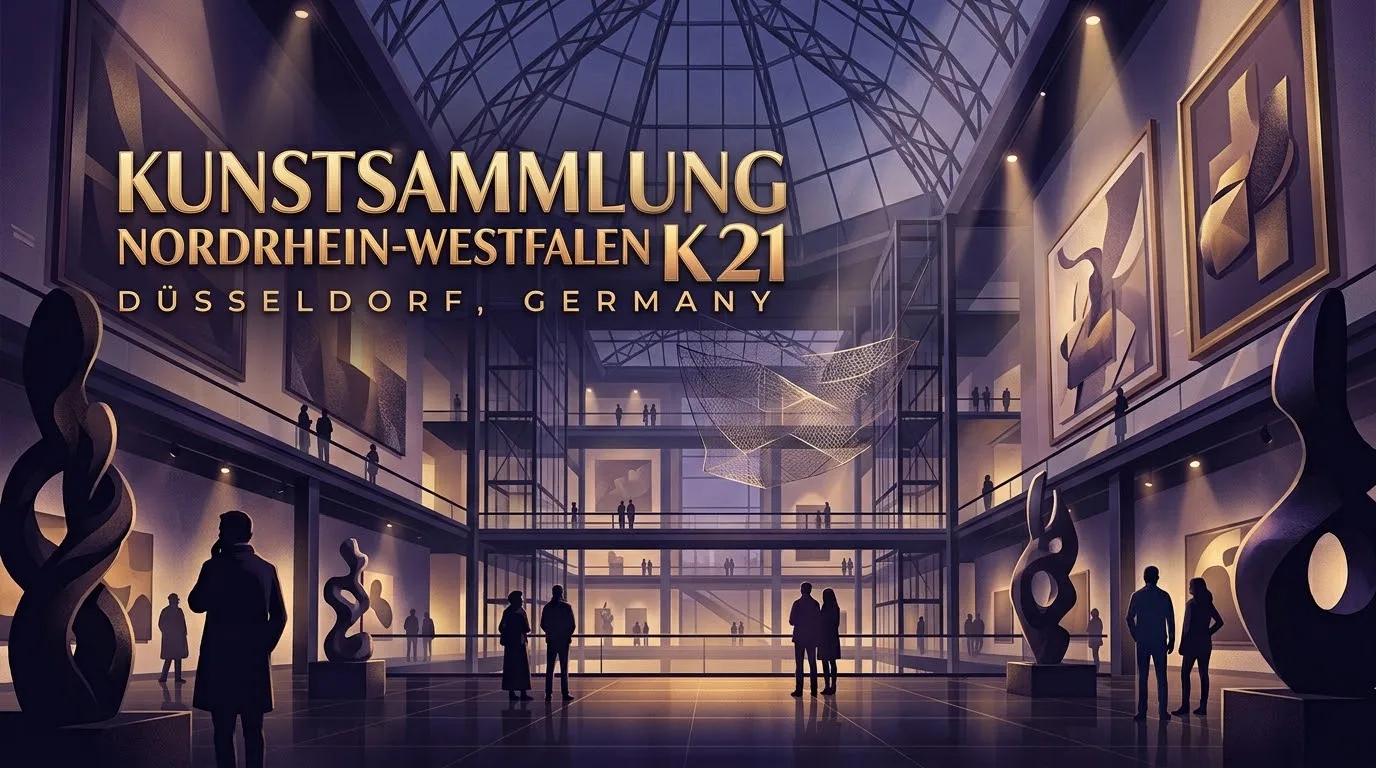
Kunstsammlung Nordrhein-Westfalen K21 is the venue for international contemporary art within the Kunstsammlung Nordrhein-Westfalen and occupies the historic Ständehaus building in Düsseldorf's Unterbilk district, just a short walk from the Königsallee. Unlike its sister site K20 on Grabbeplatz, which is devoted to classical modernism, Kunstsammlung Nordrhein-Westfalen K21 presents art of the past few decades through to the immediate present, and the building itself has become one of the most spectacular exhibition spaces in Europe: a glass dome arches over the former inner courtyard, beneath which permanent installations and changing large-scale projects unfold. Anyone wishing to experience contemporary art in an exceptional architectural setting will find Kunstsammlung Nordrhein-Westfalen K21 one of the most striking museums in the Rhineland. Beyond its grand exhibition halls, the museum houses a library of art historical literature and a café in the former foyer, making it easy to combine a visit with a longer stay.
History of Kunstsammlung Nordrhein-Westfalen K21
The building that now houses Kunstsammlung Nordrhein-Westfalen K21 had a long political history before it became a museum. Between 1876 and 1880, the architect Julius Raschdorff, who later also designed Berlin Cathedral, built the so-called Ständehaus as the seat of the Rhine Province parliament in a German neo-Renaissance style. After the Second World War, the rebuilt structure served from 1949 to 1988 as the state parliament of North Rhine-Westphalia, until the deputies moved to a newly built parliament building on the riverbank and the historic Ständehaus stood empty. In the 1990s, the Munich architectural firm Kiessler + Partner, which later also led the expansion of K20, developed a concept for converting the building into an art museum. The centrepiece of the conversion was a new steel and glass dome over the former light-filled atrium, creating a bright, almost greenhouse-like upper level. The building opened its doors in 2002 under the name K21 Ständehaus and has since been dedicated entirely to international art from the 1980s onward. Since 2016 the institution has operated together with K20 under the shared Kunstsammlung Nordrhein-Westfalen brand, while retaining its own unmistakable character through the historic plenary chamber and the glass dome. Architecturally, the historicist facade facing the street was largely preserved, while the building's interior was completely reconfigured to meet the needs of a modern exhibition venue, with climate-controlled galleries and flexible wall systems. Parts of the original staircase and foyer were deliberately left visible, allowing visitors to trace the site's double history as a seat of parliament and as an art museum.
Highlights of Kunstsammlung Nordrhein-Westfalen K21
The undisputed highlight of Kunstsammlung Nordrhein-Westfalen K21 is the permanent installation "in orbit" by the Argentine artist Tomás Saraceno, suspended high in the glass dome since 2013. Visitors can balance across delicate, walkable net structures roughly 25 metres above the ground, experiencing a sense of weightlessness while the entire former parliament staircase remains visible below; access is limited for safety reasons and is not recommended for anyone afraid of heights, but it remains one of the most photographed art experiences in the city. The floors below house key works of international contemporary art from the permanent collection, including large-scale sculptures and installations by Thomas Schütte, whose figures and architectural models have shaped German sculpture since the 1990s, alongside works by Rosemarie Trockel, Bruce Nauman, Giuseppe Penone and Marcel Broodthaers. Large-format photographs by Andreas Gursky, one of the most celebrated graduates of the Düsseldorf Art Academy, document globalised spaces ranging from stock exchange floors to warehouses. The former plenary chamber of the state parliament, an impressive semicircular room retaining traces of its historic seating, is regularly used for site-specific installations, linking the building's political past with contemporary art. During the 2026/2027 season, Kunstsammlung Nordrhein-Westfalen K21 also presents the exhibition of the winner of the K21 Global Art Award 2026, on view from October 2026 to August 2027, giving a major platform to emerging international positions. A museum education programme of workshop talks, children's activities and themed tours helps unpack the often complex media and installation-based works in the collection; many pieces are created specifically for the building's unusual architecture and respond to the particular light conditions beneath the glass dome.
Opening Hours, Tickets & How to Get to Kunstsammlung Nordrhein-Westfalen K21
Kunstsammlung Nordrhein-Westfalen K21, at Ständehausstraße 1, 40217 Düsseldorf, is open Tuesday to Sunday and on public holidays from 11am to 6pm, and is closed on Mondays. On the first Wednesday of each month, opening hours are extended until 10pm. A single ticket typically costs between 9 and 17 euros depending on the exhibition on view, while a combined ticket covering both K21 and K20, valid for one year, costs 21 euros. Students aged 18 and over pay a reduced rate of 5 euros, children and teenagers up to 17 visit free of charge, and an annual pass covering both houses is available for 49 euros. Advance booking runs through the Kunstsammlung's online shop; reserving ahead is especially advisable for access to the Saraceno installation "in orbit", since visitor numbers are limited for safety reasons. By public transport, the museum is easily reached via the Graf-Adolf-Platz stop, served by tram lines 706, 708 and 709 as well as light rail lines U71, U72, U73 and U83; from there it is only a short walk to the Ständehaus. The station is also within easy walking or riding distance of the main railway station. Parking is available, among other places, in the car park at the nearby Carlsplatz. The museum is largely accessible, with lifts connecting all exhibition levels, and audio guides in several languages are available at the ticket desk, offering additional background on the most important works.
Attractions Near Kunstsammlung Nordrhein-Westfalen K21
Kunstsammlung Nordrhein-Westfalen K21 sits conveniently between Düsseldorf's city centre and the MedienHafen, making it easy to combine a visit with other stops. Within a few minutes' walk is the famous Königsallee, lined with luxury boutiques and a tree-shaded canal, an ideal place for a stroll after the museum. Toward the Rhine lies the MedienHafen, with the dramatically tilted buildings by Frank Gehry at the Neuer Zollhof and the Rheinturm with its observation deck. Düsseldorf's old town, with its traditional Altbier breweries and the sister museum K20 on Grabbeplatz, is also comfortably reachable on foot or with just a few stops on the light rail. Culture lovers can also plan a detour to the Museum Kunstpalast at the Ehrenhof, whose broad collection ranging from old masters to glass art offers a pleasant contrast to the contemporary art at K21. For a break, the many cafés and restaurants around Carlsplatz and Friedrichstraße are a good choice. A little further on lies the expansive Hofgarten, Düsseldorf's oldest public park, a pleasant place to round off a museum visit, as is the nearby Düsseldorf Playhouse (Schauspielhaus) with its varied theatre programme.
Where to stay in Dusseldorf, Germany
Compare current hotel prices and find the right place to stay.