Kö-Bogen II
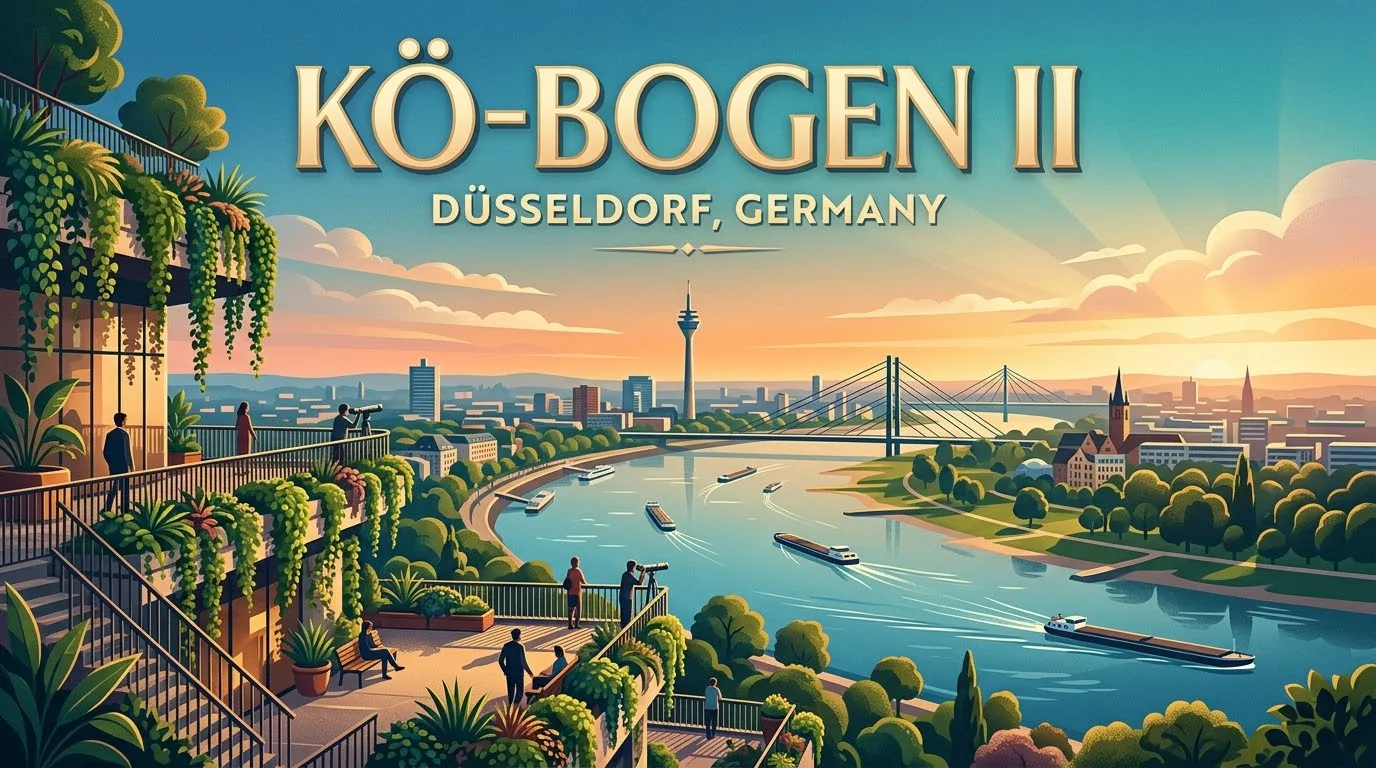
Right at the transition between the world-famous shopping street Königsallee and the sprawling Hofgarten park rises Kö-Bogen II, a building complex that has fundamentally reshaped central Düsseldorf in recent years. What sets it apart from other modern commercial buildings is its unusual, fully green facade made of trimmed hornbeam hedges, which wraps the entire northern and western exterior of the structure in gentle, sweeping curves. Seen from below, the building looks like a green hill rising in the middle of the city, blending organically into the adjoining Hofgarten. Climbing the stairs and ramps along the side of the building leads visitors onto the gently sloping, walkable roof, from which a surprising view opens up across the square, the Königsallee and the surrounding architecture. This vantage point is less spectacular in sheer height than other lookout spots in the city, but all the more distinctive in its design: here, landscape architecture, sustainability and urban space merge into an observation platform unlike any other found in a major German city. Especially in the evening hours, when locals and visitors gather on the grass roof to picnic or simply linger, it becomes clear just how much this place has grown into a lively meeting point for the city.
History of Kö-Bogen II
The history of Kö-Bogen II is closely tied to the urban redevelopment of the entire Gustaf-Gründgens-Platz. After the first construction phase, Kö-Bogen I, designed by architect Daniel Libeskind, was completed in 2013, work on the second phase began in June 2017. Responsibility for the design of Kö-Bogen II fell to Düsseldorf-based architect Christoph Ingenhoven, whose firm, Ingenhoven Associates, is internationally known for sustainable and heavily greened architecture. The project aimed to redesign the square between Königsallee and Schadowstraße, which until then had been cut through by a busy traffic artery, by consistently relocating traffic underground and creating an attractive, walkable public space at street level. With the completion of the building, this urban vision became reality: in place of a noisy intersection, a green, inviting square emerged that visually and functionally connects the Königsallee and the Hofgarten. Particularly notable is the inspiration behind the walkable grass roof, which draws on, among other references, the roof of New York's Lincoln Center, where a comparable green ramp serves as a public meeting place. The hornbeam hedge facade that Ingenhoven developed for the project is considered one of the largest continuous green facades in Europe and, upon completion, marked a milestone in the field of so-called vertical greening in urban space. Since its opening, Kö-Bogen II has become a widely cited example of how retail and office architecture can be combined with ecological ambitions and public urban space, and it is regularly featured in international publications on sustainable architecture.
Highlights of Kö-Bogen II
The most striking feature of Kö-Bogen II is undoubtedly its living facade: thousands of precisely trimmed hornbeam plants cover the sloped, north- and west-facing exteriors of the building and change their appearance with the seasons - from fresh green in spring, through dense foliage in summer, to the reddish-brown autumn tones that hornbeam famously retains well into winter. This living, ever-changing shell makes Kö-Bogen II one of the most photographed buildings in the city and a popular subject for architecture enthusiasts from around the world. The actual viewpoint is located on the gently rising roof, freely accessible from outside via ramps and stairs, offering an unusual shift in perspective on the city: from here, visitors look across the busy square directly at the historic buildings of the Königsallee, at the opposite facade of Kö-Bogen I with its well-known Apple Store, and over into the green treetops of the Hofgarten. Precisely because the view here unfolds not from great height but at eye level with the city, it creates an intimate, urban panorama quite different from classic high-up lookout points such as towers. Among the most popular moments is the view at sunset, when light filters through the leaves of the hornbeam hedges and bathes the facades of the Königsallee in warm light. In summer, the roof is frequently used by locals for sitting, picnicking, or simply watching the activity on the square below, while during special occasions, such as fashion events or Christmas festivities, temporary installations and light art can be found around the square and on the green roof. The combination of glass, travertine stone and greenery on the lower parts of the building also rewards a closer look during a walk, as it makes the fluid transition between architecture and landscape particularly visible.
Opening Hours, Tickets & How to Get to Kö-Bogen II
The walkable roof of Kö-Bogen II is a public outdoor space, freely and permanently accessible at no charge, as it functions as an open square rather than a commercial attraction. In practice, a visit is best enjoyed during daylight hours and in good weather, since the roof is a grass surface and can become slippery when wet; in the evening the square is illuminated and remains perfectly walkable. The shops and restaurants housed within the building itself follow typical city-centre opening hours, generally Monday to Saturday from around 10am to 8pm, with seasonal variations on designated shopping Sundays. Kö-Bogen II is centrally located at Königsallee 2 in the heart of Düsseldorf's city centre, directly facing the Hofgarten and right on the Königsallee. Getting there by public transport is remarkably easy: the "Heinrich-Heine-Allee" subway station, along with several tram and bus lines, stops just a few minutes' walk away, and the main train station is reachable on foot in about 15 to 20 minutes or by rail in just a few minutes. Visitors arriving by car are advised to use one of the numerous car parks around the Königsallee and Schadowstraße, since the square itself is car-free. Access to the roof is designed via gently sloped ramps, making the site well suited for wheelchair users, families with strollers, and visitors with limited mobility.
Attractions Near Kö-Bogen II
Directly opposite lies the Hofgarten, the oldest public park in Germany, with its mature trees, ponds and footpaths, making it ideal for an extended stroll following a visit. Just a few steps away begins the famous Königsallee, known locally as the "Kö", with its luxury boutiques, the tree-lined Kö-Graben canal and numerous cafés inviting visitors to linger. On the other side of the square stands Kö-Bogen I, the well-known building designed by Daniel Libeskind, which houses, among other tenants, a large Apple flagship store. Walking further toward the Altstadt, visitors reach Burgplatz and the Schlossturm on the riverfront within about 10 to 15 minutes, where an entirely different, historic view of the city opens up. The Schauspielhaus Düsseldorf theatre and the Dreischeibenhaus skyscraper, one of Germany's best-known examples of post-war modernist high-rise architecture, are also located nearby and fit well into a broader walking tour of the city centre.
Where to stay in Dusseldorf, Germany
Compare current hotel prices and find the right place to stay.