Johanneskirche
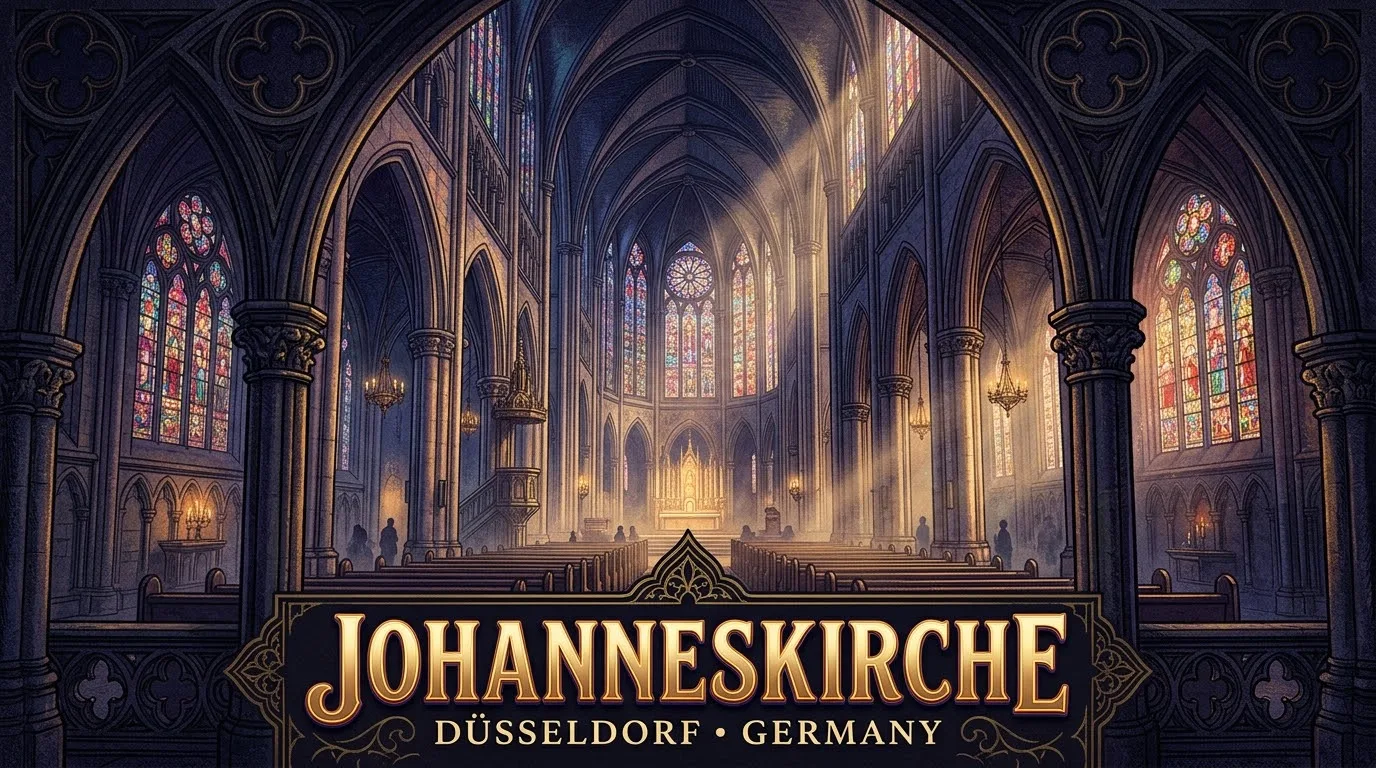
On Martin-Luther-Platz, just a short walk from the Hofgarten park and Düsseldorf's famous Königsallee boulevard, Johanneskirche rises high above the rooftops of the city center with its 87.5-meter tower. As the largest Protestant church in Düsseldorf, it is not only a striking landmark in the cityscape but also a lively center of church and cultural life that extends far beyond traditional worship services. Built in the Romanesque Revival style of the late 19th century, the church survived severe wartime damage and a postwar demolition debate to reinvent itself today as a modern "Citykirche." With an inviting café in its foyer, regular concerts, and art exhibitions, Johanneskirche combines historic architecture with contemporary urban life, drawing both worshippers and culturally curious visitors from across Düsseldorf.
History of Johanneskirche
The origins of Johanneskirche date back to 1824, when Düsseldorf's Lutheran and Reformed congregations merged into a single Protestant community and subsequently sought to build a representative shared church. Following the fundamental decision to build in 1859 and protracted negotiations over a suitable plot of land, which were not concluded until 1874, the design submitted by architects Walter Kyllmann and Adolf Heyden was accepted in 1869. The foundation stone for the church was laid in 1875, and on December 6, 1881, Johanneskirche was solemnly consecrated. On June 12, 1943, the church suffered massive destruction during a heavy bombing raid on Düsseldorf. In the years following the war, demolition of the building was even discussed to make way for growing traffic at what was then known as Königsplatz, but ultimately the decision was made to preserve the church, and restoration was completed in March 1953. Significant renovations of the interior took place again in 1997 and 2008, adapting Johanneskirche to the changing demands of modern congregational and cultural life. This eventful history of destruction, threatened loss, and persistent rebuilding makes Johanneskirche an impressive symbol of the resilience of church life in twentieth-century Düsseldorf.
Highlights of Johanneskirche
Architecturally, Johanneskirche impresses with its clean Romanesque Revival forms, featuring a 61-meter nave and a widely visible 87.5-meter tower, one of the tallest church spires in Düsseldorf. The original tufa stone facade had to be replaced with more weather-resistant basalt as early as 1905 due to severe erosion damage, giving the building its current powerful, dark appearance. Two ornate sandstone angels by sculptor Carl Hubert Müller, dating from 1878 and originally guarding the side portals, were relocated to the main western entrance in 1994, where they have greeted visitors to the church ever since. Musically, Johanneskirche is home to a significant mechanical slider-chest organ built by the Rudolf von Beckerath workshop in 1953/54, which was expanded with electrical components in 2001 and is regularly featured in concerts. Five bells hang in the tower, the largest and most resonant being the Johannesglocke cast in 1952, which can be heard far beyond the city center on special occasions. As a modern Citykirche, Johanneskirche has also developed into a central venue for the Protestant Church District of Düsseldorf: alongside traditional worship services, the church regularly hosts concerts spanning a wide range of musical genres, exhibitions by contemporary artists, and cultural discussion events. The welcoming café in the church's foyer invites visitors to linger in a relaxed atmosphere after their visit, making Johanneskirche one of the few sacred buildings in the city that is also naturally woven into everyday life. Particularly noteworthy is the fact that, despite its turbulent history, Johanneskirche continues to combine its original liturgical purpose with an open, contemporary cultural program, making it a model for numerous other Citykirche projects throughout the Rhineland. The light-filled interior, with its soaring vaults and clean, unadorned lines, offers a striking contrast to the often densely built streets of the surrounding city center and invites visitors of any faith, or none, to a moment of calm amid the urban bustle.
Opening Hours, Tickets & How to Get to Johanneskirche
Johanneskirche is generally accessible to visitors during the opening hours of its attached café, which operates Tuesday through Saturday from noon to 6 p.m. and provides an easy way to view the church interior. The parish office can be reached Tuesday through Thursday from 10 a.m. to 1 p.m., where visitors can also obtain information about current concert dates, exhibitions, and service times. Admission to the church itself is generally free of charge, though separate ticket prices may apply for individual concert events, details of which are announced on the church's website. Reaching Johanneskirche on Martin-Luther-Platz is remarkably easy thanks to its central location in Düsseldorf's city center: several tram and bus lines stop in the immediate vicinity, and the church is also only a short walk from the main train station and the renowned Königsallee shopping boulevard. Visitors arriving by car will find ample parking in the surrounding city center garages, although much of the immediate area is designated as a traffic-calmed zone. Thanks to its proximity to the Hofgarten, a visit to Johanneskirche can easily be combined with a stroll through Germany's oldest public park.
Attractions Near Johanneskirche
The location of Johanneskirche directly on Martin-Luther-Platz offers visitors an ideal starting point for further exploration of downtown Düsseldorf. Just a few steps away begins the Hofgarten, Germany's oldest public park, whose expansive lawns, ponds, and paths invite extended walks while also housing several important museums, including the Museum Kunstpalast with its remarkable collection of European art. Also nearby is the world-famous Königsallee, whose lime-tree-lined canal and elegant shops make it one of Europe's most renowned shopping streets. Visitors wishing to experience the historic Altstadt with its traditional breweries can reach it from Johanneskirche in roughly ten minutes on foot, where St. Lambertus Basilika and the Rhine riverside promenade await. The Dreischeibenhaus, an important landmark of postwar modernist architecture, as well as the Düsseldorf Playhouse, are also located directly around Martin-Luther-Platz, making the neighborhood an exciting mix of historic and modern architecture. Families with children can also enjoy a short detour to the nearby Aquazoo Löbbecke Museum, while shopping enthusiasts will find hours of entertainment along the Kö and in the adjoining shopping arcades of the city center. Altogether, a visit to Johanneskirche combines wonderfully with a full day of cultural and urban discovery in downtown Düsseldorf.
Where to stay in Dusseldorf, Germany
Compare current hotel prices and find the right place to stay.