Burgplatz
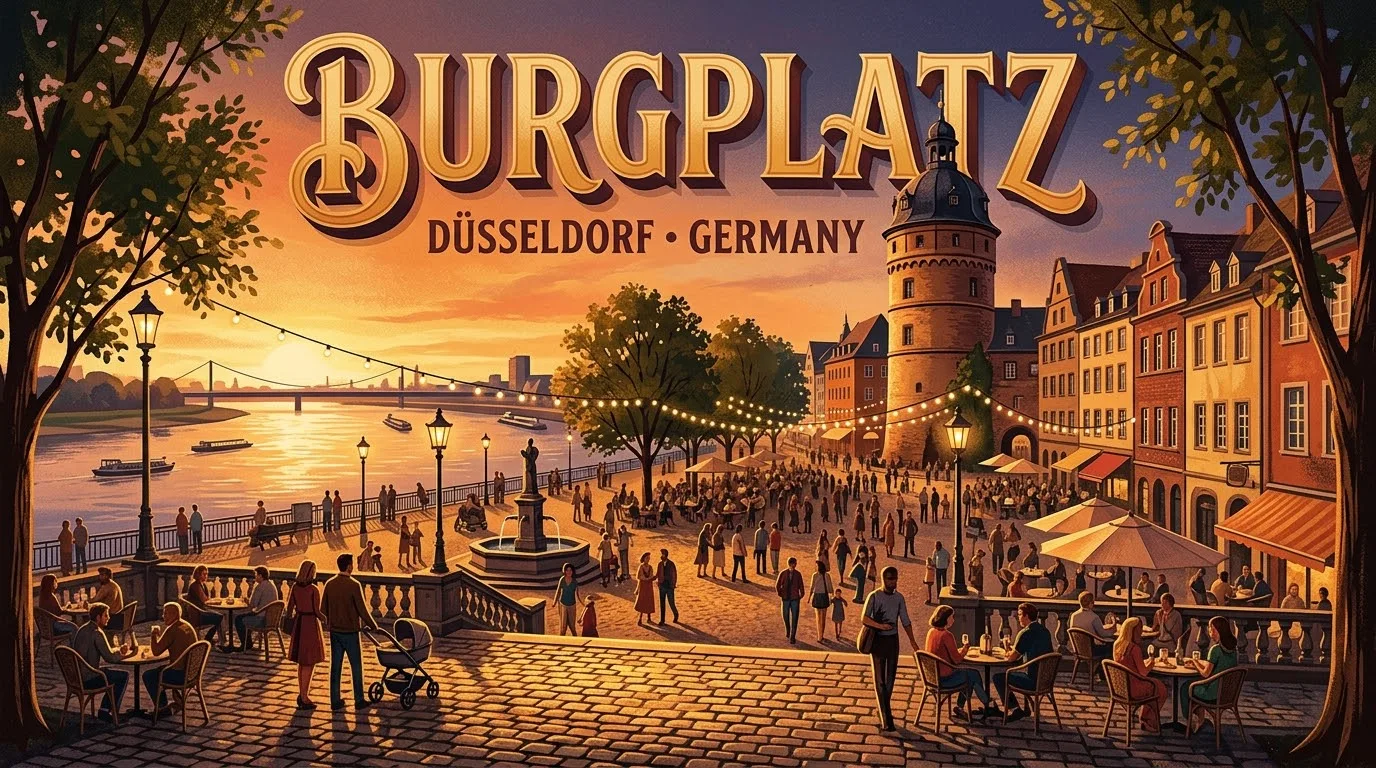
Burgplatz is one of the most atmospheric squares in Düsseldorf's Altstadt, opening directly onto the Rhine. Located right on the water, it marks the spot where the Düsseldorf city castle once stood - today only the Schlossturm, or castle tower, still recalls the centuries-old residence of the Dukes of Jülich-Berg and the Palatine prince-electors. With sweeping views across the river toward the Rheinkniebrücke bridge and the opposite bank, Burgplatz is one of the city's most popular meeting points, especially in the evening, when locals and visitors gather on the steps leading down to the Rhine to watch the sunset. Framed by historic gabled houses, cafés and the entrance to the Altstadt, the square brings together history, everyday city life and the distinctive atmosphere of the Rhine metropolis in one compact space.
History of Burgplatz
Burgplatz emerged in the late 14th century, when Düsseldorf expanded south from its original core around the parish church of St. Lambertus and the Dukes of Jülich-Berg built their residence here. For centuries the Düsseldorf castle served as the seat of the territorial rulers; it reached its social high point in 1585 with the lavish wedding of Duke Johann Wilhelm and Jakobe of Baden-Baden, which drew guests from across Europe. Between 1709 and 1712, Prince-Elector Johann Wilhelm, known as "Jan Wellem," added a three-winged gallery to the castle to house his important art collection, which later formed the foundation of Düsseldorf's painting collections. In 1795, French revolutionary troops seriously damaged the castle through bombardment and fire, but its final downfall came in 1872, when a devastating fire destroyed the entire building complex and left only the Schlossturm standing as a ruin. Between 1892 and 1902 the remaining castle debris was cleared away, and in 1902 the small Düsselschlösschen pavilion was built on the site. For decades, the square was dominated by car traffic, until the opening of the Rheinufertunnel in 1993 moved through-traffic underground. The complete redesign of Burgplatz was finished in 1995, giving it its current open, terraced form with direct access to the riverbank and finally transforming it from a traffic area into a genuine city square.
Highlights of Burgplatz
The undisputed centerpiece of Burgplatz is the Schlossturm, the only surviving part of the former Düsseldorf city castle. Its historic walls now house a shipping museum that vividly traces roughly two thousand years of Rhine navigation, while the top floor holds a restaurant offering one of the city's finest panoramic views over the river. Several artworks around the tower tell the story of the city's history and identity: the Radschlägerbrunnen fountain from 1954, created by sculptor Alfred Zschorsch, recalls the legend of the Düsseldorf Radschläger, the cartwheeling children who remain a beloved symbol of the city to this day. The Stadterhebungsmonument by artist Bert Gerresheim references the Battle of Worringen and the granting of town rights in 1288, directly linking Burgplatz to the founding history of Düsseldorf. The installation "Namen und Steine" by Tom Fecht, created in 2000, uses inset stones to commemorate the victims of HIV and AIDS, adding a thoughtful, contemporary accent amid the historic surroundings. The sculpture "Altstadtfrau" by Hannelore Köhler, depicting a typical figure of everyday Düsseldorf life, also invites visitors to linger and take photographs. The wide steps leading down from the square to the riverbank are among the city's most popular spots to sit, offering unobstructed views of passing ships, the Rheinkniebrücke bridge and the Medienhafen skyline. Burgplatz is especially lively at sunset and during the traditional Rheinkirmes fair in summer, making it one of the most vibrant spots in Düsseldorf. In the run-up to Christmas, Burgplatz also becomes one of the venues of the Düsseldorf Christmas Market, which spreads across several themed areas throughout the Altstadt down to the riverbank and turns the square into a sea of lights with wooden huts and mulled-wine stands.
Opening Hours, Tickets & How to Get to Burgplatz
Burgplatz itself is a public open space and is accessible free of charge around the clock throughout the year. Only the shipping museum housed inside the Schlossturm keeps its own opening hours and charges a separate admission fee; it's worth checking current times online before visiting, since museums in Düsseldorf are frequently closed on Mondays. Thanks to its central location in the Altstadt, getting to Burgplatz is straightforward: from the Heinrich-Heine-Allee stop, served by several Rheinbahn U-Bahn lines, the square is a five-minute walk through the Altstadt. The stops around Düsseldorf's main railway station, about two kilometers away, are also well connected to Burgplatz by bus and tram. Visitors arriving by car should note that the square itself has been car-free since its 1995 redesign; the nearby Rheinufertunnel carries through-traffic underground, while parking is available in car parks at the edge of the Altstadt, for example near Schlossufer or close to Carlsplatz. Those traveling by bicycle can easily reach Burgplatz via the Rhine promenade, which runs along the river from Kaiserswerth in the north to Medienhafen in the south. River cruise and excursion boats also dock close to the square, so Burgplatz is easily reached by water as well.
Attractions Near Burgplatz
From Burgplatz, the main sights of Düsseldorf's Altstadt are within a few minutes' walk. Just a short stroll away stands St. Lambertus Basilica with its distinctive twisted spire, one of the oldest churches in the city. Also close by is Marktplatz with the historic town hall and the equestrian statue of Prince-Elector Jan Wellem, whose former art collection was once housed in the castle on Burgplatz. Following the tangle of Altstadt lanes further south leads to Carlsplatz, Düsseldorf's best-known food market with stalls for fruit, fish and regional specialties. Along the Rhine promenade, visitors can walk or cycle to the modern Medienhafen district with its striking architecture, as well as the North Rhine-Westphalia state parliament building. Heading north, it's worth detouring via Heinrich-Heine-Allee to Königsallee and Schadowplatz, the heart of Düsseldorf's shopping district. The Kunstsammlung Nordrhein-Westfalen (K20) art museum and the Kunstakademie Düsseldorf art academy are likewise only a few minutes from Burgplatz and combine well with a walk through the Altstadt. For a longer excursion along the Rhine, the historic district of Kaiserswerth is also worth considering: with its castle ruins and narrow lanes, it lies a few kilometers north of Burgplatz and is conveniently reached by light rail.
Where to stay in Dusseldorf, Germany
Compare current hotel prices and find the right place to stay.