Bismarck-Denkmal
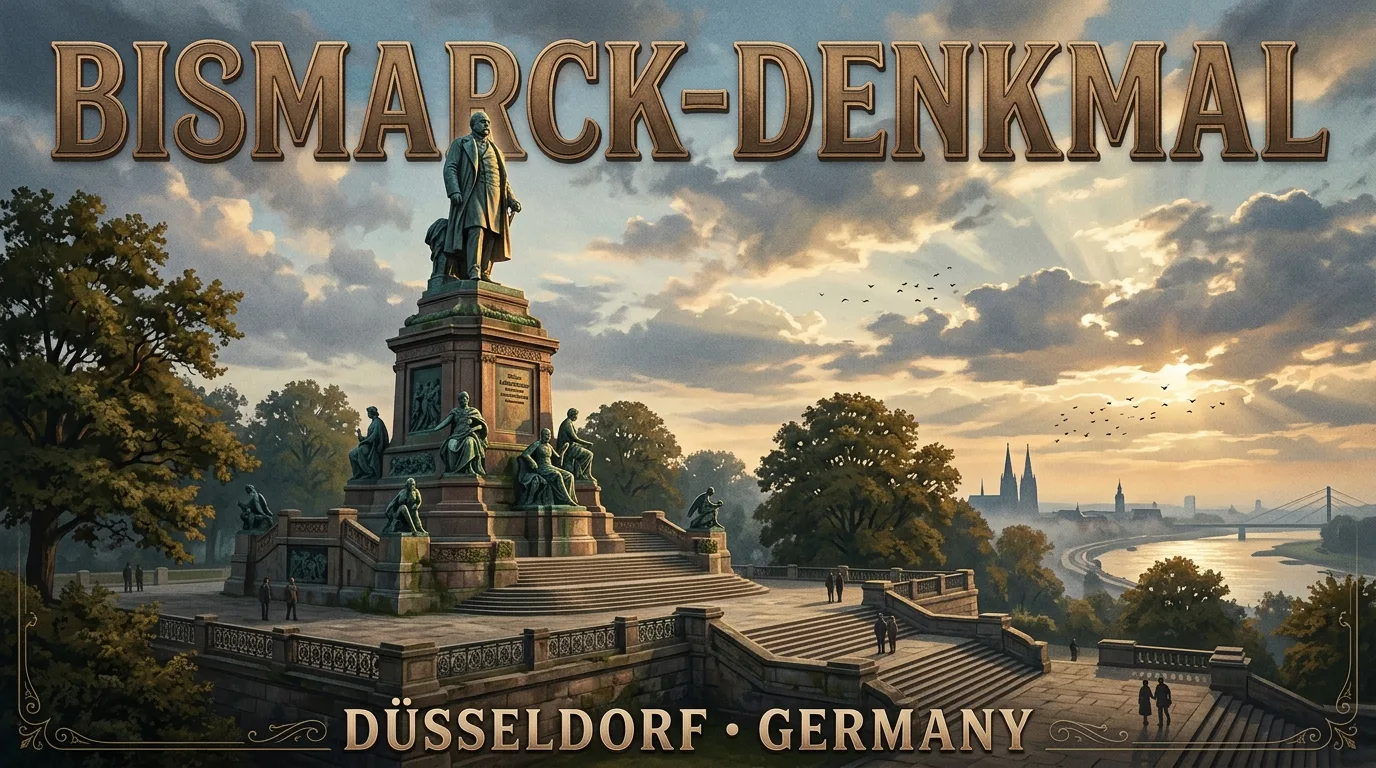
The Bismarck-Denkmal is one of the most striking historical monuments in Düsseldorf's city center, commemorating one of the defining figures of 19th-century German history, the first Chancellor of the German Empire, Otto von Bismarck. Anyone strolling across Martin-Luther-Platz in the heart of the city today encounters the imposing bronze figure standing directly beside the Kaiser-Wilhelm-Denkmal, surrounded by the bustle of city traffic yet carrying its own almost solemn presence. The monument is far more than a simple statue; it is a work in stone and bronze that bears witness to the political mood of the German Empire at the end of the 19th century, when a veritable wave of Bismarck monuments and Bismarck towers swept across numerous German cities, as conservative and national-liberal citizens' committees paid tribute to the "Iron Chancellor" following his forced resignation. Düsseldorf's Bismarck-Denkmal ranks among the finest examples of this wave of monuments and remains to this day a popular photo spot as well as a starting point for walks through the adjoining green spaces of the Hofgarten.
History of Bismarck-Denkmal
The history of the Bismarck-Denkmal is closely tied to the political developments of the German Empire during the 1890s. After Otto von Bismarck, who had played a decisive role in shaping the German Empire in 1871 and led it as Chancellor until 1890, was pressured into resignation by Kaiser Wilhelm II, a movement emerged among large parts of the liberal and national-conservative bourgeoisie that sought to honor the "Iron Chancellor" through monuments, partly as an expression of admiration and partly as quiet political criticism of his dismissal by the young Kaiser. In Düsseldorf too, a citizens' committee formed to drive the funding and construction of such a monument. The artistic execution was entrusted to sculptors August Bauer and Johannes Röttger, who together created an imposing bronze figure of Bismarck. The statue depicts the former Chancellor not in the civilian frock coat in which he is often portrayed, but in the uniform of a Prussian cuirassier officer of the Halberstadt regiment, complete with a Pickelhaube helmet and the Iron Cross, underscoring the close connection between Bismarck's political career and the Prussian military. Two allegorical figures were placed at the base of the statue: a warrior figure bearing oak leaves symbolizing German unity, and a female figure personifying the industriousness and industry of the new German Empire. Four coats of arms representing the major German states of Bavaria, Prussia, Saxony and Württemberg originally adorned the granite pedestal as well, though these were lost during the Second World War. The monument was ceremonially unveiled on May 10, 1899, at its original location on what was then Alleestraße, today's Heinrich-Heine-Allee, directly in front of the Kunsthalle Düsseldorf, where it served as an urban counterpart to the city's art museum of the time. Over the course of the 20th century, the monument was relocated to its present site on Martin-Luther-Platz, where it now forms an ensemble of Wilhelmine monumental art alongside the Kaiser-Wilhelm-Denkmal. Despite the historical sensitivity that Bismarck monuments carry within today's culture of remembrance, the Düsseldorf example survived intact and is now regarded as an important document of the historical self-image of the Wilhelmine Empire.
Highlights of Bismarck-Denkmal
The Bismarck-Denkmal impresses from a distance through its imposing height and the dynamic stance of the bronze figure, whose raised gaze and firm posture radiate the self-assurance of the Wilhelmine Empire. Particularly worth admiring are the fine craftsmanship details of the uniform, from the braiding on the cuirassier jacket to the characteristic Pickelhaube helmet, which demanded exceptional precision from sculptors August Bauer and Johannes Röttger. Visitors who take the time to examine the monument up close will discover the two allegorical companion figures at its base, whose symbolic meaning only becomes clear on closer inspection: the warrior figure with oak leaves alludes to the military path toward German unity in 1871, while the female figure, with her attributes of industry and diligence, symbolizes the economic optimism of the so-called Gründerzeit boom years. The massive granite pedestal on which the two figures sit is itself typical of the monumental construction style of public monuments of the era, deliberately built for permanence and grandeur. The immediate proximity to the Kaiser-Wilhelm-Denkmal on the same square allows for an interesting comparison between two central figures of German unification and their respective monumental portrayals. For history-minded visitors, the Bismarck-Denkmal offers a rare opportunity to engage with the complex and still controversially discussed culture of remembrance surrounding Bismarck, given that, unlike many comparable monuments in other cities, this one was never melted down or removed during the 20th century. The surrounding Martin-Luther-Platz, with its trees and seating areas, further invites visitors to take in the monument at a leisurely pace and absorb the atmosphere of this historical ensemble before continuing their walk through central Düsseldorf.
Opening Hours, Tickets & How to Get to Bismarck-Denkmal
Since the Bismarck-Denkmal is a freely accessible monument standing in public space, there are no fixed opening hours and no admission fee; Martin-Luther-Platz, and therefore the monument, can be visited around the clock on every day of the year. This makes a visit especially flexible and easy to combine with other stops in the city center, whether during the day in good light for photographs or in the evening, when the surrounding illumination lends the monument a particular atmosphere. Martin-Luther-Platz lies centrally within Düsseldorf's Stadtmitte district and is excellently connected by public transport: the nearest tram stop is Steinstraße/Königsallee, just a short walk from the monument, as is the Heinrich-Heine-Allee stop. Düsseldorf's main train station is also reachable by tram in roughly ten minutes or on foot in about 20 minutes. Drivers will find paid parking in several garages in the surrounding area, for instance around Königsallee or at Schadowplatz. Since the monument sits in close proximity to Königsallee and the Hofgarten, it is well worth combining a brief visit with a longer walk through these two popular destinations. Those wishing to photograph the monument should ideally come in the morning hours, when light from the east falls on the bronze figure and brings out the fine details of the uniform and pedestal particularly well.
Attractions Near Bismarck-Denkmal
Martin-Luther-Platz, where the Bismarck-Denkmal stands, sits amid one of the densest concentrations of sights in central Düsseldorf. Directly on the same square rises the Kaiser-Wilhelm-Denkmal, another monumental equestrian statue from the same era, as well as the striking Johanneskirche, a large neo-Gothic church that was rebuilt after its destruction in the Second World War and whose tall tower defines the surrounding cityscape. Just a short walk away begins the world-famous Königsallee, affectionately known as the "Kö," whose chestnut-lined boulevard and artificial canal make it one of the most exclusive shopping streets in Europe. Also within walking distance is the expansive Hofgarten, Germany's oldest public park, home to the Düsseldorf Schauspielhaus theater and the striking Dreischeibenhaus high-rise. Continuing from here toward the Rhine quickly brings visitors to the modern Kö-Bogen shopping and office district with its distinctive architecture, before the route continues on to the historic Altstadt with its narrow lanes and traditional brewery pubs. Culturally minded visitors will also find the Tonhalle Düsseldorf, a former planetarium that today serves as one of the city's most important concert halls, within comfortable reach of Martin-Luther-Platz.
Where to stay in Dusseldorf, Germany
Compare current hotel prices and find the right place to stay.