Altstadt
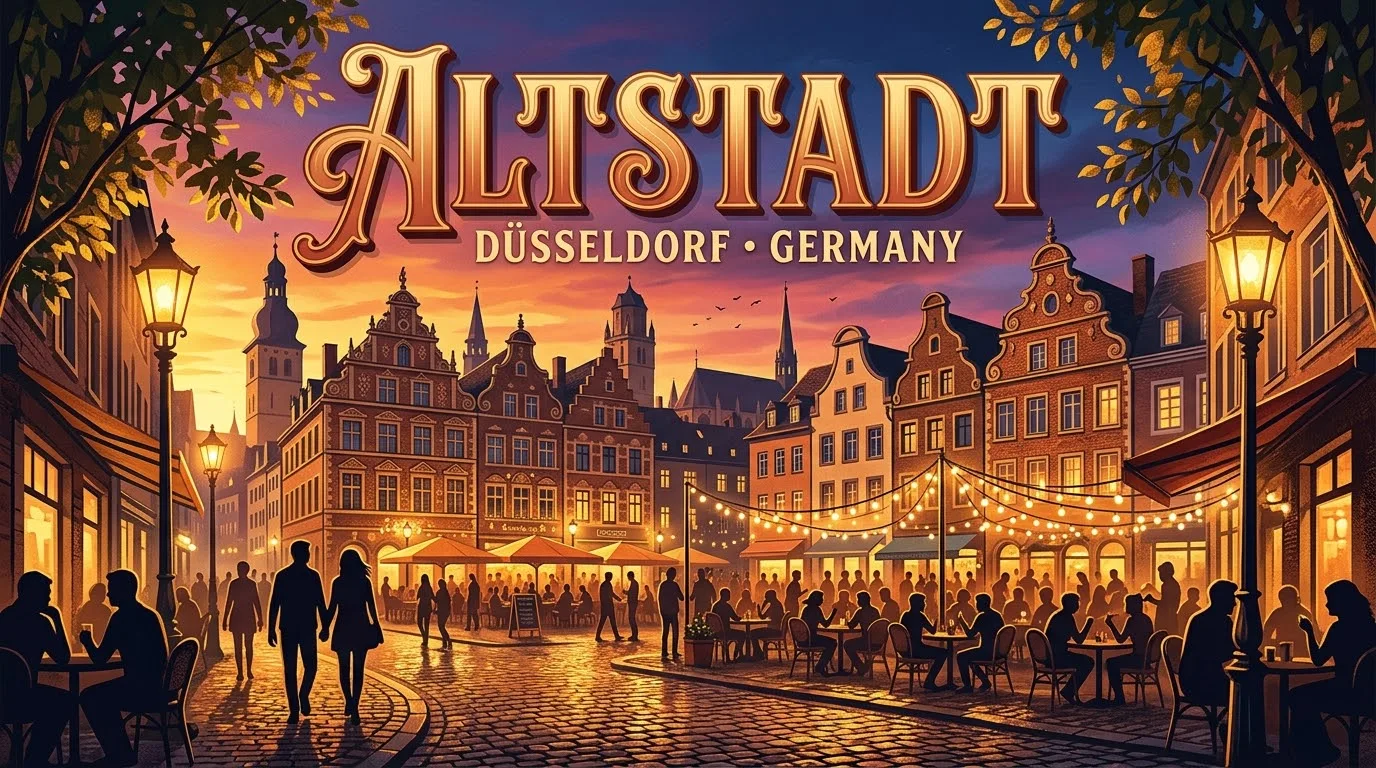
Altstadt is the historic heart of Düsseldorf and one of Germany's most famous entertainment districts. Covering barely 0.47 square kilometers and wedged between the Rhine, Heinrich-Heine-Allee and Ratinger Straße, this compact quarter packs narrow medieval lanes, historic façades, churches and more than 300 pubs, breweries and restaurants into half a square kilometer - which is exactly why Altstadt has been affectionately nicknamed the "longest bar in the world" for decades. Despite its small size, it remains one of the most visited corners of the city, blending seven centuries of urban history with traditional brewpubs that still brew the city's signature top-fermented Altbier in copper kettles on site. By day, boutiques, galleries and cafés invite visitors to stroll through Altstadt; by night, the lanes around Bolkerstraße, Flinger Straße and Kurze Straße turn into one of the liveliest nightlife districts in the country, drawing locals and visitors from around the world.
History of Altstadt
The roots of Altstadt reach back to the 13th century. On August 14, 1288, the small settlement on the Rhine that had grown up around the parish church of St. Lambertus was granted town rights by Count Adolf V of Berg following the Battle of Worringen. This date is still regarded as the official birth of Düsseldorf, and the area of today's Altstadt formed the fortified core of the young town. Over the following centuries the settlement grew along streets such as Krämerstraße, Flinger Straße and Bolkerstraße, which remain among the oldest thoroughfares in the city. St. Lambertus Basilica, first documented in 1159 and completed in its current form in 1394, still defines the skyline of Altstadt with its distinctively twisted spire. Between 1570 and 1573 the city, under master builder Heinrich Tussmann, erected the town hall on Marktplatz, which still serves as the seat of the city administration today. As Düsseldorf industrialized and expanded during the 19th and early 20th centuries, Altstadt lost its role as the sole city center but was preserved as the historic core - in 1924 it was even the site of the Wilhelm-Marx-Haus, Germany's first purpose-built office high-rise. The Second World War destroyed large parts of the historic fabric, but many buildings were faithfully reconstructed in the postwar years, so Altstadt still preserves its medieval street layout today. The poet Heinrich Heine was also born on Bolkerstraße in Altstadt in 1797, giving the quarter a lasting literary significance.
Highlights of Altstadt
Altstadt's best-known feature is undoubtedly its extraordinary concentration of traditional breweries and taverns. Within a tiny area, brewpubs such as Zum Uerige, Füchschen and Schumacher stand side by side, each brewing its own spicy, top-fermented Altbier on the premises and serving it in plain glasses straight over the bar - a tradition dating back to the 19th century that earned Altstadt its nickname, the "longest bar in the world." Beyond the beer culture, a walk through the narrow, cobblestoned lanes around Bolkerstraße, Kurze Straße and Mühlengasse reveals a mix of historic half-timbered and brick façades alongside modern boutiques, galleries and street cafés. St. Lambertus Basilica, with its striking, slightly twisted spire, is one of the oldest buildings in the city and houses late-Gothic artworks as well as the tombs of several Dukes of Jülich-Berg. Right on the Rhine, Altstadt offers an appealing contrast to its tangle of lanes: wide promenades, riverside cafés and the nearby Rheinturm tower invite visitors to linger along the water. St. Andreas Church, a former 17th-century Jesuit church with a lavish Baroque interior, as well as Marktplatz with its town hall and the equestrian statue of Prince-Elector Jan Wellem, also lie right in the middle of Altstadt and can be reached on foot within minutes. Visitors wanting to dig deeper into the quarter's literary history will find further points of interest at the Heinrich Heine Institute and the poet's birthplace on Bolkerstraße. Altstadt is especially lively during events such as the Rheinkirmes fair or Carnival, when its lanes and squares fill with visitors from across the region.
Opening Hours, Tickets & How to Get to Altstadt
Since Altstadt is an open city district rather than a single institution with fixed hours, it can be visited around the clock and free of charge. Shops, cafés and boutiques generally open between 10am and 7pm, while many of the traditional brewery taverns open in the early afternoon and stay busy well into the night; on weekends, the lanes are often lively until long after midnight. Individual sights within Altstadt, such as St. Lambertus Basilica or the Heinrich Heine Institute, keep their own separate opening hours, which should be checked online in advance. Getting to Altstadt is straightforward: the Rheinbahn public transport network serves the district via the Heinrich-Heine-Allee stop, served by several U-Bahn lines, or the Düsseldorf Altstadt stop, reached by several bus and tram lines. Düsseldorf's main railway station lies about two kilometers away and can be reached on foot in roughly 25 minutes or quickly by light rail. By car, the best approach is via the B1 federal road or the A52 motorway, followed by parking in one of the numerous car parks at the edge of Altstadt, for example near Carlsplatz or along the Schlossufer, since Altstadt itself is largely traffic-calmed or car-free. The district is also easily reached on foot or by bicycle along the Rhine promenade from many other parts of the city center.
Attractions Near Altstadt
Altstadt makes an ideal starting point for exploring more of central Düsseldorf on foot. Directly adjoining it is Burgplatz with the Schlossturm, the last remaining remnant of Düsseldorf's former ducal castle, offering sweeping views over the Rhine. Just a few minutes' walk further south lies Carlsplatz, Düsseldorf's best-known gourmet market, where fresh fruit, vegetables, fish and regional specialties are sold every day except Sunday. Following the river south leads to the modern Medienhafen district with its striking architecture, including buildings by Frank Gehry. Heading north via Heinrich-Heine-Allee connects to the elegant Königsallee shopping boulevard along with Schadowplatz and Schadowstraße, while the Kunstsammlung Nordrhein-Westfalen (K20) art museum and the Kunstakademie Düsseldorf art academy are likewise only a short stroll away. The Rheinturm tower with its observation deck and the North Rhine-Westphalia state parliament building are also comfortably reached from Altstadt within about 15 to 20 minutes on foot.
Where to stay in Dusseldorf, Germany
Compare current hotel prices and find the right place to stay.