Stadtbücherei
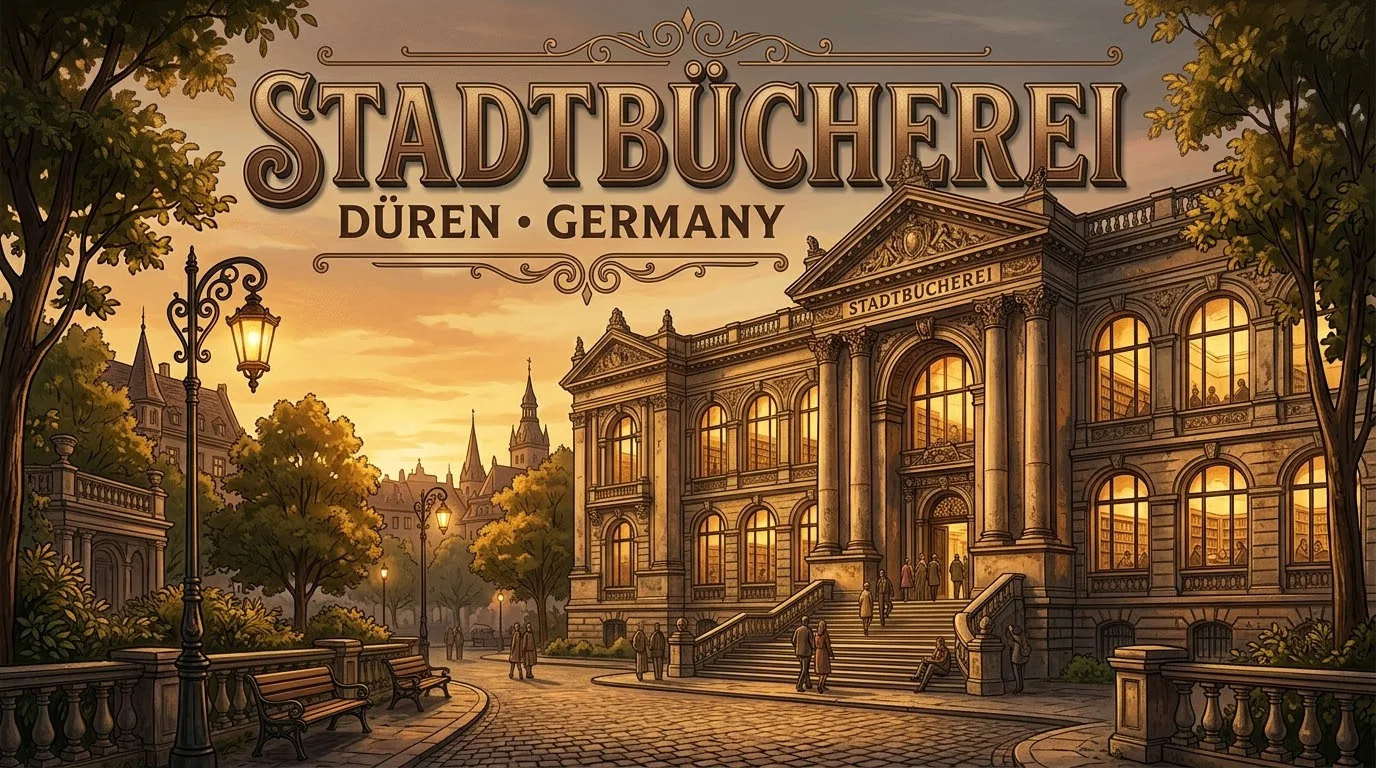
Inside the "Haus der Stadt" on Stefan-Schwer-Straße in northern Düren sits an institution whose history reaches back far further than the building itself: the Stadtbücherei Düren. As the oldest city library in the entire Rhineland, it looks back on more than 150 years of tradition, starting out in 1870 as a modest teachers' library and developing, through several buildings, complete wartime destruction, and multiple relocations, into a modern, heavily used public library that today holds around 62,000 items. What makes its story particularly notable is that for decades the library was housed in buildings originally constructed for entirely different purposes, from the town hall to a museum wing, before finally finding its own, purpose-built cultural home in the Haus der Stadt in 1991. For visitors interested in both Düren's town history and modern library culture, the Stadtbücherei is a place with a surprisingly layered past. Hardly any other public building in town links the destruction and reconstruction of 20th-century Düren so directly with the everyday culture of the present as this tradition-rich yet thoroughly lively educational institution.
History of Stadtbücherei Düren
The origins of the Stadtbücherei Düren go back to February 1870, when the institution was first founded as a teachers' library for Düren's elementary school teachers. It officially opened as a publicly usable library on November 4, 1871, making the Düren library the oldest city library in the entire Rhineland. A key role in building up its early holdings was played by Düren industrialist Wilhelm Edmund Hoesch, the same family name behind the neighboring Leopold-Hoesch-Museum, who donated 3,000 Taler to the young library for the purchase of books. In its early years the library was housed in the town hall, before moving to a side wing of the same building in 1891. In 1905 it relocated again, this time to a side wing of the newly built Leopold-Hoesch-Museum, where it remained for almost four decades. That long chapter ended abruptly on November 16, 1944, when the entire book collection was destroyed during the severe Allied air raid on Düren, the same attack that reduced much of the rest of the old town to rubble. It was not until 1951 that the library reopened with a modest starting collection of around 2,000 books. On March 16, 1971, the institution moved into rented premises on Arnoldsweilerstraße, before the decisive step into the present came on September 28, 1991, with the move into the newly built Haus der Stadt, where the library has since had around 3,000 square meters of floor space at its disposal. The Haus der Stadt itself was completely newly built by the city of Düren in the late 1980s within what was then the largest urban renewal area in North Rhine-Westphalia, designed by the Düsseldorf architects Christoph and Brigitte Parade, and officially opened on September 30, 1991.
Highlights of Stadtbücherei Düren
With more than 62,000 books, six daily or weekly newspapers, more than 50 subscribed periodicals, and over 5,000 CDs, 2,500 DVDs, and 400 board games, the Stadtbücherei Düren offers a media collection far larger than one might expect from a city library of this size. One particular architectural highlight is the "Q-Thek" on the second floor, a lounge-style meeting area with comfortable seating and a light column that glows in changing colors, lending the space an unusually modern, lounge-like atmosphere for a library. This is complemented by a "Soundbox," where visitors can enjoy audiobooks and music in a relaxed setting. Because the library shares its building with the city and district archives, the "Multi Kulti" youth center run by the Evangelical congregation, a community center for Düren-Nord, several conference rooms, and a technically well-equipped theater hall, visitors benefit from a lively, multifunctional cultural venue where readings, lectures, and events combine easily with a library visit. The building's theater hall also carries forward a theatrical tradition in Düren spanning more than a century, tracing back through the former Stadttheater Düren and performances in the auditorium of the Stiftisches Gymnasium and the old town hall. The Stadtbücherei is led by director Alexandra Oidtmann as part of "Düren Kultur," the municipal cultural operator founded in 2010 as successor to the former "Kulturbetrieb der Stadt Düren."
Opening Hours, Tickets & How to Get to Stadtbücherei Düren
The Stadtbücherei Düren is located in the Haus der Stadt on Stefan-Schwer-Straße, 52349 Düren, in the Düren-Nord district. Opening hours follow the usual service pattern of a municipal library, typically spanning several weekdays between morning and early evening along with a Saturday morning slot; for current, binding opening hours, it is best to check the library's website or call ahead, since hours can change depending on the season and staffing. Entering the library and reading on site are free of charge; borrowing items usually requires an annual membership fee that varies by age and user category, available on request directly from library staff. Getting there is easy by public transport: several Rurtalbus lines serve the "Haus der Stadt" stop right nearby, on both Fritz-Erler-Straße and Stefan-Schwer-Straße. From Düren's main train station, the Haus der Stadt is just a few minutes away by bus, or about a twenty-minute walk. Drivers will find ample parking on the grounds of the Haus der Stadt and in the immediate surrounding area.
Attractions Near Stadtbücherei Düren
Since the Stadtbücherei sits in the Düren-Nord district, somewhat outside the historic city center, a visit works well as its own short excursion that can be combined with a subsequent stroll through central Düren. By bus or on foot from there, visitors can reach the Rathaus Düren on Kaiserplatz, an impressive example of 1950s postwar reconstruction architecture. Not far beyond lies the Leopold-Hoesch-Museum, in whose historic side wing the library itself was once housed for many years, as well as the directly adjoining Papiermuseum Düren with its interactive exhibition on Düren's papermaking tradition. The Stadtmuseum Düren on Arnoldsweilerstraße, which tells the town's history chronologically, and the surviving remnants of the medieval city wall, particularly the Dicker Turm and the Mona-Lisa-Turm, also fit well into an extended tour of Düren's history. Visitors wanting to dig deeper into the town's cultural scene will find a quite different facet of it at the Komm-Kulturzentrum, housed in the historic Pleußmühle.
Where to stay in Düren, Germany
Compare current hotel prices and find the right place to stay.