Rathaus Düren
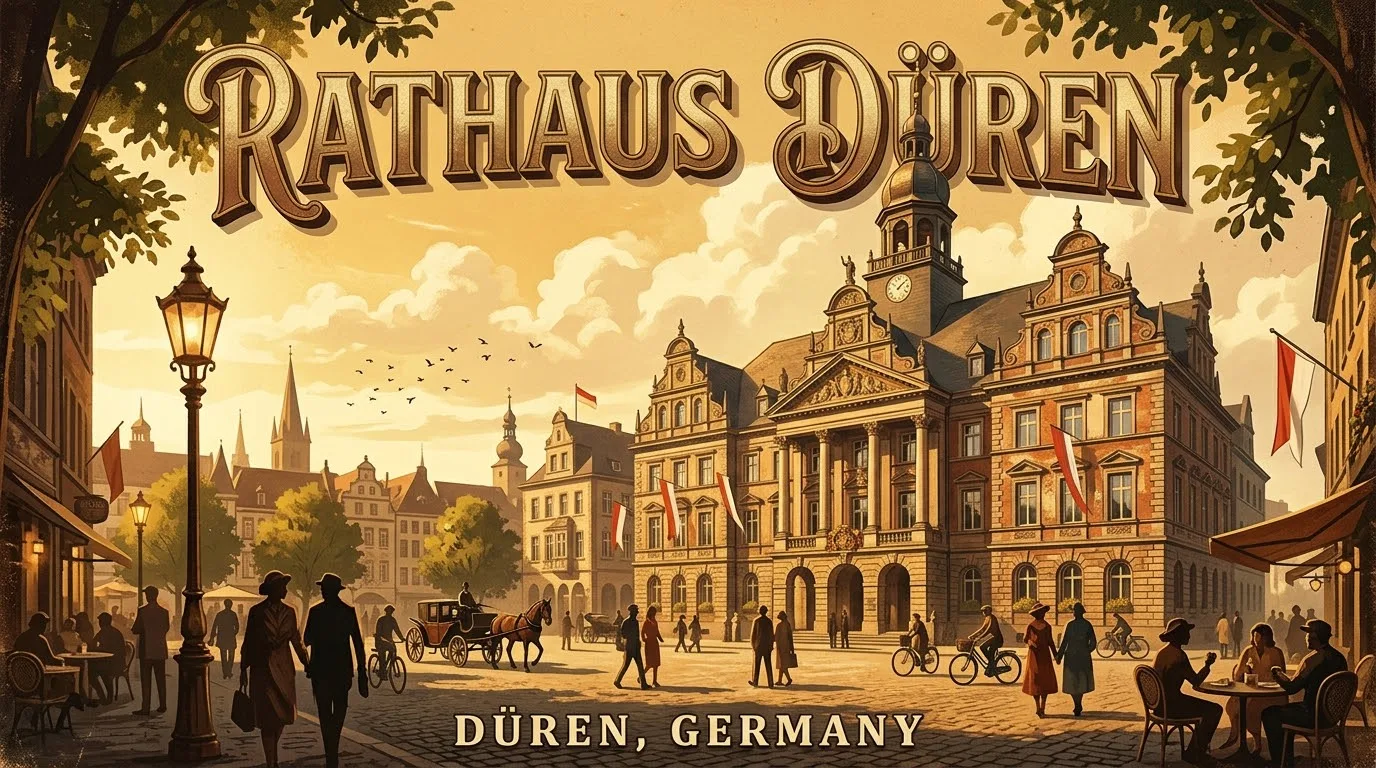
On Kaiserplatz in the center of Düren stands a building that looks sober and strictly geometric at first glance, but reveals itself on closer inspection as one of the most telling examples of 1950s West German postwar reconstruction architecture: the Rathaus Düren. Unlike many historic city halls in German towns, which often date back to the late medieval or early modern period, today's Rathaus Düren is a child of the postwar era, built on the site of several predecessor buildings that were completely destroyed in the air raid of November 16, 1944. Since 1989 the building has been protected as a historic monument, not despite its clear, era-typical design language but precisely because of it, as it is considered an important document of Düren's urban renewal after the catastrophe of the Second World War. For visitors interested in architectural history and the reconstruction achievements of Rhineland towns, the Rathaus Düren is far more than just a functional seat of local administration.
History of Rathaus Düren
The history of Düren's town halls stretches back a long way: as early as the 13th century, a first, late Romanesque town hall is believed to have existed, though its exact location and appearance can no longer be reliably reconstructed. A second building is documented as early as before 1333. In 1520, then-mayor Gerhard Harper, during a period of economic prosperity for the town, commissioned a new, representative town hall, popularly known as "Haus Schwert" (House of the Sword) because of a figure of Justitia displayed inside, which also housed the lay-judge and bailiff courts. This town hall, with its striking polygonal staircase tower and a wooden bell tower rising from the roof, was severely damaged as early as 1543 during the siege of Düren by the troops of Emperor Charles V. It was rebuilt, among other things, with an open, four-arched arcade portico, and repairs are documented for the years 1752 and 1770. Between 1788 and 1790, a fundamentally new town hall was built on its predecessor's foundations according to plans by architect Franz Klausener of Burtscheid, featuring three double-wing entrance portals facing the market square and historic units of measurement, such as the Brabant and Prussian "Elle," set into the facade. This neoclassical town hall bore Düren's coat of arms, combining the imperial eagle with the lion from the 1242 pledge agreement with Count Wilhelm IV of Jülich, though the coat of arms had to be covered with mortar in 1798 on orders of the French occupying authorities. This building survived more than 150 years of town history until it was completely destroyed on November 16, 1944, in the devastating Allied air raid that reduced the entire old town of Düren to rubble.
Highlights of Rathaus Düren
Reconstruction planning for the town hall began in earnest in 1953 and 1954, and in mid-1954 a design competition was announced that attracted 74 submissions. The jury unanimously selected the design by architect Denis Boniver of Mettmann, which the city council approved for construction on January 20, 1955. Ground was broken on October 17, 1956, the topping-out ceremony took place on March 8, 1957, and on January 9, 1959, the finished building was officially handed over by municipal director Hans Brückmann and mayor Heinrich Spies. With an enclosed volume of around 41,000 cubic meters and roughly 200 office and auxiliary rooms, the new town hall was designed to meet the needs of a growing municipal administration; it includes a cashier's hall, three meeting rooms, a large council chamber, and the town and district archives. One visual highlight that still stands out today is the town's coat of arms, crafted from around 25,000 pieces of Milanese glass mosaic, mounted above the clock that was installed in September 1958, an impressive piece of craftsmanship within the facade design. On the east side of the building, a basin fountain invites visitors to pause and provides a calm counterpoint to the building's clean architectural lines. Total construction costs in 1959 amounted to 4,942,475.25 Deutsche Mark, a considerable investment for the town's administrative infrastructure at the time. Following a municipal reorganization, the town hall was expanded and modernized in 1972 at a cost of roughly two million Deutsche Mark, and between 2012 and 2015 it underwent a comprehensive core renovation, during which staff relocated to temporary offices from March to July 2012; the renovated town hall reopened on July 13, 2015.
Opening Hours, Tickets & How to Get to Rathaus Düren
The Rathaus Düren at Kaiserplatz 2-4 is first and foremost an active seat of municipal administration rather than a classic tourist attraction with fixed visiting hours; however, its exterior facade, the distinctive tower with its clock and mosaic coat of arms, and the fountain on the east side can be freely viewed from outside at any time, at no cost. The administration's general office hours follow the usual schedule of the city of Düren, typically weekday mornings along with a few afternoon slots, and for many administrative matters an appointment booked in advance through the city's website is recommended. Since this is a listed but still actively used administrative building, interior visits to the council chamber or other historic rooms are generally only possible as part of guided city tours or by prior arrangement with the city's visitor services. Getting to the Rathaus is straightforward, as it sits right in the middle of Düren's city center: from Düren's main train station on the Cologne-Aachen rail line, it is only a short, roughly ten-minute walk to Kaiserplatz. Several Rurtalbus bus lines stop nearby, and drivers will find multiple public parking garages in the surrounding area, from which Kaiserplatz is easily reached on foot.
Attractions Near Rathaus Düren
Kaiserplatz with the Rathaus Düren sits right at the heart of the town, making it an ideal starting point for a walk through the city center. A short walk away are the Leopold-Hoesch-Museum and the directly adjoining Papiermuseum Düren, both well worth visiting and easy to combine with a stop at the town hall. The Stadtmuseum Düren on Arnoldsweilerstraße, which tells the town's history chronologically from its earliest documented mention to the present day, is likewise only a few minutes away. History enthusiasts should also plan a detour to the surviving remnants of the medieval town wall, in particular the Dicker Turm and the Mona-Lisa-Turm, two well-preserved watchtowers that tell the story of Düren's destruction and reconstruction just as vividly as the town hall itself. The Komm-Kulturzentrum, with its historic building fabric, and the Stadtbücherei Düren, housed in an architecturally notable building, round out a walk through central Düren and illustrate just how closely history, reconstruction, and modern city life remain intertwined here.
Where to stay in Düren, Germany
Compare current hotel prices and find the right place to stay.