Mona-Lisa-Turm
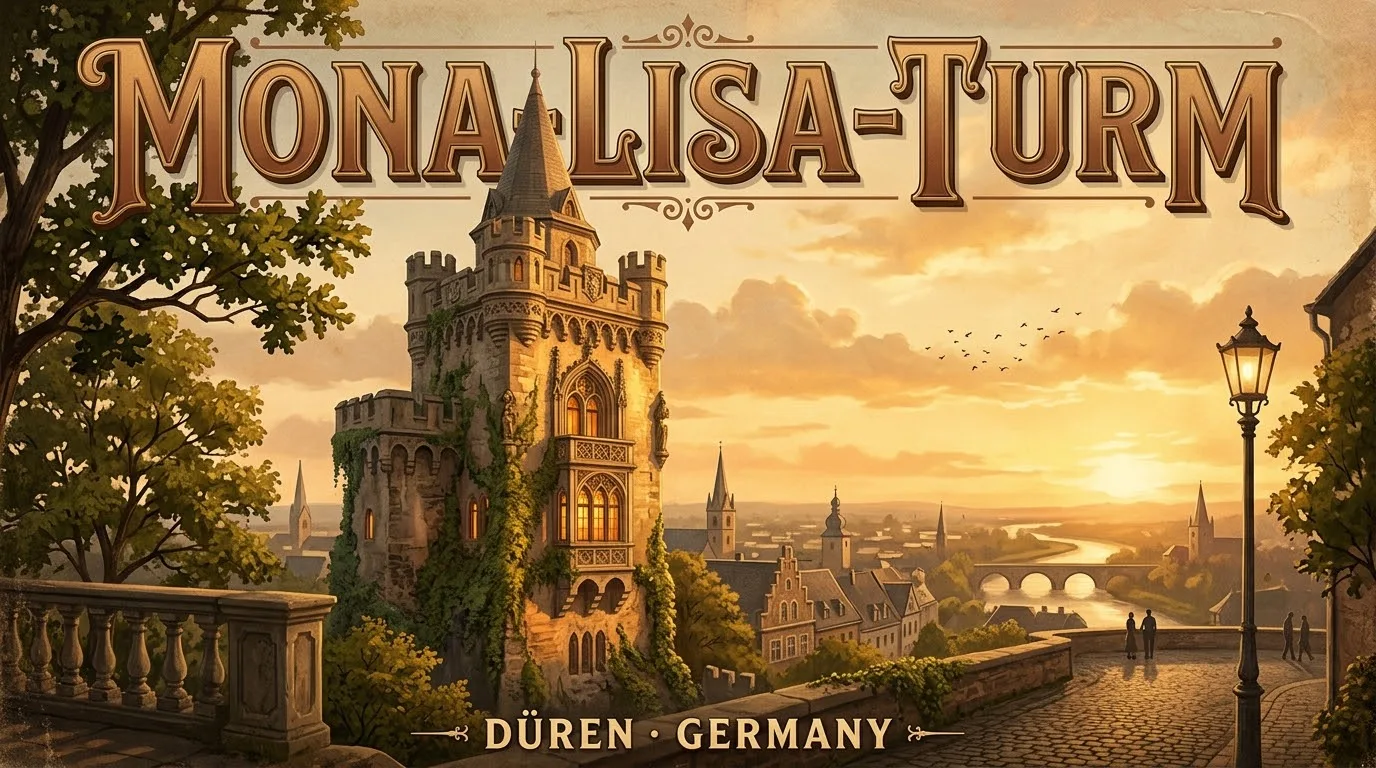
In Schillingspark, a popular green space in the Düren district of Gürzenich, stands a small, unassuming brick tower with an unusual name: the Mona-Lisa-Turm. Unlike the Dicker Turm or the Grönjansturm in central Düren, this tower is not a remnant of the medieval city fortifications but a small 19th-century structure deliberately built using salvaged stonework from the once-powerful Burg Gürzenich castle. It is precisely this deliberate reuse of lost building material that makes the Mona-Lisa-Turm one of the town's most unusual heritage structures: a Romantic-era garden folly that literally carries a piece of Gürzenich's history within its own walls. For visitors looking to explore the more rural, park-like side of Düren beyond the city center, a detour to Schillingspark is doubly worthwhile. While the major landmarks of the inner city often tell the story of the destruction of 1944 and its subsequent reconstruction, the Mona-Lisa-Turm in Gürzenich opens up an entirely different chapter of Düren's history, one that reaches back well before the 20th century and is closely bound up with the fate of a long-vanished noble castle.
History of Mona-Lisa-Turm
To understand the history of the Mona-Lisa-Turm, it helps to look at the nearby Burg Gürzenich, whose traces live on in the tower to this day. Burg Gürzenich is first documented in 1143 in connection with one Adolfus de Gorcenic and remained the seat of important noble families for centuries: it initially belonged to the ministerial lineage of the lords of Gürzenich, who were wiped out in 1232 during an attack by knights from Burg Bachem. In the 14th century, ownership passed to the von Echtz family, and in 1404 Johann Schellart, steward to Duke Rainald, acquired one half of the estate, while the other half passed by marriage to Dietrich von Beusdael in 1523, before both halves were reunited around 1530 by the Schellart family, who rebuilt the castle extensively. The complex consisted of a polygonal outer ward with four towers and a freestanding, two-story main house with a stepped gable and a rear round tower topped by a conical roof, as recorded by the 18th-century draftsman Renier Roidkin. Over the course of the 19th century, however, the castle fell into increasing disrepair, and by around 1830 its buildings were so dilapidated that demolition became unavoidable. Parts of the masonry from the former outer ward were built into the shed of the neighboring Kreuder farm, but one particularly distinctive element, a sandstone lintel stone bearing the carved year 1555, found its way into the newly created Schillingspark and was built into the small rectangular brick-and-rubble tower erected there in the early to mid-19th century, which has carried the name Mona-Lisa-Turm ever since. The park itself lies in the historic center of Gürzenich, a settlement dating back to around 300 BCE as "Curtiniacum," which only became part of the city of Düren on January 1, 1972, after centuries as an independent municipality.
Highlights of Mona-Lisa-Turm
The particular charm of the Mona-Lisa-Turm lies less in its size than in its history as a stone link between the vanished Burg Gürzenich and today's Schillingspark. The clearly visible 1555 lintel stone set into its facade is the oldest surviving dated architectural element of the former castle complex, allowing visitors to see with their own eyes a piece of the stonework that once belonged to one of the region's most important noble residences. The small tower also fits harmoniously into the romantic, park-like design of Schillingspark, which serves as the central recreational space for everyday life in Gürzenich and, besides the tower, is also home to the so-called Fischerhäuschen (fishing house), another small garden structure typical of parks from that era. The park and the adjoining Schillingsstraße most likely take their name from the Schillings family, which included the naturalist, photography pioneer, and early conservationist Carl Georg Schillings, born in Gürzenich in 1865, whose family lived at the nearby Weiherhof estate from 1871 onward and whose extensive legacy collection is today preserved largely at the Leopold-Hoesch-Museum and the Stadtmuseum Düren. A walk to the Mona-Lisa-Turm therefore combines perfectly with a visit to the Weiherhof and its historic fish ponds, which once belonged to the Kreuzherrenkloster Schwarzenbroich monastery founded in 1340, turning the tower into the starting point of a short but historically rich walking tour of Gürzenich.
Opening Hours, Tickets & How to Get to Mona-Lisa-Turm
The Mona-Lisa-Turm is located at Schillingsstraße 331 in the Düren district of Gürzenich, postal code 52355, standing as a freely accessible outdoor structure right in the middle of the public Schillingspark. Since it is a park monument rather than a museum, there are no fixed opening hours and no admission fee; the park, and with it the tower, can be visited free of charge year-round during normal daylight hours. Getting there from central Düren takes roughly ten to fifteen minutes by car or public transport, since Gürzenich lies somewhat outside the city center; bus lines 213, 296, and 297 connect the district with downtown Düren and stop near Schillingspark. Drivers will find ample parking along Schillingsstraße and in the surrounding area. Visitors looking to combine the trip with a larger leisure activity can easily pair their visit with the nearby Dürener Badesee, a popular local recreation area set in a former lignite mining pit that operated between 1941 and 1956.
Attractions Near Mona-Lisa-Turm
Right next to the Mona-Lisa-Turm, still within Schillingspark, it is worth taking a look at the historic Fischerhäuschen as well as the remains of the Kreuder farm, whose barn walls still contain masonry from the former outer ward of Burg Gürzenich. Just a few minutes away lies the Weiherhof with its historic fish ponds, which once belonged to the Kreuzherrenkloster Schwarzenbroich monastery and still lend the district its rural character today. The Catholic church of St. Johannes Evangelist on Schillingsstraße is also a short walk away and worth a visit. For a longer outing, the Dürener Badesee, created on the site of a former open-pit mine, offers swimming and relaxation. Visitors heading back from Gürzenich to central Düren can easily combine the trip with the historic sights located there, such as the Rathaus Düren, the Dicker Turm, and the Leopold-Hoesch-Museum, which together with the Mona-Lisa-Turm paint a multifaceted picture of Düren's eventful history.
Where to stay in Düren, Germany
Compare current hotel prices and find the right place to stay.