Marktplatz
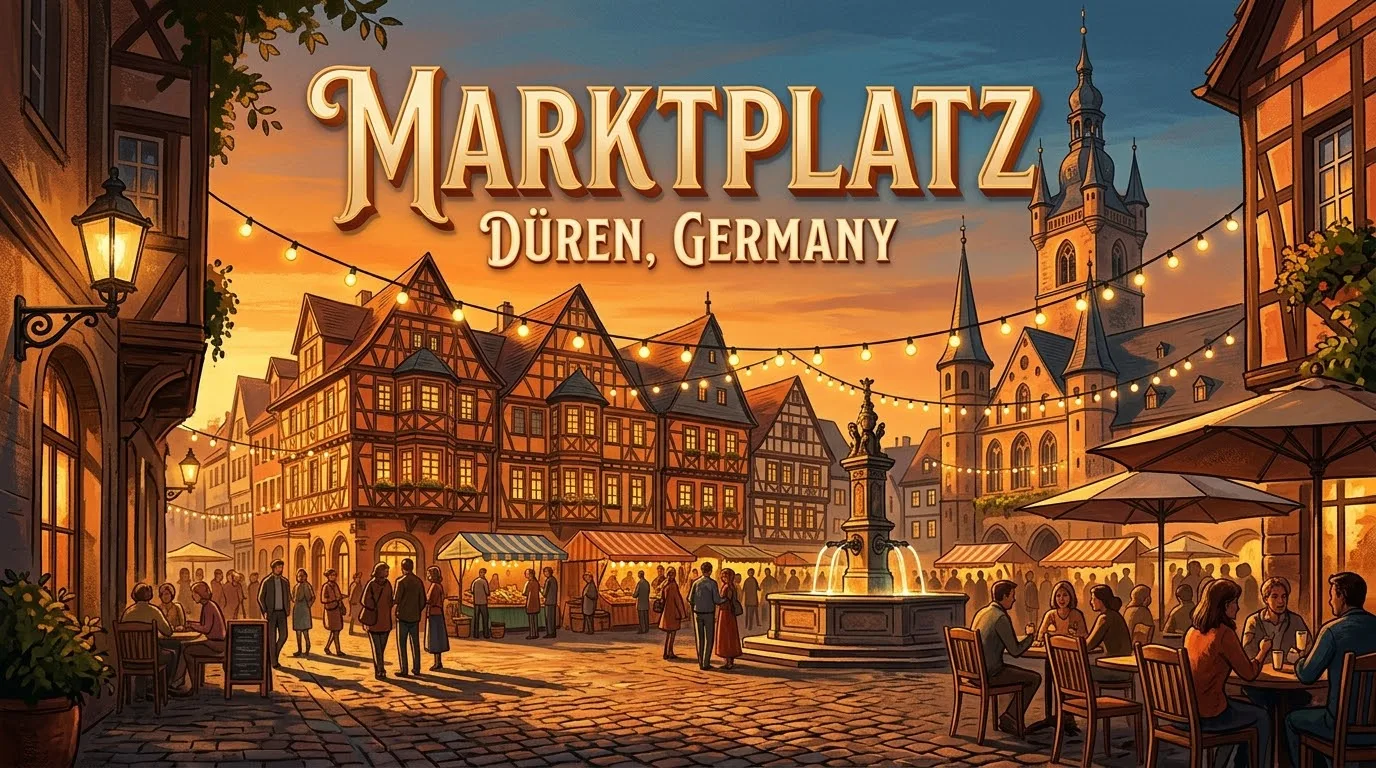
The Marktplatz is the historic heart of Düren and has been the pulse of city life for more than 650 years. A grain market is documented here as early as 1361, and over the centuries the square developed into the city's central marketplace, where grain, livestock, bread, butter, poultry, and wood were traded. Wealthy merchants and respected citizens settled around the Marktplatz in grand houses, and numerous inns clustered around the square to serve the grain trade. Like almost the entire inner city of Düren, the Marktplatz was completely destroyed in the air raid of November 16, 1944, so that not a single building from the historic square survives today. Nevertheless - or perhaps precisely because of this - the Marktplatz remains the lively center of the city, a place where history, reconstruction, and modern city life meet in close proximity.
History of Marktplatz
The history of Düren's Marktplatz reaches far back into the Middle Ages. A grain market is already documented at this location in 1361, and over the following centuries the square established itself as the central trading hub for numerous categories of goods, including livestock, bread, butter, poultry, and wood markets. The surrounding houses belonged to wealthy merchants and respected citizen families, and the many inns on the square primarily served traders who came into the city for the grain trade. Before the Second World War, the Marktplatz was also the central starting point for all streetcar lines of the Dürener Kreisbahn, making it the transportation hub of the city as well.
November 16, 1944, marks the deepest rupture in the square's history: on that day, 474 Royal Air Force bombers dropped 2,751 tons of bombs on Düren within just 21 minutes, destroying roughly 99 percent of the city - of 6,431 houses, only thirteen remained undamaged. The old town hall, built in 1520 and originally standing on the Marktplatz, also fell victim to the attack; after the war it was rebuilt not on the Marktplatz but on the newly created Kaiserplatz. The Marktplatz itself was rebuilt over the following decades in the sober style of 1950s reconstruction architecture, which still shapes the streetscape of Düren's city center today. In 1857, a Mariensäule, or column of the Virgin Mary, had first been erected on the northern side of the square; after it was destroyed in the war, sculptor Günter Haese created a new Mariensäule, which was ceremonially unveiled on October 11, 1957, by Bishop Johannes Pohlschneider of Aachen and still defines the square today.
Highlights of Marktplatz
The most striking highlight of the Marktplatz is certainly the Mariensäule of 1957, a work by sculptor Günter Haese that is regarded as an impressive symbol of the reconstruction following the destruction of 1944. Also worth seeing is the former officers' mess of the Belgian army at Markt 16, built in 1952 by architect Benno Sommer - a relic from the period when post-war Düren hosted the largest Belgian garrison outside Belgium, with the building now used as a restaurant. At Markt 26, a commemorative plaque marks the birthplace of Düren dialect poet Joseph van der Giese, who captured the local dialect in his literary works. Today, the Marktplatz is a traffic-calmed pedestrian zone and the setting for a weekly market held three times a week, on Tuesdays, Thursdays, and Saturdays, where regional traders sell fresh produce. The square also serves as the central venue for city festivals and, since December 2024, has hosted Düren's Christmas market. In 2017, the Marktplatz was fundamentally redesigned as part of the city's Inner City Master Plan, giving it today a modern, inviting appearance with generous open spaces and seating that combines the historic significance of the site with contemporary urban planning.
Opening Hours, Tickets & How to Get to Marktplatz
The Marktplatz is a public, freely accessible square in Düren's city center and can therefore be visited free of charge at any time; naturally, there are no fixed opening hours. Only the weekly market itself follows a fixed schedule - Tuesday, Thursday, and Saturday mornings - offering a good opportunity to experience the square at its liveliest. For a quieter visit, the other weekdays or the evening hours are recommended, when the square is shaped mainly by the surrounding restaurants and cafés. The Marktplatz lies in the absolute center of Düren and is therefore one of the easiest destinations to reach in the city. Travelers arriving by train reach Hauptbahnhof Düren and can walk to the Marktplatz from there in just a few minutes. Numerous regional bus lines also pass through the nearby Kaiserplatz, which functions as the central bus hub, providing good connections to the surrounding Düren area. Drivers will find ample parking in the central parking garages and lots of the city center, though it should be noted that the Marktplatz itself, as a pedestrian zone, cannot be driven on. The square makes an ideal starting point for a walking tour of the entire historic city center.
Attractions Near Marktplatz
From the Marktplatz, practically all of the central sights of Düren's city center are reachable within a few minutes' walk. Just a short stroll away lies Kaiserplatz, with the town hall opened in 1959 and the Flammenengel, a memorial sculpture created in 1962 by Adolf Wamper to commemorate the destruction of Düren. Also within walking distance are the Annakirche and the surrounding squares of Annaplatz and Ahrweilerplatz, whose Gothic south portal survived the wartime destruction and which today invite visitors to linger among numerous restaurants and cafés. Culture enthusiasts should visit Hoeschplatz with the Leopold-Hoesch-Museum and the adjoining Papiermuseum, both among the most important cultural institutions in the region. Those interested in the period before Düren's destruction will also find further impressive testimonies to the city's eventful history at the Bismarckdenkmal in Theodor-Heuss-Park and at the surviving remains of the medieval city wall, for instance along the nearby Wallstraße.
Taken together, these nearby sights make the Marktplatz an excellent starting point for exploring the full arc of Düren's history, from its medieval trading days through the destruction of 1944 to its present-day revival as a pedestrian-friendly city center.
Where to stay in Düren, Germany
Compare current hotel prices and find the right place to stay.