Marienkirche
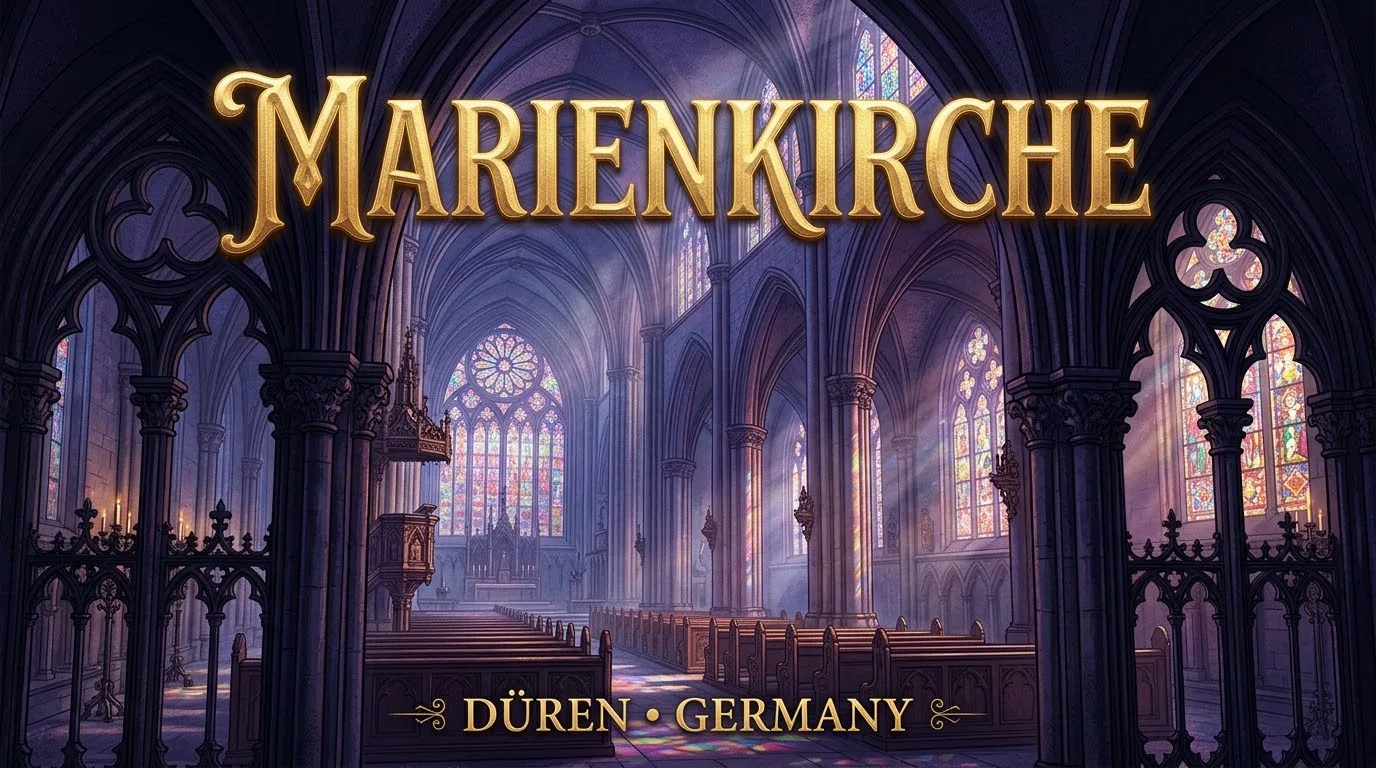
The Marienkirche is one of the most historically rich sacred buildings in Düren's city centre, with a history stretching back to the 15th century. Officially known as St. Marien, the church originated as part of a Franciscan monastery founded in 1459 and was only elevated to an independent parish church in 1832. Following a neogothic extension in the early 20th century, the building was almost completely destroyed during the air raid on Düren in November 1944 and was rebuilt just a few years later, architecturally distinct from its predecessor. Located directly on Hoeschplatz, right next to the Leopold-Hoesch-Museum, the Marienkirche today serves as a subsidiary church of the St. Lukas parish and ranks among the most striking historic buildings in the heart of Düren, significant both architecturally and musically.
History of Marienkirche
The roots of the Marienkirche go back to 1459, when Franciscan friars settled in Düren and founded a monastery, which included an early monastery church consecrated in 1470 with a total of four altars. A devastating fire destroyed the monastery in 1533, but reconstruction was completed just three years later, allowing the monastery and its church to endure for centuries. It was not until 1832 that the former monastery church was elevated to the independent parish church of St. Marien, finally integrating it into the town's wider ecclesiastical life. In the early 20th century, the church received a neogothic extension with a west front and bell tower, designed by the Cologne architect Heinrich Renard, which was solemnly consecrated on 21 November 1915 and gave the Marienkirche its most striking exterior appearance up to that point. This neogothic building, however, was almost completely destroyed during the severe air raid on Düren on 16 November 1944. Reconstruction began quickly: the foundation stone for the new church was laid on 1 May 1949, built to designs by architect Hans Peter Fischer using rubble bricks salvaged from the ruins. Just a few months later, on 6 November 1949, the new Marienkirche was solemnly consecrated. With the founding of the St. Lukas parish in January 2010, the Marienkirche lost its status as an independent parish church and became a subsidiary church, though it remains an important centre of community life to this day.
Highlights of Marienkirche
The Marienkirche impresses with its blend of different building eras, reflecting its eventful history: while its exterior form is largely shaped by the postwar reconstruction, its location and basic layout still recall its medieval roots as a Franciscan monastery church. The musical tradition of the building is particularly noteworthy: in 1924 the Marienkirche received an organ from the renowned Cologne organ-building firm Klais with 51 stops, which at the time of its installation was considered the largest organ in the entire Archdiocese of Cologne and underlined the church's musical significance far beyond Düren. After this instrument was destroyed during the Second World War, the Marienkirche received a new mechanical organ by organ builder Heinz Wilbrand in 1992/1993, with 29 stops, which is still regularly used for concerts today, including performances by the ensemble Capella Villa Duria. Architecturally, the interior is characterised by flexible seating arrangements that allow for various uses of the church space, setting the Marienkirche apart from many more traditional sacred buildings; an adjoining community room further extends the possibilities for cultural and parish events. Its immediate proximity to the Leopold-Hoesch-Museum on Hoeschplatz also makes the Marienkirche a fixed part of the cultural heart of Düren's city centre. For anyone interested in the history of postwar reconstruction in the Rhineland, the Marienkirche offers an impressive example of how a new, functional church could rise from the rubble of a destroyed building within a short period of time, remaining in active use to this day.
Opening Hours, Tickets & How to Get to Marienkirche
The Marienkirche is centrally located on Hoeschplatz in 52349 Düren, directly next to the Leopold-Hoesch-Museum, making it one of the easiest churches to find in the city centre. As the Marienkirche today, as a subsidiary church of the St. Lukas parish, is used for services as well as concerts and other events, exact opening hours vary depending on the programme; reliable information on current service times, concert dates, and possible viewing opportunities is available via the website of the St. Lukas parish or by phone through the parish office at Annaplatz 8. Admission to the Marienkirche is generally free for visits and services; only for selected concert events, such as performances by the ensemble Capella Villa Duria, separate tickets may be required. Getting to the Marienkirche is straightforward thanks to its central location: from Düren's main railway station on the Cologne–Aachen line, it is roughly a ten-minute walk through the historic city centre to Hoeschplatz. Visitors arriving by car will find ample parking in the surrounding car parks and streets of the city centre, while numerous VRS bus lines connect the Marienkirche with other parts of town and neighbouring communities. Its central location makes the Marienkirche an ideal starting point for a walk through Düren's old town.
Attractions Near Marienkirche
Directly next to the Marienkirche is the Leopold-Hoesch-Museum & Papiermuseum, one of the region's most important art museums, which combines modern art with Düren's industrial paper-making history and pairs perfectly with a visit to the Marienkirche. Just a few minutes' walk away is the Annakirche, home to the famous relic of Saint Anna, considered the city's most important pilgrimage church and offering a striking architectural counterpoint to the Marienkirche. The Christuskirche, Düren's most important Protestant church with its distinctive free-standing tower, is also within walking distance and makes for a worthwhile combined visit to all three of Düren's churches. Düren's town hall, with the adjoining Kaiser-Friedrich-Park, is ideal for a relaxing break amid greenery, while the nearby district court building adds another striking structure to the historic cityscape. For a trip beyond the city limits, the Jülich Citadel, one of the best-preserved Renaissance fortifications in Europe, is recommended and can be reached by car in around 20 minutes, making an excellent addition to a day trip to Düren.
Where to stay in Düren, Germany
Compare current hotel prices and find the right place to stay.