Mahnmal für die Opfer des Nationalsozialismus
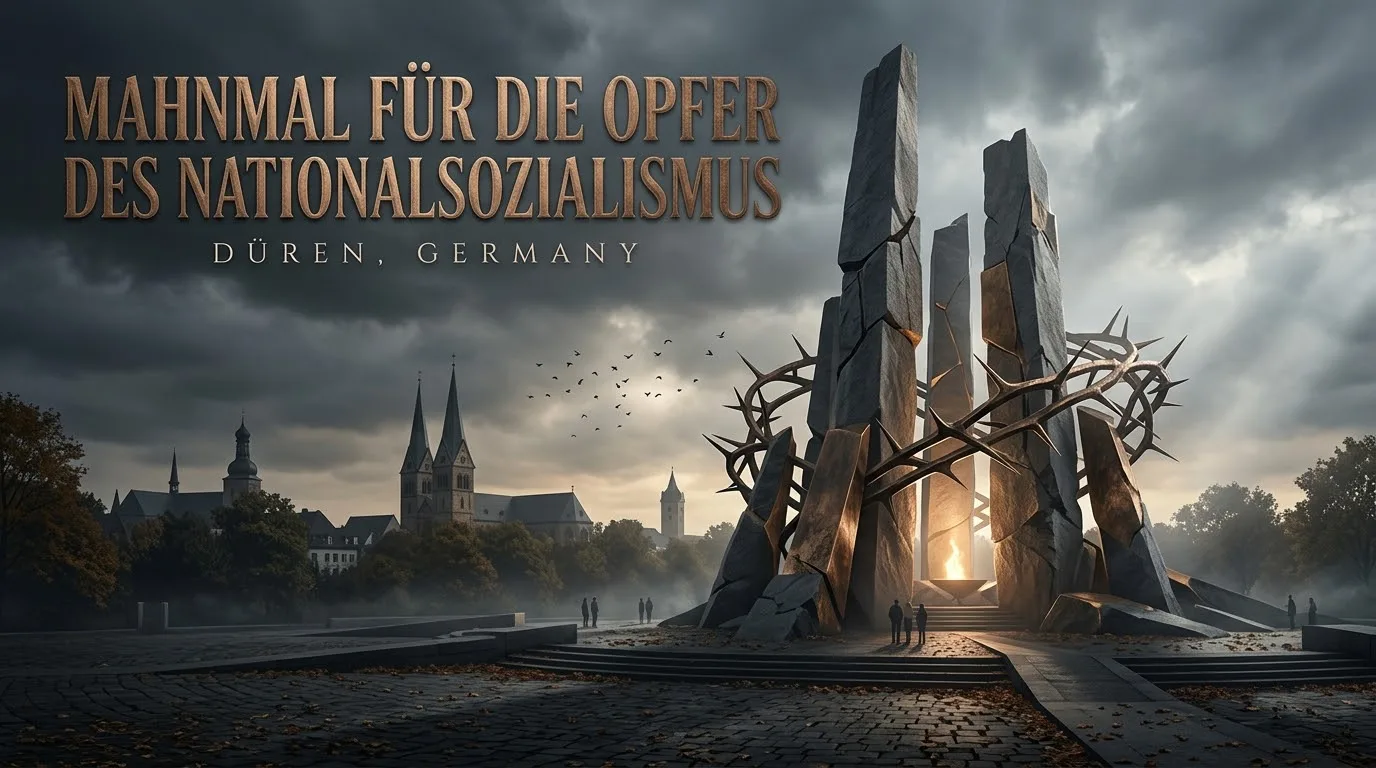
The Mahnmal für die Opfer des Nationalsozialismus on Rückmüller-Platz is one of the quieter, yet no less meaningful, sites of remembrance in Düren. Unlike the central squares of the city center, Rückmüller-Platz lies somewhat off the tourist trail, offering a place of calm where the victims of National Socialist tyranny can be remembered in a dignified way. The memorial fits into Düren's broader culture of remembrance, which for decades has actively kept alive the memory of the persecution, expulsion, and murder of Jewish residents and other victim groups during the Nazi era - among other things through the Stolpersteine laid throughout the city by artist Gunter Demnig, and the monumental steles created in 1988 by Ulrich Rückriem, which at several locations across Düren recall the destruction of the city's Jewish community. Visiting Rückmüller-Platz means stepping into a quiet but powerful station of Düren's landscape of remembrance.
History of Mahnmal für die Opfer des Nationalsozialismus
The history of National Socialist tyranny left deep scars on Düren. As in many German cities, Jewish fellow citizens in Düren were systematically stripped of their rights and excluded from 1933 onward, and from the early 1940s were deported to extermination camps; the once vibrant Jewish community of the city was thereby almost entirely destroyed. Alongside the Jewish population, political opponents, forced laborers, and other groups targeted by the Nazi regime also suffered persecution and violence. After the war, which almost completely destroyed Düren's inner city through the air raid of November 16, 1944, it took years before the city engaged with this past in an appropriate way. Only over the course of the post-war decades did an active culture of remembrance develop in Düren, taking several forms: in the 1980s, artist Ulrich Rückriem created monumental steles that, at various locations across the city - including at the Amtsgericht and in several districts - recall the destruction of Düren's Jewish community. Since the 2000s, the Stolpersteine project by artist Gunter Demnig has complemented this remembrance, using small brass plaques set into the pavement to make visible the names and fates of individual Nazi victims directly in front of their last known homes. The memorial on Rückmüller-Platz stands within this tradition, offering a fixed, publicly accessible place where the victims of National Socialism in Düren can be remembered, particularly during commemorative events around Volkstrauertag and the anniversary of the November pogroms of 1938.
Highlights of Mahnmal für die Opfer des Nationalsozialismus
Rückmüller-Platz itself presents as a quiet, manageable square within Düren's urban fabric, radiating a noticeably more restrained, contemplative atmosphere than the lively central squares such as Marktplatz or Kaiserplatz. This restraint suits a place of remembrance well, giving visitors room for a moment of reflection and quiet contemplation without the distraction of traffic noise or bustling activity. The memorial itself is deliberately kept simple, as is typical of many memorials of this kind in German cities - a restrained but clear visual language that recalls the injustices of the Nazi era without grand staging, giving precedence to remembering the victims over artistic self-expression. The square is regularly used for municipal commemorative events, during which representatives of the city, schools, and civil society groups lay wreaths and honor the victims. Visitors wishing to engage more deeply with Düren's Nazi-era history can combine a visit here with other sites of remembrance in the city: the Rückriem steles at several locations across the urban area, as well as the numerous Stolpersteine set into the pavements of the city center, complement the memorial on Rückmüller-Platz to form a dense network of remembrance. This combination of several memorial sites spread across the city makes clear how seriously Düren takes the reckoning with its own Nazi-era past, and Rückmüller-Platz forms an important, easily accessible building block of this landscape of remembrance.
Opening Hours, Tickets & How to Get to Mahnmal für die Opfer des Nationalsozialismus
Since this is a freely accessible memorial in public space, there are no fixed opening hours and no admission fee. Rückmüller-Platz, and the Mahnmal für die Opfer des Nationalsozialismus that stands there, can be visited year-round and free of charge. As this is a place of remembrance, a visit during quieter times of day, such as the morning or early afternoon, is recommended, to fully appreciate the square's contemplative atmosphere. A visit is particularly worthwhile around Volkstrauertag in November or around the anniversary of the November pogroms, since commemorative events are often held at the memorial on these occasions. Getting to Rückmüller-Platz from Düren's city center is easy on foot, as the square lies within the inner-city area and is well connected to the city's pedestrian network via the surrounding streets. Visitors arriving by train reach Hauptbahnhof Düren and can continue from there on foot in a few minutes or by one of the city's numerous bus lines. The square is also reachable by car via the surrounding city center streets, with parking available in the adjoining neighborhoods and in the city's central parking garages. Since Rückmüller-Platz lies close to several other central locations, a visit combines well with a larger walking tour of Düren's city center.
Attractions Near Mahnmal für die Opfer des Nationalsozialismus
Several of Düren's most important sights lie close to Rückmüller-Platz, making it easy to combine a visit to the memorial with a broader walk through the city. Just a few minutes' walk away is the Marktplatz, the historic heart of the city, as well as Kaiserplatz with the town hall and the Flammenengel, another significant memorial commemorating the destruction of Düren in 1944. The Annakirche, together with the surrounding Annaplatz and Ahrweilerplatz, whose historic fabric survived the wartime destruction only in part, is likewise within walking distance. Those wishing to explore the city's culture of remembrance in greater depth can continue from here to one of the locations of the Rückriem steles, which at several points across the city recall the destruction of Düren's Jewish community. Culture enthusiasts should also visit Hoeschplatz with the Leopold-Hoesch-Museum and the Papiermuseum, while lovers of city history can gain a further impression of historic Düren before the destruction of 1944 at the surviving remains of the medieval city wall, for instance along Wallstraße.
Where to stay in Düren, Germany
Compare current hotel prices and find the right place to stay.