Burgauer Wald
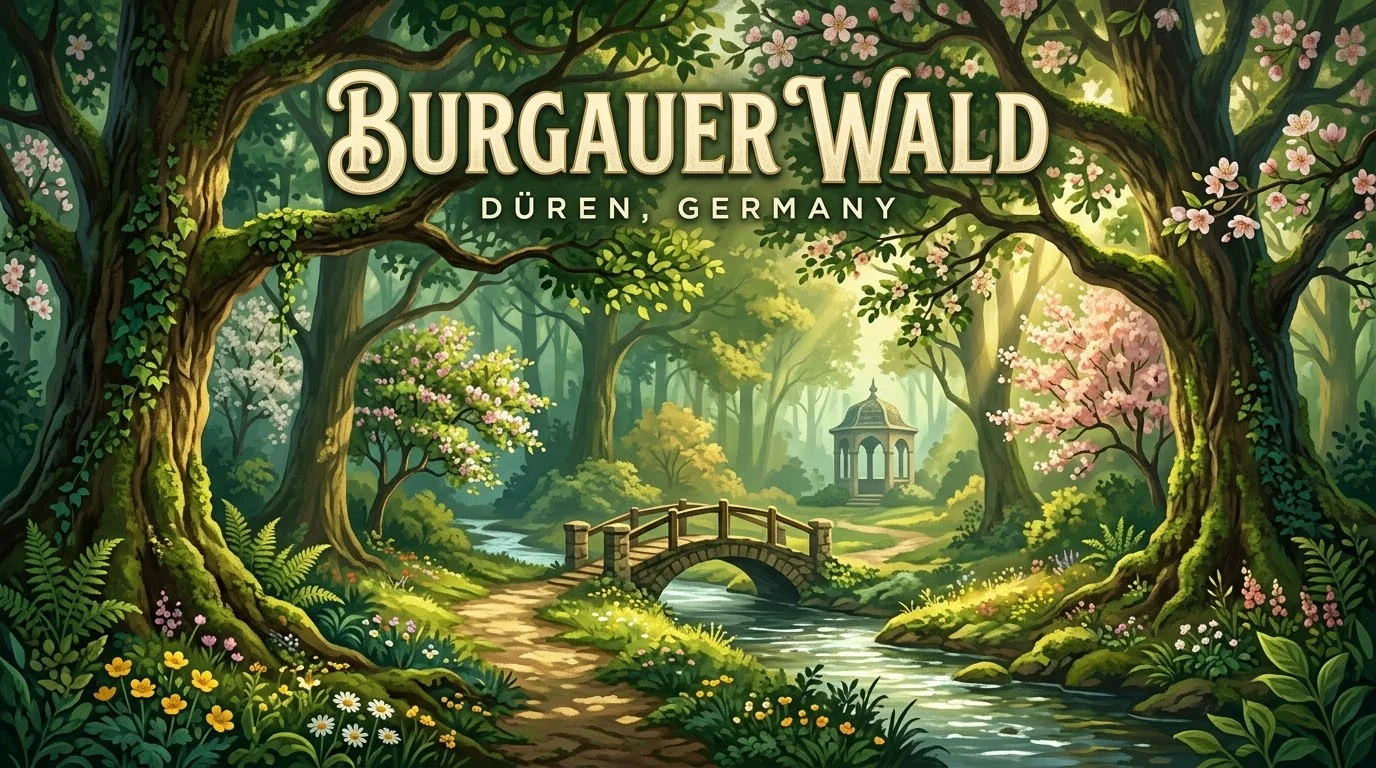
On the western edge of Düren's Niederau district lies the Burgauer Wald, a connected area of woodland that takes its name from the medieval moated castle of Schloss Burgau, which rises on a small island right in the middle of this forest. Unlike many purely commercial forests in the region, the Burgauer Wald has for decades been deliberately developed as a recreational area for the people of Düren, with a network of marked hiking and walking trails suited to very different needs. Anyone wanting to escape the bustle of the city for an hour or two will find shaded deciduous woodland, open clearings and repeatedly surprising views of the castle, all without ever leaving the city limits of Düren. The forest is also an important ecological refuge for numerous native plant and animal species, helping ensure that Düren, despite its industrial past as a paper-making city, retains generous, natural green space right on its doorstep.
History of Burgauer Wald
The history of the Burgauer Wald is closely tied to the history of Schloss Burgau, whose earliest structural traces date back to the 11th century and which was first documented in writing in 1313. For many centuries the surrounding forest served mainly as a hunting ground and source of timber for whoever owned the castle, which passed to the von Elmpt family through inheritance in 1475 and received its still-visible baroque three-wing form in 1730. With the city of Düren's acquisition of the entire estate and surrounding woodland in 1917 for 600,000 marks, the character of the forest changed fundamentally: a private hunting and working forest gradually became a publicly accessible recreational woodland, now maintained by the municipal forestry administration. During the occupation period after the First World War, the area around Schloss Burgau was already popular among Düren's residents as an outing destination and a place for communal celebrations, underscoring the forest's long tradition as a local recreation area. The severe destruction of Düren in the air raid of 16 November 1944 affected the city centre far more than the peripheral woodland around Burgau, so the Burgauer Wald served as a comparatively unscathed refuge for recreation for the postwar generation. In the following decades the paths were systematically expanded, signposted and fitted with educational panels, while between 1974 and 1991 the castle itself underwent an extensive restoration, which brought additional attention and visitor numbers to the entire area.
Highlights of Burgauer Wald
The Burgauer Wald scores above all with its well-developed network of marked circular trails designed for different groups of visitors. Particularly popular is the "Große Runde durch den Wald von Schloss Burgau", a roughly 6.8-kilometre, low-gradient route that is passable year-round and is therefore well suited to less experienced hikers or a relaxed walk with the whole family. For families with younger children, the roughly 2.5-kilometre Forstlehrpfad educational forest trail through the Schloss Burgau woodland is a good choice, where information panels playfully convey knowledge about native tree species, forest ecology and the area's wildlife. Along both routes, attractive views of the moated castle of Schloss Burgau repeatedly open up, its towers standing out between the treetops, particularly striking in autumn when the foliage turns deep shades of red and gold. The dense, predominantly deciduous tree cover provides pleasant coolness in summer, making the forest an attractive destination for joggers, cyclists and dog walkers even on hot days. Those spending longer in the forest will repeatedly come across small clearings and benches well suited to a picnic break, while anyone interested in nature can learn more about the area's ecological relationships from the panels along the educational trail. The immediate proximity to the Schlosspark Burgau also means a forest walk can be ideally combined with a stop at the café by the castle or an indoor visit, timing permitting. Birdwatchers particularly value the Burgauer Wald in spring, when numerous songbird species nest in the dense undergrowth and their calls accompany the otherwise quiet forest atmosphere, while in autumn mushroom foragers can often be found exploring the damper, shadier sections. Mountain bikers occasionally use the firmer forestry tracks outside the signposted hiking routes, though they should always be mindful of pedestrians and the more sensitive natural areas, which are ecologically particularly valuable.
Opening Hours, Tickets & How to Get to Burgauer Wald
As a public forest, the Burgauer Wald is freely accessible year-round and around the clock, with no admission charge. For hikes, daylight hours are generally recommended, since the paths, while well signposted, remain largely natural in character and correspondingly harder to navigate in the dark. From Düren's city centre, the edge of the forest near Niederau can be reached on foot or by bicycle in around fifteen to twenty minutes, making the Burgauer Wald one of the most easily accessible larger wooded areas in the immediate vicinity of the city. Drivers will find designated parking near Schloss Burgau, from where the marked circular trails start directly. Users of public transport can take VRS bus lines towards Niederau and reach the edge of the forest within a few minutes' walk of the nearest stop. Sturdy footwear is recommended for the more natural sections, especially after rainfall, since some stretches of the educational trail and informal paths away from the main routes can become muddy, while the "Große Runde" remains manageable even in changeable weather thanks to its gentle gradient.
Attractions Near Burgauer Wald
At the heart of the Burgauer Wald naturally stands the moated castle of Schloss Burgau itself, whose interior rooms, exhibition spaces and attached café can be visited separately and form the historical highlight of any forest outing. The directly adjoining Schlosspark Burgau, with its moat and mature trees, offers a calmer, more cultivated complement to the wilder character of the surrounding forest. Towards Düren's city centre, the Rurufer with its walking and cycling paths and Holzbendenpark with its duck pond are both within comfortable reach for anyone wanting to explore further green spaces after the forest walk. Those interested in culture will also find the Annakirche, with its striking tower, and the Leopold-Hoesch-Museum in the city centre, both reachable within a short drive or a longer walk from the edge of the forest. Families with children may also enjoy Konrad-Adenauer-Park and Willy-Brandt-Park as additional destinations with their own play areas, easily combined into a day trip around Niederau and Düren's city centre.
Where to stay in Düren, Germany
Compare current hotel prices and find the right place to stay.