Bismarckdenkmal
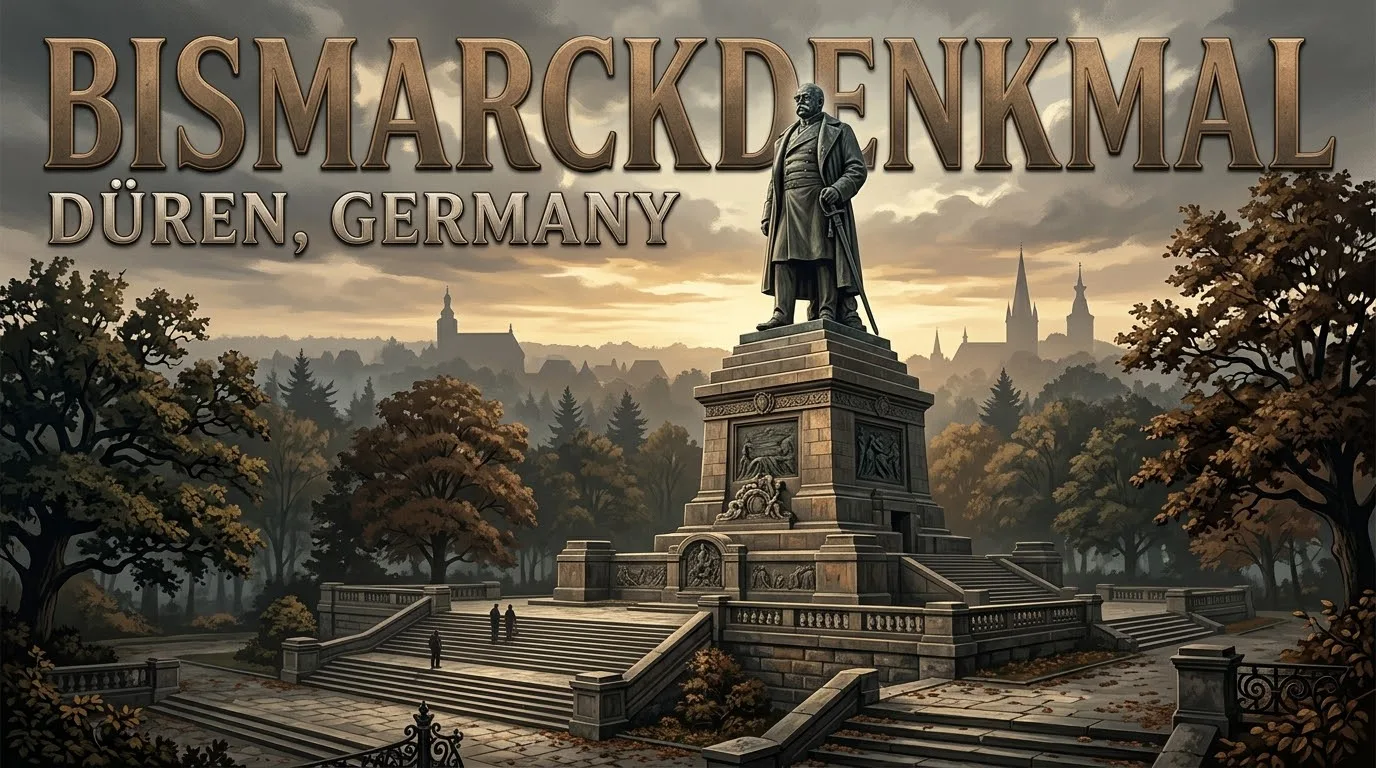
The Bismarckdenkmal in Düren is one of the few historical monuments in the city that has survived, in altered form, the almost total destruction of the Second World War. The over-life-size bronze statue of the first German Chancellor, Otto von Bismarck, stands today in the Theodor-Heuss-Park on Bismarckstraße, just a short walk from the Kreishaus, the administrative seat of the Düren district. The monument was created by sculptor Joseph Uphues between 1891 and 1892, at a time when numerous German cities were honoring the architect of German unification with public statues. It was ceremonially unveiled on September 18, 1892, and for more than five decades shaped the streetscape at the junction of Bismarckstraße and Moltkestraße. That the figure survived the air raid of November 16, 1944, which reduced almost 99 percent of Düren's inner city to rubble, makes it a rare architectural witness to the pre-war town. Today the Bismarckdenkmal recalls not only a central figure of German imperial history but also the turbulent history of Düren itself.
History of Bismarckdenkmal
The story of the Bismarckdenkmal begins in the final years of the former Chancellor's life, when a veritable cult of personality around Otto von Bismarck swept through German cities. Düren, too, wanted to erect a visible monument to the statesman, and the city commissioned sculptor Joseph Uphues to design a neoclassical bronze figure. The statue was created between 1891 and 1892 and was originally presented on an elaborately designed pedestal that featured relief portraits of Generals Albrecht von Roon and Helmuth von Moltke, together with an accompanying sculpture of the muse Clio - a reference to the historical significance of the figures depicted. On September 18, 1892, the ensemble was ceremonially unveiled to the public at the then-intersection of Bismarckstraße and Moltkestraße, and it remained a fixed feature of Düren's townscape for more than fifty years.
The turning point in the monument's history came with the Royal Air Force air raid of November 16, 1944, in which 2,751 tons of bombs were dropped on Düren in just 21 minutes, destroying roughly 99 percent of the town. The Bismarckdenkmal was severely damaged in the attack; the elaborate pedestal with its reliefs of Roon and Moltke, as well as the Clio figure, were lost and never restored. Only the bronze figure of Bismarck itself survived the destruction in a repairable state. It was not until September 25, 1956, more than a decade after the end of the war, that the restored statue was re-erected on a new, markedly simpler and lower pedestal - this time in the newly laid-out Theodor-Heuss-Park, where it still stands today. As a protected architectural monument of the city of Düren, the Bismarckdenkmal documents both the monumental culture of the German Empire and the pragmatic reconstruction of the post-war decades.
Highlights of Bismarckdenkmal
At the heart of the Bismarckdenkmal stands the over-life-size bronze figure of Otto von Bismarck, depicted in a classical, dignified pose typical of the Wilhelmine monument culture found in many German cities around the turn of the twentieth century. Joseph Uphues, who was also involved in other major monument projects of his era, created a work whose craftsmanship from the late nineteenth century remains evident today, despite the loss of its original pedestal decoration. Particularly striking is the contrast between the historic figure and its present-day surroundings: the Theodor-Heuss-Park, where the monument has stood since 1956, has in recent years been redesigned as part of the development of the so-called Bismarck-Quartier, so the restored statue is now presented in a well-tended, modern park setting with paths, lawns, and seating areas. An information panel near the Bismarckdenkmal tells visitors about its history and places it within the broader context of Düren's past. For photographers, the combination of historic bronze sculpture and green park surroundings offers appealing motifs, especially in the early morning and evening hours, when the light brings out the patina of the statue particularly well. Those interested in architectural history will also find an anchor point here, since the monument is one of the few surviving structures that still directly recall the Düren that existed before the destruction of 1944. The Kreishaus, the administrative seat of the Düren district, is located nearby as well, so a walk to the Bismarckdenkmal can easily be combined with a look at the region's modern administrative architecture.
Opening Hours, Tickets & How to Get to Bismarckdenkmal
Because the Bismarckdenkmal is a freely accessible outdoor monument within the public Theodor-Heuss-Park, there are no fixed opening hours and no admission fee. The park, and with it the monument, can be visited free of charge year-round, day and night, although a visit in daylight is recommended in order to fully appreciate the details of the bronze figure and its park surroundings. The best time to visit is during spring and summer, when the park is in full green, though a walk in autumn with colorful foliage has its own particular charm. Getting to the Bismarckdenkmal is easy, whether by car or public transport. The park is located on Bismarckstraße in central Düren, within walking distance of the city center and the Kreishaus, the district administration building. Travelers arriving by train reach Düren's main railway station, Hauptbahnhof Düren, from which the Bismarckdenkmal can be reached on foot in just a few minutes. Numerous regional bus lines also stop near the Kreishaus and the city center, providing good connections to the rest of Düren. Visitors arriving by car will find various parking options around the Kreishaus and in the adjoining streets of the city center. Since the monument forms part of a public park, a visit can easily be combined with a longer walk through the surrounding green spaces or a subsequent stroll through Düren's historic city center.
Attractions Near Bismarckdenkmal
Visitors to the Bismarckdenkmal should take time for a walk through the surrounding area, since Düren, despite the massive destruction of 1944, has numerous other sights to offer. Just a few minutes' walk away stands the Kreishaus, the striking administration building of the Düren district, reflecting the region's modern development. Heading toward the city center, visitors reach Kaiserplatz with its imposing town hall from 1959 and the Flammenengel, a memorial sculpture created in 1962 by Adolf Wamper to commemorate the destruction of Düren. A little further south lies the historic Marktplatz, where market days have been held for centuries and which is also home to the Mariensäule of 1957, another post-war monument. The Annakirche, together with the surrounding Annaplatz and Ahrweilerplatz, whose Gothic south portal survived the wartime bombing, is also well worth a visit and lies only a short walk from the Bismarckdenkmal. Culture enthusiasts should also visit Hoeschplatz with the Leopold-Hoesch-Museum and the adjoining Papiermuseum, both among the most important museums in the region. Finally, it is worth taking a look at the remains of Düren's medieval city wall, which - unlike most of the town's historic buildings - largely survived the 1944 air raid and can still be seen today at several points around the city, for instance along Wallstraße.
Where to stay in Düren, Germany
Compare current hotel prices and find the right place to stay.