Alte Stadtmauer
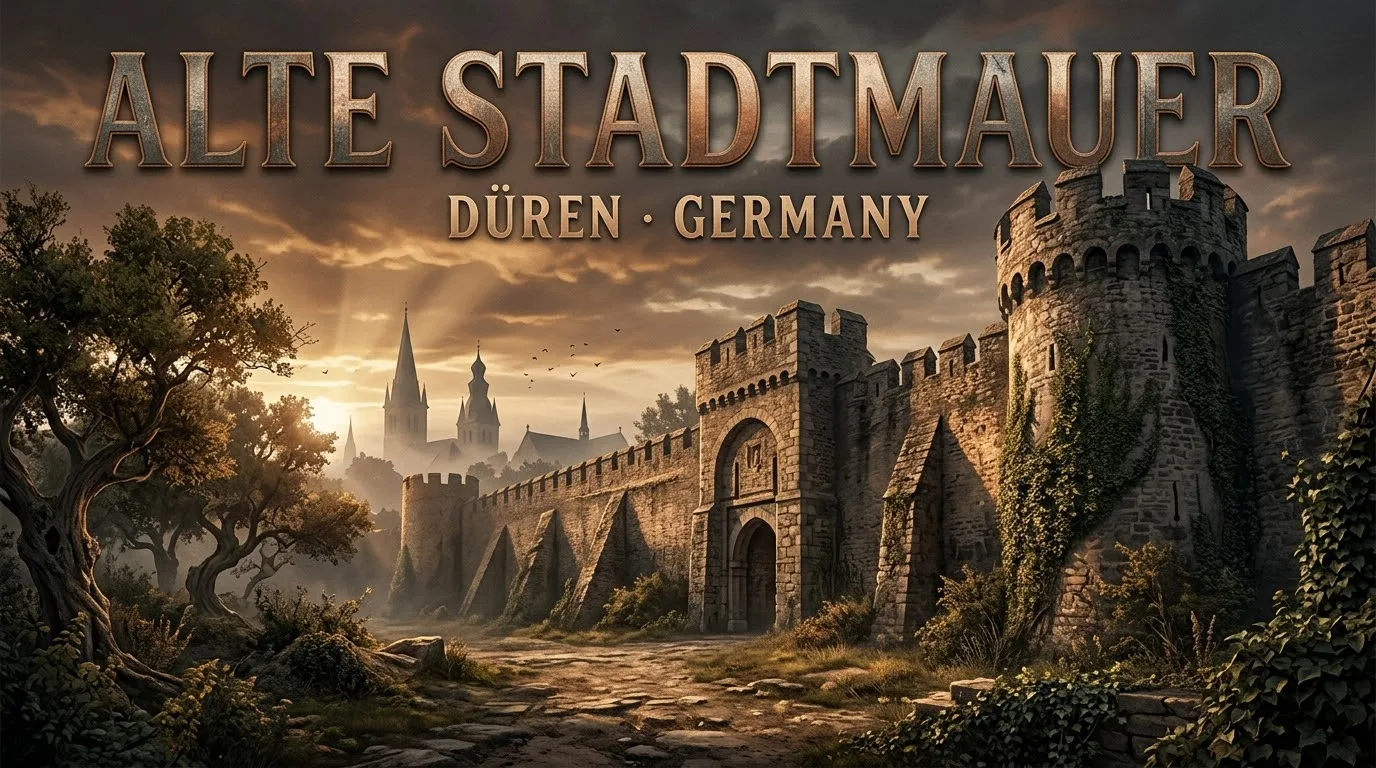
The Alte Stadtmauer is one of the oldest and, at the same time, most remarkable testimonies to Düren's history, since it is among the very few structures that survived the devastating air raid of November 16, 1944, largely unscathed. While almost the entire inner city of Düren was reduced to rubble within just 21 minutes that day, large sections of the medieval fortification survived and can still be seen today at several points around the city, for instance along Wallstraße, Schenkelstraße, Oberstraße, and in the area of Hohenzollernstraße and Waisenhausstraße. Construction of the city wall began around 1212, and for centuries it secured Düren with twelve towers and five gates facing all four points of the compass. Walking along the surviving wall sections and towers today offers a rare, direct impression of what the city must have looked like before its almost total destruction in the Second World War - an impression that hardly any other place in Düren can convey so immediately.
History of Alte Stadtmauer
The start of construction on Düren's city fortifications is dated to around 1212, although the exact date is not fully established in historical research; a historical inscription is said to have once recorded that the people of Düren began building strong walls in that year. As early as 1226, Düren was documented as a fortified settlement, referred to as "oppidum nostrum Duren," and in 1261 the first written mention of one of the city gates, the Holztor, appears in the records. The wall itself was initially built from sandstone blocks, and in the fourteenth century supporting arch constructions were added to improve the structure's stability. From 1493 onward, projecting round bastion towers made of brick were additionally built, strengthening the defense of the wall sections between the older towers. The entire complex was also surrounded by a double moat; excavations in 2011 uncovered a city ditch roughly five meters deep near the former Pletzerturm, confirming the scale of the original fortification.
Altogether, five major gates controlled access to the city: the Philippstor and Wirteltor to the north, the Kölntor to the east, the Obertor to the south, and the Holztor to the west. Among the towers that have survived in the historical record are the Spießenturm - also known as the "Grey Hat" - the Pletzergassenturm, the Dicker Turm built in 1493, and the Grönjansturm. While the air raid of November 16, 1944, destroyed almost the entire rest of the city, the fortification remained largely intact, since this massive, militarily insignificant structure lay outside the bombers' immediate target area. This fortunate circumstance makes the Alte Stadtmauer one of Düren's most valuable architectural relics today. Several towers and a total of six wall sections at the locations mentioned are under heritage protection, including a roughly 84-meter-long section, up to 3.5 meters high, between the Dicker Turm and the Grönjansturm, which counts among the best-preserved stretches of the entire fortification.
Highlights of Alte Stadtmauer
The outstanding highlight is undoubtedly the long, well-preserved wall section between the Dicker Turm and the Grönjansturm, which at roughly 84 meters long and up to 3.5 meters high gives an impressive sense of the scale of the medieval fortification. The Dicker Turm, built in 1493, impresses with its massive, round form and vividly shows how defensive technology evolved in the late Middle Ages from simple walls to sophisticated bastion systems. Equally worth seeing is the Spießenturm, popularly nicknamed the "Grey Hat" because of its characteristic shape, and one of the most distinctive towers of the complex. Along Wallstraße - whose very name refers directly to the former fortification - several wall sections can be seen within a short distance of one another, making for a coherent walk along the former boundary of the city. Further protected wall remains can also be found around Oberstraße, Schenkelstraße, and around Hohenzollernstraße and Waisenhausstraße, each showing its own architectural details, such as differing masonry techniques from various building phases between the thirteenth and fifteenth centuries. For history enthusiasts, it is especially compelling to consider that these wall remains are among the oldest surviving structures in the entire city, offering a direct connection to the medieval Düren that otherwise almost entirely vanished in the destruction of 1944.
Opening Hours, Tickets & How to Get to Alte Stadtmauer
Since the Alte Stadtmauer is a freely accessible structure in public space throughout the city, there are no fixed opening hours and no admission fee. The surviving wall sections and towers can be visited free of charge at any time, year-round, although a visit in daylight is recommended in order to properly appreciate the different masonry techniques and architectural details. Since the remains of the city wall are spread across several locations throughout the city, a longer walk connecting several stops, such as Wallstraße, Oberstraße, and Schenkelstraße, is recommended for a comprehensive impression. The easiest way to reach Düren is via Hauptbahnhof Düren, from which the city center, and therefore most of the wall sections, can be reached on foot within a few minutes. Within the city, numerous bus lines connect the various districts to the city center, so wall remains located a little further away are also easily reachable by public transport. Visitors arriving by car will find various parking options in the central parking garages and along the streets of the city center, from which the wall remains can be comfortably explored on foot. Combining a walk along the city wall with a visit to the central squares of the city center is particularly recommended, since the historic routes often overlap.
Attractions Near Alte Stadtmauer
Since the remains of the Alte Stadtmauer are spread across several locations throughout the city, practically all of Düren's central sights lie within reach of at least one wall section. From the area around Wallstraße, it is only a few minutes' walk to the historic Marktplatz with the Mariensäule, re-erected in 1957, and to Kaiserplatz with the town hall and the Flammenengel, a memorial commemorating the destruction of Düren in 1944. The Annakirche, together with the surrounding Annaplatz and Ahrweilerplatz, whose Gothic south portal survived the wartime destruction, is also within comfortable walking distance of several wall sections. Near Oberstraße, where further protected wall remains can be found, lies the Bismarckdenkmal in Theodor-Heuss-Park, one of the few other architectural reminders of the Düren that existed before 1944. Culture enthusiasts should also visit Hoeschplatz with the Leopold-Hoesch-Museum and the neighboring Papiermuseum. A walk along the city wall can thus be ideally combined with a comprehensive tour of Düren's entire historic city center, offering ever-changing perspectives on the city's eventful history along the way.
Where to stay in Düren, Germany
Compare current hotel prices and find the right place to stay.