Ahrweilerplatz
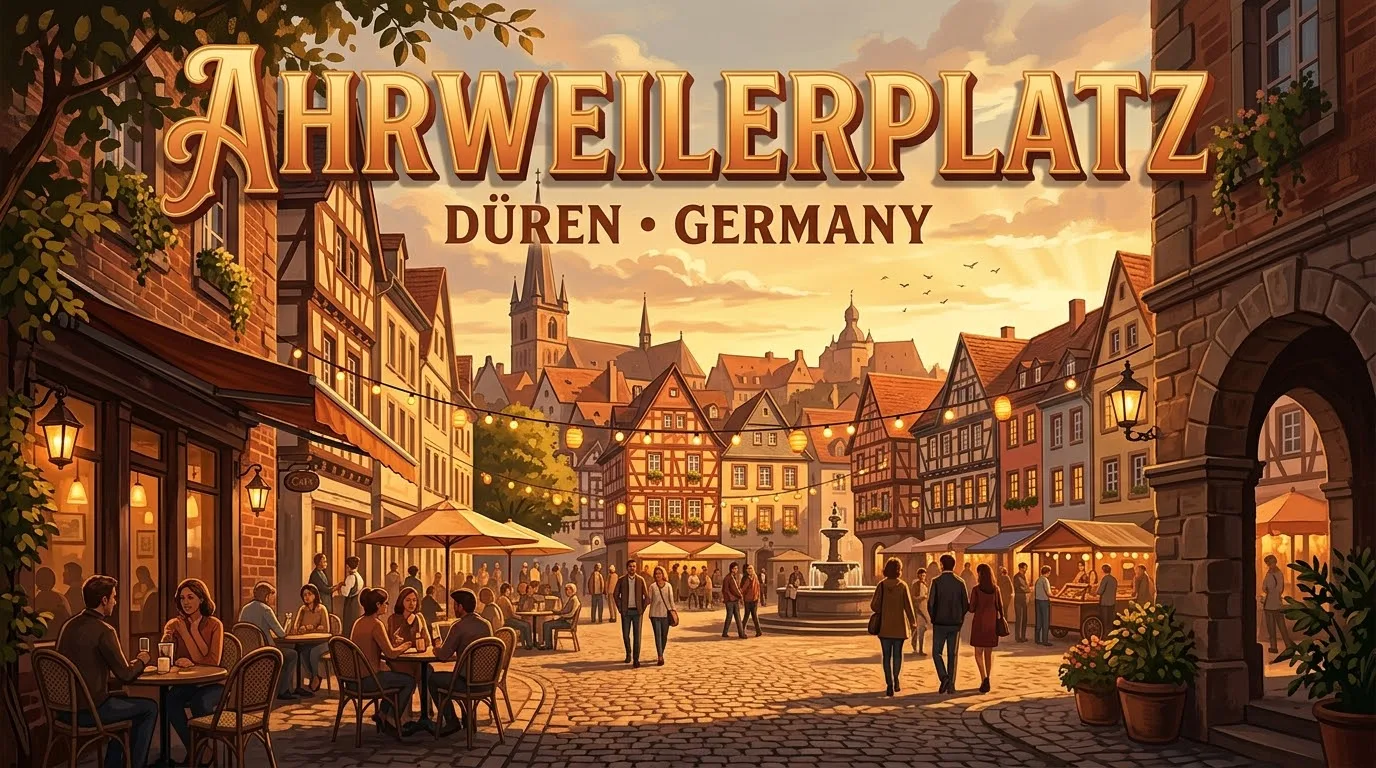
Ahrweilerplatz is one of the most historically rich and, at the same time, liveliest squares in Düren's city center. It lies between Oberstraße and Wilhelmstraße, to the north and west of the Annakirche, and together with the adjoining Annaplatz to the east forms a connected square ensemble around the central church of Düren's St. Lukas parish. While Annaplatz is shaped more by religious life, Ahrweilerplatz has developed into a popular dining destination, with numerous restaurants and cafés clustered around the historic square. Especially in summer, when the open-air concert series "Airweiler" takes over the square, Ahrweilerplatz becomes a lively meeting point for locals and visitors alike. Its long history, reaching back to the medieval city fortifications, also makes it a fascinating place for anyone interested in Düren's urban past.
Unlike many other squares in the city that lost their historic fabric entirely in the air raid of 1944, Ahrweilerplatz still allows its centuries-long history of use to be traced today through several archaeological and onomastic clues, making the square especially valuable for urban historians.
History of Ahrweilerplatz
Ahrweilerplatz originally lay within Düren's medieval city fortifications, and its western section long carried the name "Hühnermarkt," or chicken market, reflecting its earlier use as a trading place for poultry. Even earlier, the square was known as "Deutscher Friedhof," named after a German school located there, and indeed served for centuries as a burial ground. A characteristic feature of this use was the so-called "Beenes," a structure where bones uncovered during the digging of new graves were collected - a building typical of medieval and early modern cemeteries that illustrates the area's long use as a burial site. Around 1890, Ahrweilerplatz was fundamentally redesigned, during which extensive archaeological finds from the former burial ground came to light, providing important insights into the area's history of use.
The square received its present name in 1881, when it was renamed in honor of Alexander Theodor Ahrweiler, who lived from 1786 to 1868 and was especially recognized as a deserving benefactor of the Stiftisches Gymnasium in Düren. This renaming was part of a wave of similar square and street namings in the late nineteenth century, through which the city publicly honored deserving citizens and benefactors. Over the course of the twentieth century, Ahrweilerplatz increasingly evolved from a purely commercial and burial site into a central urban meeting point, a development that continued after the Second World War with the reconstruction of Düren's city center and persists to this day.
The renaming itself is also telling of the city's civic self-image in the nineteenth century: rather than honoring a ruler or a historical event, the city chose to recognize Alexander Theodor Ahrweiler, a local benefactor whose commitment to the education of young Düren citizens was considered exemplary - a sign of how closely urban development and civic engagement were historically intertwined in Düren.
Highlights of Ahrweilerplatz
The special highlight of Ahrweilerplatz is its lively dining scene: numerous restaurants and cafés have established themselves around the historic square, inviting visitors to linger outdoors on fine days. In summer, the square is transformed by the open-air concert series "Airweiler" into a stage for live music under the open sky, regularly drawing many visitors from Düren and the surrounding region. Those interested in history should also take time to explore the connection between Ahrweilerplatz and the neighboring Annaplatz, since both squares together enclose the Annakirche, forming a connected urban ensemble that reflects the religious and commercial development of Düren's city center over the centuries. The square's history as a former burial ground and later poultry market gives it a depth that would hardly be suspected from the sight of today's restaurant-lined square alone. It is precisely this contrast between hidden history and lively present that makes Ahrweilerplatz one of the most interesting squares in all of central Düren.
Visitors spending several days in Düren would do well to experience Ahrweilerplatz both during a daytime walk and during an evening meal, since the square's atmosphere changes considerably depending on the time of day.
Its proximity to Marktplatz, Kaiserplatz, and Hoeschplatz makes Ahrweilerplatz a natural fixture on any walking tour of Düren.
Opening Hours, Tickets & How to Get to Ahrweilerplatz
Ahrweilerplatz is a public, freely accessible square and can therefore be visited free of charge at any time; there are no fixed opening hours for the square itself. The numerous restaurants and cafés on the square have their own individual opening hours, generally following standard dining establishment hours and varying from business to business. The "Airweiler" concert series takes place during the summer months, with exact dates available through the city's official events calendar. Ahrweilerplatz lies centrally in Düren's city center, just a few minutes' walk from the Marktplatz and Kaiserplatz, making it very easy to reach on foot. Travelers arriving by train reach Hauptbahnhof Düren and can reach Ahrweilerplatz from there with a short walk through the city center. Numerous regional bus lines stop near Kaiserplatz, from which Ahrweilerplatz is also easily reached on foot. Drivers will find ample parking in the city center's parking garages, though it should be noted that Ahrweilerplatz itself is primarily designed as a pedestrian area.
Attractions Near Ahrweilerplatz
Directly adjoining is Annaplatz, which together with Ahrweilerplatz encircles the Annakirche, whose surviving Gothic south portal and post-war church, consecrated in 1956 by architect Rudolf Schwarz, are well worth a visit. Just a few minutes' walk away lies the historic Marktplatz with the Mariensäule, re-erected in 1957, as well as Kaiserplatz with the town hall and the Flammenengel, a memorial commemorating the destruction of Düren in 1944. Culture enthusiasts should also visit Hoeschplatz with the Leopold-Hoesch-Museum and the adjoining Papiermuseum. Those interested in the period before Düren's destruction will also find further impressive testimonies to the city's history at the Bismarckdenkmal in Theodor-Heuss-Park and at the surviving remains of the medieval city wall, for instance along Wallstraße. All of these destinations lie within comfortable walking distance of Ahrweilerplatz, making it easy to combine an extended tour of Düren's historic city center with a dining break on the square.
Where to stay in Düren, Germany
Compare current hotel prices and find the right place to stay.