Troisdorf Fußgängerzone
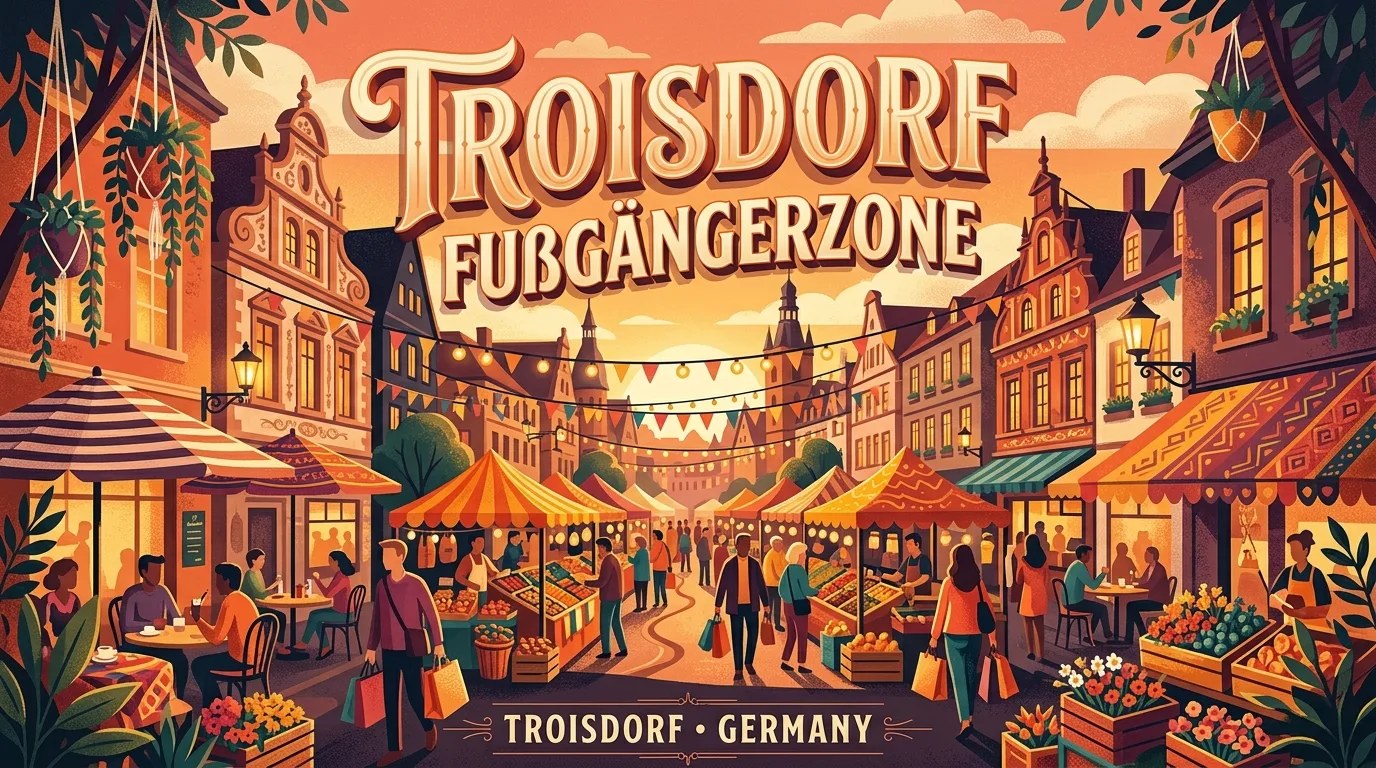
The Troisdorf Fußgängerzone forms the lively heart of Troisdorf’s city centre and ranks among the longest and most attractive pedestrian zones in the region. Stretching for about 1.5 kilometres along Kölner Straße, this car-free promenade combines shopping, culture and relaxation in a pleasant atmosphere. Visitors stroll past modern shops, cosy street cafés, artistic installations and inviting squares with water features. The zone was created in the 1980s and comprehensively modernised between 2014 and 2018, resulting in elegant paving, barrier-free surfaces and generous seating areas. Families particularly appreciate the child-friendly fountains and the absence of traffic noise. For day-trippers from Cologne, Bonn or the Rhein-Sieg district, the Troisdorf Fußgängerzone is an ideal destination for a relaxed urban walk that satisfies both shopping interests and the desire for city atmosphere.
History of Troisdorf Fußgängerzone
The history of the Troisdorf Fußgängerzone is closely linked to the urban development of the town. Until the 1970s the busy federal road B8 ran straight through the centre. Kölner Straße served as a major traffic artery and shaped the image of a classic street village. The construction of the Theodor-Heuss-Ring bypass created space for redesign. Planning for a pedestrian zone began in the late 1970s. In 1979 the lower part of Hippolytusstraße was converted first. The main development followed in the early 1980s. An architectural competition was held and won by the Tchorz brothers from Cologne. They designed the generous pedestrian axis that still forms the backbone of the city centre today.
A special highlight was the design of the city gates. In 1982 the authorities launched an art competition. Artists Joachim Bandau from Aachen and Victor Bonato from Niederkassel won with their designs of steel and glass structures featuring flowing water. These gates have marked the beginning and end of the zone ever since. The large gate at Ursulaplatz and the smaller one at the upper end of Kölner Straße open deliberately towards the centre, symbolising openness rather than enclosure. The first section, including Kölner Platz, was officially inaugurated in 1983. By 1988 the pedestrian zone was essentially complete and had given Troisdorf a true urban core for the first time.
Between 2014 and 2018 a major renewal took place under the Zukunfts-Initiative Troisdorf Innenstadt (ZiTi). In five construction phases the paving, street furniture and infrastructure were modernised. The first section at Bürgerhaus and Fischerplatz was completed in 2015, further parts of Kölner Straße followed until 2018. The project cost around 6.5 million euros, 70 percent of which was covered by federal and state funding from North Rhine-Westphalia. Nine information steles have since documented the transformation: historical photographs by city photographer Heinz Müller stand opposite current images and impressively show how a busy road became a calm promenade.
Highlights of Troisdorf Fußgängerzone
The Troisdorf Fußgängerzone offers a wide range of sights and experiences. Particularly striking are the two city gates by Joachim Bandau and Victor Bonato. The staggered glass panes with flowing water invite children to splash on warm days and create architectural accents. At Kölner Platz the water steps, also designed by Victor Bonato and installed in 1988, form a popular meeting point. Five steps and four spheres invite climbing and playing, making the square especially family-friendly.
Another artwork is the “Dicker Mann” (Fat Man) by Karl-Henning Seemann at Fischerplatz. First shown publicly in 1987, the sculpture of a naked worker sparked discussion at the time and has since become part of the cityscape. Nine city steles along the zone tell the story of individual locations. They show how intersections and buildings once looked and how they have changed. Galerie Troisdorf at Wilhelm-Hamacher-Platz is a central attraction. On two levels visitors find shops such as C&A, Saturn and Müller as well as cafés and restaurants. The modern shopping centre replaced the former community centre and offers shelter and variety in any weather.
Numerous fountains and water features characterise the area. They provide cooling in summer and create a pleasant atmosphere. The light-grey paving is barrier-free and offers ample space for outdoor seating. Along Kölner Straße boutiques, shoe shops, drugstores, speciality stores and cafés line the street. Whether looking for fashion, electronics or regional products, the selection is diverse. At weekends and during the pre-Christmas period the zone is further enlivened by markets and events. The combination of shopping, art and public space makes the Troisdorf Fußgängerzone a place where people enjoy spending time.
Opening Hours, Tickets & How to Get to Troisdorf Fußgängerzone
The Troisdorf Fußgängerzone is a public space accessible around the clock and free of charge. There is no entrance fee and no closing times for the zone itself. Shops are generally open Monday to Friday from around 9:30 or 10:00 until 18:00 or 19:00, and on Saturdays usually until 16:00 or 18:00. Individual stores, especially in Galerie Troisdorf, may have slightly different hours. Cafés and restaurants often invite guests to stay longer. Cycling has been unrestricted throughout the entire zone since early 2024; e-scooters, however, are not permitted.
Getting there is straightforward. By train, Troisdorf station is only a few minutes’ walk from the pedestrian zone. Several bus lines stop directly in the centre. By car, multiple multi-storey car parks are available: under Galerie Troisdorf, at the station, behind the Stadthalle and at Kaufland. Parking is considered relatively easy. The central address is Kölner Straße, 53840 Troisdorf. Cyclists find good parking facilities and benefit from the direct access. Barrier-free entrances ensure that people with limited mobility can also enjoy the promenade without difficulty.
Attractions Near Troisdorf Fußgängerzone
Several worthwhile destinations lie within easy reach of the Troisdorf Fußgängerzone. Only a few minutes’ walk away is Burg Wissem, home to Europe’s unique Picture Book Museum and the Museum of Town and Industrial History. The adjoining park with a deer enclosure invites a leisurely stroll. The Stadthalle Troisdorf and the Kunsthaus host cultural events. The Happy Franky experience centre at the former Forum site adds to the leisure options. Nature lovers can reach the Wahner Heide and the Siegaue in a short time. A visit to the pedestrian zone can therefore easily be combined with further discoveries in Troisdorf.
Where to stay in Troisdorf, Germany
Compare current hotel prices and find the right place to stay.