St. Georg (Altenrath)
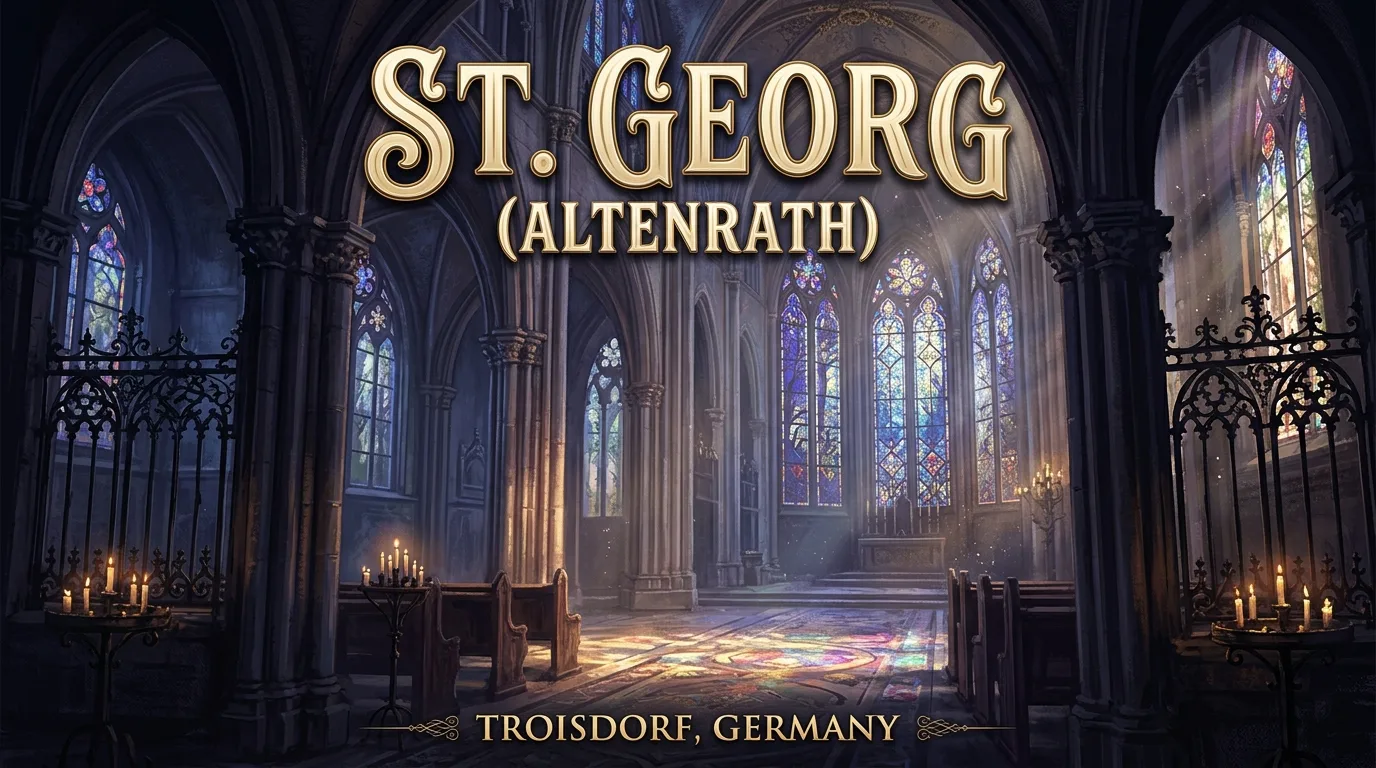
The St. Georg (Altenrath) in Troisdorf-Altenrath is one of the oldest churches in the region and a Romanesque pillar basilica from the mid-12th century. The church is listed as a historic monument and shapes the townscape of the district on the edge of the Wahner Heide. It stands elevated in the middle of its churchyard and forms an attractive ensemble together with the neighbouring 19th-century rectory and the Wahner Heide information centre. The flat-roofed, three-aisled basilica with a projecting west tower, transept and long choir tells of a long ecclesiastical and village history. From 1572 to 1613 it served as a simultaneous church for Catholics and Protestants. After forced evacuation in 1938 and later restorations it now presents itself in well-kept condition. The church invites visitors to services and quiet viewing and is an important testimony to Romanesque architecture in Troisdorf.
History of St. Georg (Altenrath)
The history of St. Georg (Altenrath) goes back to the mid-12th century, when the Romanesque pillar basilica was built. In 1311 the church was the core of the parish of Altenrath when it was sold to the County of Berg. In the 15th and 16th centuries extensions took place, including the lengthening of the choir and additions such as the Sülz chapel and the sacristy. During the Reformation the church served as a simultaneous church from 1572 to 1613. In the Thirty Years’ War the sacristy was plundered. In 1938 Altenrath was forcibly evacuated because of the expansion of the Wahn military training area; the last service took place on 26 June 1938. The church could be preserved from destruction. After the war the interior was made reasonably presentable again in the 1950s. A fundamental restoration took place between 1959 and 1967. From 2009 to 2011 further conservation measures were carried out, preserving the rubble-stone masonry, re-roofing the slate roofs and restoring metal and glass elements. The church belongs to the Parish Community of Troisdorf.
Highlights of St. Georg (Altenrath)
The highlights of St. Georg (Altenrath) lie in the Romanesque fabric and the historic furnishings. The flat-roofed, three-aisled pillar basilica with projecting west tower, transept and long choir with 3/8 termination is a rare example of Romanesque architecture in the region. The baptismal font of roughly hewn sandstone dates from the construction period. Notable are the Gothic monstrance and a brass holy-water stoup donated in 1528 on the occasion of the marriage of the Wesseling bailiff Wilhelm Stael von Holstein. The organ of 1965 was built by Romanus Seifert & Sohn. The present bells are loaned bells from the Hamburg bell depot. The churchyard contains older gravestones. The church stands elevated in a valley hollow and forms an attractive ensemble with the rectory and the Wahner Heide information centre. After the 2009–2011 conservation the plastered rubble-stone masonry presents itself in a white finish. A visit conveys an impression of the long history of the place and of Romanesque sacred architecture.
Opening Hours, Tickets & How to Get to St. Georg (Altenrath)
The St. Georg (Altenrath) is generally open during service times and during the day for visitors. Services take place on Sundays at 8:15 among other times. Exact opening times depend on the service schedule of the parish community and can be obtained via the parish website or the pastoral office. Admission is free. The address is Flughafenstraße 16, 53842 Troisdorf-Altenrath. By car reach Altenrath via the A 3 or the L 84 and follow the signs. Parking is available in the surroundings. By public transport take bus lines to Altenrath. The Wahner Heide information centre lies immediately adjacent. Current service times and events can be found on the website of the Parish Community of Troisdorf. The church is accessible and invites a quiet visit and exploration of the churchyard.
Attractions Near St. Georg (Altenrath)
Immediately beside St. Georg (Altenrath) are the Wahner Heide information centre and the churchyard with older gravestones. The Wahner Heide itself offers extensive walking and cycling paths in the nature reserve. The Hohe Schanze with Celtic burial mounds is nearby. The centre of Troisdorf with Burg Wissem, the Picture Book Museum and MUSIT is reachable by bus or car. Half-timbered houses and wayside crosses shape the village. Bonn and Cologne lie within easy reach. In this way a visit to the Romanesque church can easily be combined with an exploration of the Wahner Heide and an outing into the surrounding nature and culture.
Where to stay in Troisdorf, Germany
Compare current hotel prices and find the right place to stay.