Sieglarer See
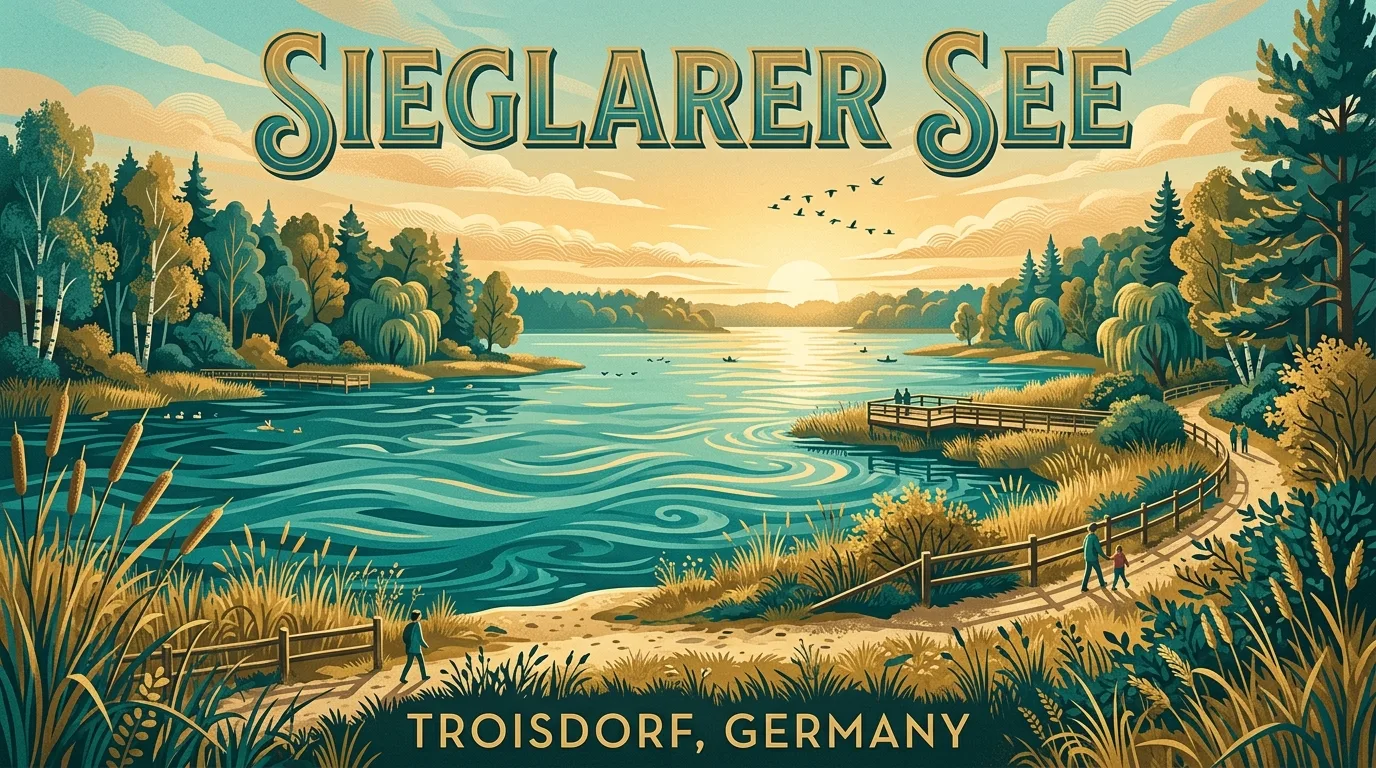
The Sieglarer See lies south of the Sieglar district in Troisdorf and ranks among the most attractive still waters in the region. Created as a gravel-pit lake, it has developed over the decades into a valuable habitat within the Siegaue and Siegmündung nature conservation and FFH area. Measuring roughly 670 metres in length and 260 metres in width, with a water surface of about 16 to 17 hectares, it offers quiet shoreline paths ideal for relaxed walking and nature observation. Especially appealing are the two islands in the middle of the lake, home to breeding colonies of grey herons and cormorants. The lake is not a bathing site – swimming and bathing are strictly prohibited – but a place of tranquillity and biodiversity. Those seeking slow-down find idyllic paths lined by small woods and shrubs that provide nesting sites for numerous bird species in spring. The proximity to the river Sieg and the integration into the floodplain landscape make the Sieglarer See a typical example of how an artificial body of water can become a natural retreat. For walkers, cyclists and birdwatchers it is a rewarding destination best discovered on quiet days with binoculars and sturdy footwear.
History of Sieglarer See
The Sieglarer See owes its existence to the construction of the federal motorway A 59, also known as the airport motorway. In the early 1970s large quantities of sand and gravel were required for the roadworks. Excavation south of Sieglar created a substantial pit that filled with groundwater and surface water, forming the present lake. Its morphology differs from many typical gravel-pit lakes: besides steep banks there are shallow-water zones and two islands in the southern half. Soon after its creation the lake developed into an important substitute habitat for lost backwaters of the Sieg. A small channel at the southernmost point connects the lake to the river during high water levels. This allows river fish to use the lake as a winter refuge and enriches the fish stock. In the following decades the surroundings were planted and developed into a structured floodplain area with remnants of alluvial forest, meadows and woodland. In 1986 the Siegaue was designated a nature reserve; the lake has since lain within NSG Siegaue (SU-009) and the FFH area Siegaue und Siegmündung. Today the Sieglarer See is recognised as a nationally significant breeding, resting, feeding, passage and wintering biotope for many bird species. The formerly artificial site now appears almost natural, surrounded by small woods and shrubs. The aggressive droppings of the breeding colonies on the islands have caused many trees to die – a natural process that underlines the dynamics of the habitat. The lake thus serves as a clear example of renaturation and protection of floodplain landscapes in the Rhein-Sieg district.
Highlights of Sieglarer See
Among the outstanding features of the Sieglarer See are the two islands in the centre of the lake. Stable breeding colonies of grey herons and cormorants have established themselves here. The birds nest undisturbed, and the aggressive droppings cause trees to die – a visible sign of intensive use. Greylag geese also nest in the protected shoreline areas. The surrounding small woods and shrubs provide spring habitat for marsh and willow tits, reed warblers and reed buntings. The lake is encircled by idyllic paths that allow a complete circuit under normal water levels. Some flatter shore zones invite visitors to linger; picnic spots exist, though one should watch for duck droppings. The proximity to the Sieg permits fish exchange during floods and strengthens ecological connectivity. The lake is embedded in the varied river floodplain of the Siegaue with backwaters, alluvial forest remnants and species-rich grassland on the flood embankment. This diversity makes it a first-class observation site for waterbirds, waders and birds of prey. In winter and spring particularly many species appear, including great crested grebes, various ducks and geese. The paths are mostly unpaved and level, ideal for relaxed walks of about three kilometres around the lake. Longer routes follow the Sieg embankment and through the floodplains and can cover seven to ten kilometres. The quiet atmosphere, away from heavy traffic noise (apart from the nearby motorway at the start of some tours), and the chance to watch birds with binoculars rank among the greatest attractions. In summer nettles and brambles may border the paths, so long clothing is advisable. The Sieglarer See is not a place for noisy leisure activities but for careful nature experience and deceleration.
Opening Hours, Tickets & How to Get to Sieglarer See
The Sieglarer See lies in a nature reserve and is accessible year-round at any time. There are no fixed opening hours and no entrance fee. Access is free of charge. Compliance with nature-protection rules is essential: paths must not be left, the shoreline must not be entered, bathing, swimming, diving and navigating the water are forbidden. Plants and fungi may not be taken, camping and littering are prohibited. Animals must not be disturbed. Only members of the Sieglar angling club are allowed to fish; day tickets are not issued. Arrival by car: via the A 59 exit Troisdorf towards Sieglar, then to Meindorfer Straße or Hüttenstraße. Free parking is available, including the hiking car park Sieglarer See at Hüttenstraße 15a and further spaces near Meindorfer Straße, only a few metres from the lake and embankment. By public transport: from Troisdorf station by bus towards Sieglar (for example line 506 to Kerpstraße or similar connections), then continue on foot. Cyclists reach the lake via existing cycle paths along the Sieg and through the floodplains. During high water on the Sieg parts of the paths may be flooded; in such cases the current situation should be checked and alternative routes chosen if necessary. Sturdy shoes and weatherproof clothing are recommended, as is a pair of binoculars for birdwatching. Arrival is straightforward and the car parks are generously sized.
Attractions Near Sieglarer See
In the immediate vicinity of the Sieglarer See further attractive destinations await. Only about three kilometres away lies the Rotter See, Troisdorf’s most popular local recreation area with bathing facilities and extensive green spaces. The Eschmarer See is a similar distance and also forms part of the nature reserve. Along the Sieg, walking and cycling paths lead to the confluence with the Rhine at Mondorf; the Sieg embankment offers wide views over the floodplain landscape. The Siegaue itself, with its meadows, backwaters and remnants of alluvial forest, is an extensive protected area of high biodiversity. In Bergheim there are refreshment possibilities and historical references to the former Sieg ferry. The Sieglar district itself offers further discoveries with its historic church and mill stream. Longer tours of seven to more than twenty kilometres connect the lake, river and floodplains. Proximity to Bonn and Cologne also makes the area attractive for day visitors from the region. Anyone wishing to explore the nature of the lower Sieg will find a compact and varied destination here.
Where to stay in Troisdorf, Germany
Compare current hotel prices and find the right place to stay.