Rotter See Badesee
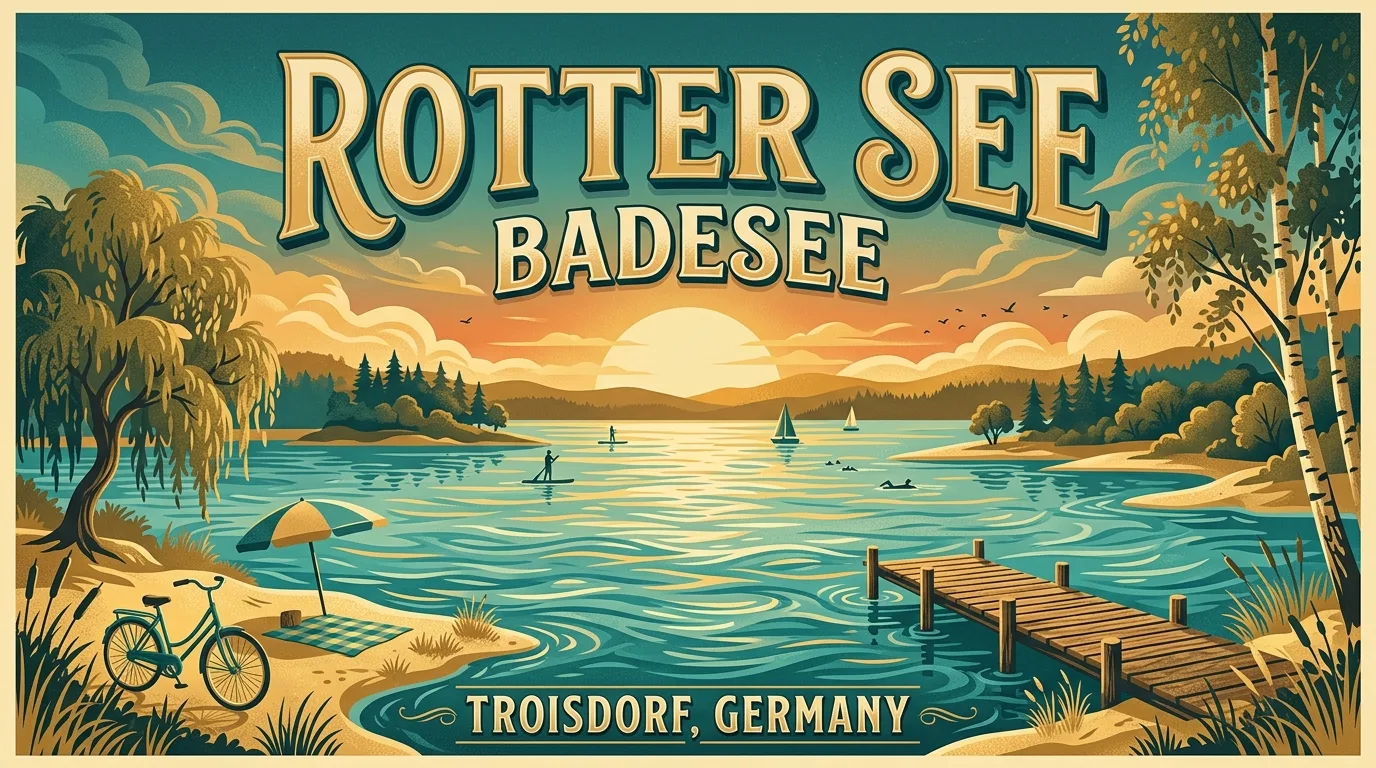
The Rotter See Badesee in Troisdorf is one of the most popular recreational lakes in the Rhein-Sieg district and the southeastern districts of Cologne. This former gravel pit covers around 17 hectares of water and features spacious grassy sunbathing areas, a sandy beach and an officially designated swimming zone on the northwest shore. On hot summer days the lake attracts hundreds of visitors seeking relaxation, a refreshing swim and outdoor activities. Regular water-quality checks by the Rhein-Sieg health authority and DLRG supervision on weekends and public holidays during the bathing season make a visit particularly pleasant. Anyone looking for an uncomplicated free swimming day with wide green spaces and a circular path of roughly three to four kilometres will find the Rotter See Badesee an ideal destination. Its location in the Rotter See district near Kriegsdorf combines urban convenience with near-natural recreation and turns the lake into a genuine regional highlight.
History of Rotter See Badesee
The Rotter See Badesee originated as a gravel pit whose extraction permanently shaped the landscape. Gravel and sand were already being quarried here around 1860. After the Second World War the operation intensified from 1958 onward, when first 2.4 hectares and later another 11.2 hectares were excavated. The gravel works dominated the area for decades until extraction ceased in 1978. The city of Troisdorf had secured ownership rights early on with the clear intention of turning the former open-cast site into a public recreational area.
Both the lake and the surrounding district take their name from the historic Haus Rott, a former fortified residence. First documented in 1289, Haus Rott was considered the most important moated castle between Cologne and Siegburg in the 12th century. In 1416 the complex was destroyed by the Archbishop of Cologne during the Stiftsfehde. It was rebuilt in the 17th century; the manor house is now a listed building and was restored in the 1980s. Remains of the artificial motte and the inner moat can still be seen south of the present residential development.
Until the municipal reorganisation of 1969 the surrounding land belonged to the municipality of Sieglar and was used for agriculture. From 1970 onward the present Rotter See district developed in parallel with the renaturation of the lake; in 1999 it was officially separated from Sieglar. Since 2001 a municipal by-law has regulated the use of the recreational area and emphasises its character as a public facility open to everyone. Archaeological finds in the vicinity reach back to the Rössen culture around 3800 BC and testify to a long history of settlement in the region.
Highlights of Rotter See Badesee
The central attraction of the Rotter See Badesee is the official bathing area on the northwest shore. Visitors find a sandy beach and extensive lawns ideal for sunbathing and relaxation. The designated swimming zone reaches depths of up to about five metres, while the lake as a whole is between nine and eleven metres deep. Water quality is monitored throughout the bathing season by the local health authority and is generally rated good to excellent.
A circular walking and cycling path of roughly three to four kilometres encircles the lake and offers pleasant views of the water and the surrounding vegetation. The southern peninsula is reserved for the Sieglar angling club, while the island in the lake is left to flora and fauna and may not be entered. Divers can obtain day or annual tickets from the Troisdorf Fun Divers association; the official entry point lies in the extension of Pfälzer Weg.
About 500 metres from the lake, near Haus Rott, further leisure facilities await: a water playground, a skate park with half-pipe, basketball courts and large meadows where barbecuing is permitted. Opposite the bathing bay, strawberries can be picked in summer on the fields of the Engelshof farm. Clear separation of the swimming area from club grounds and consistent enforcement of rules such as the glass ban and the dog prohibition on the beach help keep the Rotter See Badesee relatively orderly even on busy days. Stand-up paddleboards are allowed outside the marked bathing zones, while air mattresses and inflatable islands are prohibited in the water.
Opening Hours, Tickets & How to Get to Rotter See Badesee
The Rotter See Badesee is freely accessible all year round and has no fixed opening hours. Admission is free. During the bathing season from May to September the DLRG supervises the swimming area on weekends and public holidays from 10 a.m. to 6 p.m. The water-rescue teams work on a voluntary basis and provide additional safety.
Parking is available on Uckendorfer Straße. At weekends and on busy days the car park of the vocational college at Kerschensteinstraße 4 may also be used; from there it is only a short walk to the beach. The city of Troisdorf asks visitors to keep emergency access routes clear, as illegally parked vehicles are towed without exception. By car the lake is reached via the A59, exit Spich, then towards Sieglar and the exit for Rotter See at the roundabout.
Public transport options include the S12 or S19 to Spich and onward by bus 503 or 508 to Haus Rott, or bus line 507 to Bremer Straße. Cyclists find the lake well connected to the regional path network. Anyone wishing to dive needs a ticket from Troisdorf Fun Divers; fishing is restricted to members of the Sieglar angling club. Current water-quality data can be consulted on the official North Rhine-Westphalia bathing-water website.
Attractions Near Rotter See Badesee
Only a few hundred metres from the Rotter See Badesee lies Haus Rott with the historic remains of the former moated castle, the tennis club and the adjoining green spaces. The water playground and skate facility offer variety especially for families and young people. In Kriegsdorf the public West Golf course features a driving range, an academy course and a restaurant.
A little farther afield the Wahner Heide, one of the most species-rich nature reserves in North Rhine-Westphalia, and the Siegaue invite longer walks and cycle tours. Burg Wissem in Troisdorf with its picture-book museum and the nearby ice rink complete the leisure options. Regional farms such as the Engelshof and farm shops in the vicinity allow the purchase of fresh produce directly from the producer. A swimming day at the lake can therefore easily be combined with culture, sport and nature experiences.
Where to stay in Troisdorf, Germany
Compare current hotel prices and find the right place to stay.