Rotes Haus
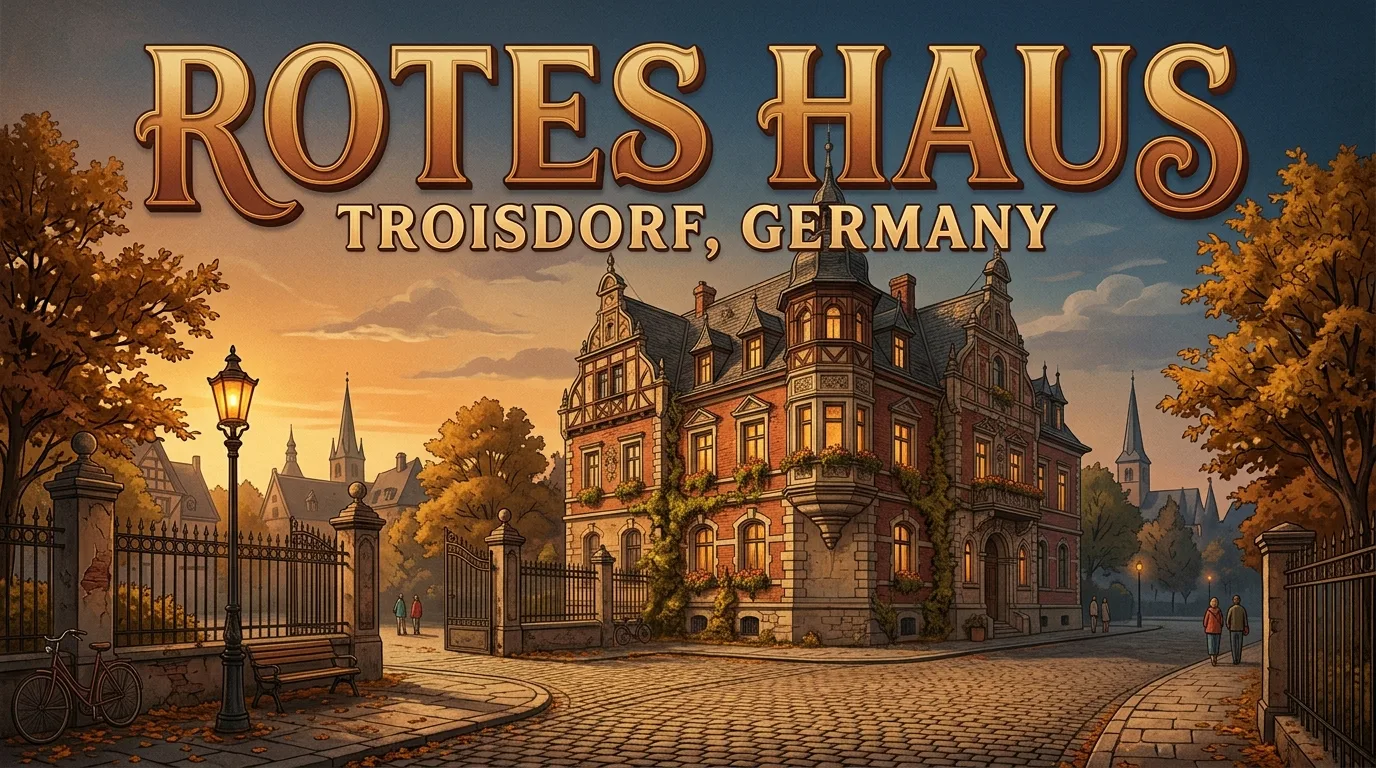
The Rotes Haus in Troisdorf is not a publicly accessible museum or classic tourist destination with fixed opening hours and admission. In Troisdorf there are several historically significant buildings and settlements with red colouring, including the listed Rote Kolonie, a former workers’ settlement from the early 20th century. The Rotes Haus as an independent, publicly visitable attraction with exhibition or visitor centre is not established as such in Troisdorf. Visitors looking for historic buildings will find numerous listed monuments and industrial heritage sites in the city. The Rote Kolonie with its characteristic red roof tiles and other historic manor houses such as Haus Rott or Haus Broich offer insights into the settlement and industrial history. A walk through the protected areas gives an impression of Troisdorf’s architectural development. For concrete visits the well-known museums and parks of the city are recommended.
History of Rotes Haus
Under the name Rotes Haus no independent historic building with continuous public use as a museum is documented in Troisdorf. The designation appears in the region mainly in connection with the Rote Kolonie, a company housing estate built in 1912/1913 for workers and employees of the Faconeisen rolling mill Louis Mannstaedt. The settlement received its name because of the continuous red roof tiles. It was planned according to the concept of English garden cities by the Dortmund architects Dietrich and Karl Schulze and comprised 64 houses with 176 apartments. The houses already had electricity, hot water and flush toilets – progressive for the time. The Rote Kolonie is protected as a monument area and documents the industrial development of Troisdorf. Other “red” buildings in the wider region, such as the well-known Rotes Haus in Monschau, do not belong to Troisdorf. Local history is closely linked to industrialisation and workers’ settlements.
Highlights of Rotes Haus
As the Rotes Haus in Troisdorf is not a publicly accessible exhibition building, the noteworthy aspects lie in the surrounding historic fabric. The Rote Kolonie shows uniform semi-detached houses with dormers, cross-bar windows and the eponymous red roofs. Bismarckplatz and Zeppelinplatz form the centre of the settlement. The architecture reflects the garden-city idea and has largely survived despite wartime destruction. Nearby there are further industrial heritage sites and green spaces. A walk through the settlement provides insights into the living conditions of early industrial workers. The combination of historic building stock and living residential quarter makes the area interesting for those interested in architecture and history. A visit to the Rote Kolonie typically takes 30 to 60 minutes and combines well with further exploration of Troisdorf-West.
Opening Hours, Tickets & How to Get to Rotes Haus
The Rotes Haus does not have public opening hours or admission arrangements in Troisdorf, as it is not a museum or visitor centre. The Rote Kolonie and comparable historic areas are freely accessible as a residential settlement and can be viewed from the outside. No admission is charged. The Rote Kolonie is located in Troisdorf-West around Bismarckplatz and Zeppelinplatz. By car the area is reached via the A 59 and local roads. By public transport travel to Troisdorf and use bus connections into the district. Parking is available in the surroundings. For current information on guided tours or monument days the Tourist Information at Burg Wissem is recommended. A visit to the historic settlement combines ideally with a walk or a visit to the museums at Burg Wissem.
Attractions Near Rotes Haus
Near the historic areas around the Rotes Haus or the Rote Kolonie lie further attractions of Troisdorf. Burg Wissem with the Picture Book Museum, MUSIT and the Portal Wahner Heide is quickly reachable by bus or car. The Wahner Heide offers extensive natural areas. Rotter See and further green spaces invite walks. The town centre with pedestrian zone and the Kunsthaus Troisdorf expand the cultural offer. Bonn and Cologne are well connected. In this way the exploration of the historic settlement structures can easily be extended into a half-day or full-day outing in Troisdorf.
Where to stay in Troisdorf, Germany
Compare current hotel prices and find the right place to stay.