Ortskern Altenrath
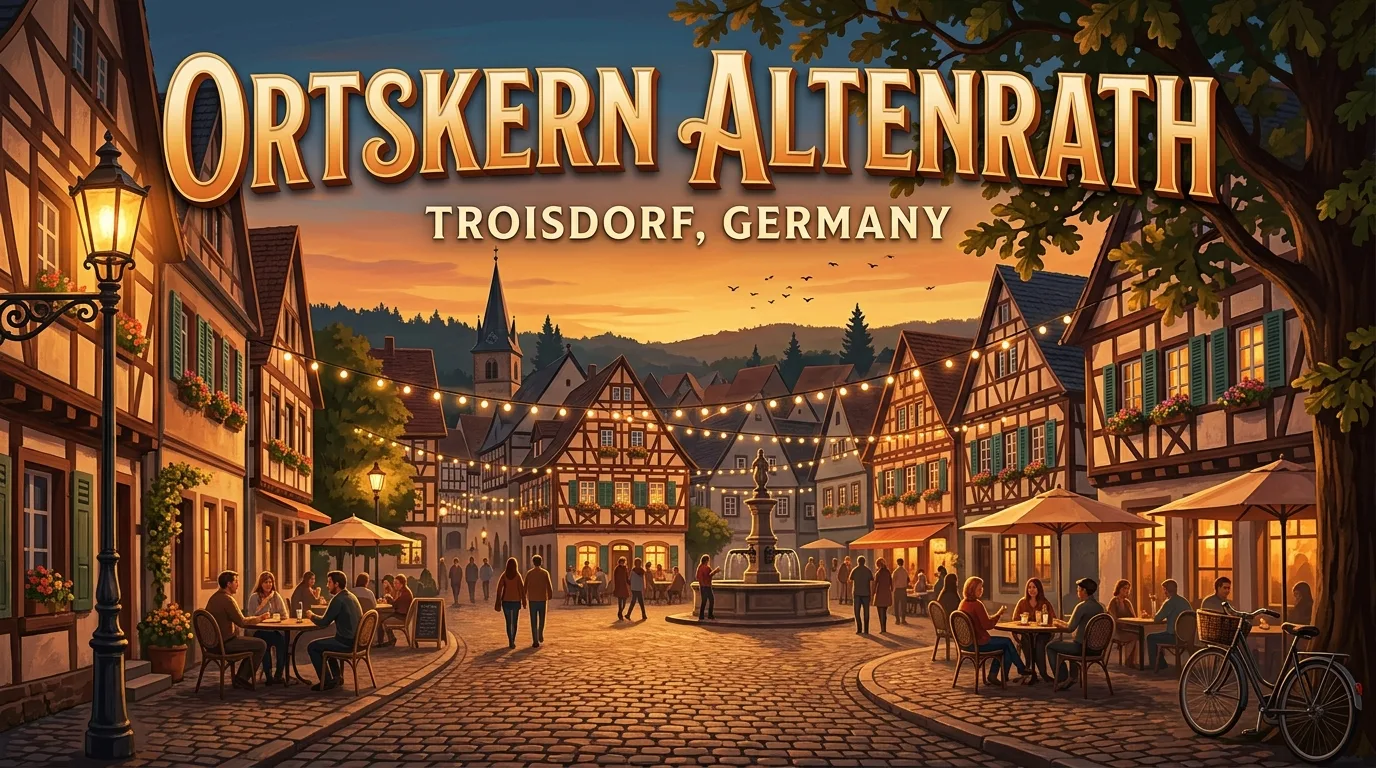
The Ortskern Altenrath forms the historic and lively heart of the Altenrath district of Troisdorf, a quiet residential area with around 2,300 inhabitants located on the northern edge of the city and directly adjacent to the Wahner Heide nature reserve. Nestled in attractive heathland and only a few kilometres from Cologne/Bonn Airport, the village centre combines rural charm with an extraordinary history. Here, Romanesque architecture, half-timbered houses and modern residential areas meet, while the surrounding nature invites hiking and exploration. Particularly noteworthy is the Romanesque parish church of St. Georg, which has marked the centre of the settlement since the 12th century. Anyone seeking tranquillity, history and unspoilt landscape will find an authentic destination in Ortskern Altenrath, away from major tourist flows. The proximity to the Wahner Heide also makes the place an ideal starting point for extended walks and cycling tours through one of the most species-rich nature reserves in North Rhine-Westphalia.
History of Ortskern Altenrath
The settlement history of Ortskern Altenrath reaches far back into prehistory. Archaeological finds document human presence as early as the Palaeolithic period. The oldest written mentions date from between 1065 and 1075, when the foundation charters of Siegburg Abbey refer to a farm called “Haus Sulsa”. The name originally related to the Sülz stream, which flows into the Agger to the east. In 1311 the place first appears as “Aldinroide” – the “old clearing” – after the church had been built at a new location and the name was extended to the entire parish.
The Romanesque parish church of St. Georg, whose core dates to the mid-12th century, became the spiritual and spatial centre. In the 13th and 14th centuries Altenrath was the seat of a high court and changed hands several times between Heinsberg, Berg and Jülich before permanently belonging to the Duchy of Berg. During the Reformation the church served as a simultaneous church from 1572 to 1613. The Thirty Years’ War brought plundering by Swedish troops in 1632. From the 1630s onwards Altenrath developed into an important pottery centre; potters from the Westerwald and Siegburg produced stoneware here, a tradition still reflected in field names such as “Scherfelberg”.
A decisive event was the establishment of the Wahner Heide military training area from 1817 onwards. Between 1913 and 1915 already 60 houses had to be evacuated. In 1936 an order was issued for the complete clearance of the village, which was carried out on 1 July 1938 – Altenrath temporarily ceased to exist. After the Second World War the damaged houses were resettled. In 1951 barracks were built for Belgian soldiers (Camp Altenrath). With the municipal reorganisation on 1 August 1969 the former independent municipality was incorporated into the city of Troisdorf. In the 1980s partial privatisation and the planned development of new residential areas began. Today single-family houses and preserved historic buildings characterise Ortskern Altenrath, which visibly preserves its eventful past.
Highlights of Ortskern Altenrath
The most striking building in Ortskern Altenrath is the listed parish church of St. Georg. The flat-roofed, three-aisled Romanesque pillar basilica with a west tower was built around the middle of the 12th century. It stands elevated in the middle of the churchyard and impresses with its simple, authentic architecture. The cemetery contains older gravestones, some of which come from the abandoned settlement of Sand. Directly adjacent is the 19th-century rectory. The church is regularly open for services and invites quiet visits.
Only a few steps away is the Wahner Heide Information Centre on Flughafenstraße. It serves as a starting point for guided walks into the surrounding heathland and provides information on flora, fauna and the military past of the area. The adjoining demonstration garden and picnic areas make the location particularly family-friendly. Numerous trails into the Wahner Heide begin here, including circular routes of about 6 to 7 kilometres that pass the Hohe Schanze.
The Hohe Schanze contains one of the largest Hallstatt-period burial mound fields (750–500 BC) in the region, with around 700 mounds and about 1,000 burials. It was discovered in 1841 by the teacher Joseph Rademacher. Also worth seeing is the former tank washing facility of the earlier barracks on the Old Cologne Road – a military relic that today forms an ecologically valuable biotope. Typical half-timbered houses, six listed wayside crosses from the 17th to 19th centuries and a wayside shrine from the 18th century complete the picture of an authentic Rhenish village centre. The quiet, nature-surrounded atmosphere and the proximity to the heath make Ortskern Altenrath an ideal destination for history enthusiasts and nature lovers alike.
Opening Hours, Tickets & How to Get to Ortskern Altenrath
Ortskern Altenrath is a public residential and settlement area and is freely accessible at all times. There are neither entrance fees nor regular opening hours for the village centre itself. The parish church of St. Georg is generally open during service times and on special occasions; visits outside services are usually possible when no mass is taking place. The Wahner Heide Information Centre has limited opening hours, often on Sundays from 11:00 to 15:00 during the season from April to October; outside these times information boards and leaflets are available. Guided tours into the Wahner Heide are offered regularly and should be enquired about in advance.
Arrival by car is via Altenrather Straße (the former “Panzerstraße”) or Flughafenstraße. Parking is available near the church and the information centre. The A3 and A59 motorways are nearby and provide quick connections to Cologne and Bonn. Public transport reaches Altenrath several times a day with bus line 507 of the Rhein-Sieg transport association towards Lohmar or Spich. The “Altenrath Mitte” stops are within walking distance of the village centre. Cologne/Bonn Airport is only a few minutes away. For hikers and cyclists the direct connection to the Wahner Heide trails offers ideal conditions. Ortskern Altenrath is an excellent starting point for day trips into the surrounding nature.
Attractions Near Ortskern Altenrath
Immediately adjacent lies the Wahner Heide Nature Reserve, one of the largest and most species-rich protected areas in North Rhine-Westphalia. Extensive heathland, forests and wetlands invite long walks and cycling tours. The heather blossom in late summer is particularly impressive. The Wahner Heide Portal at Burg Wissem in Troisdorf-Mitte (around 5 kilometres away) offers an interactive exhibition on the landscape and its history. In Troisdorf itself Burg Wissem with the Picture Book Museum and the Aggua adventure pool are worthwhile visits. Further nearby destinations include the hermitage at Ravensberg, remains of the former Belgian Camp Altenrath (renatured) and the surrounding places of Lohmar and Rösrath with their own historic and scenic attractions. Ortskern Altenrath thus forms the ideal starting point to experience the history and nature of the region in a compact area.
Where to stay in Troisdorf, Germany
Compare current hotel prices and find the right place to stay.