Mutter Teresa
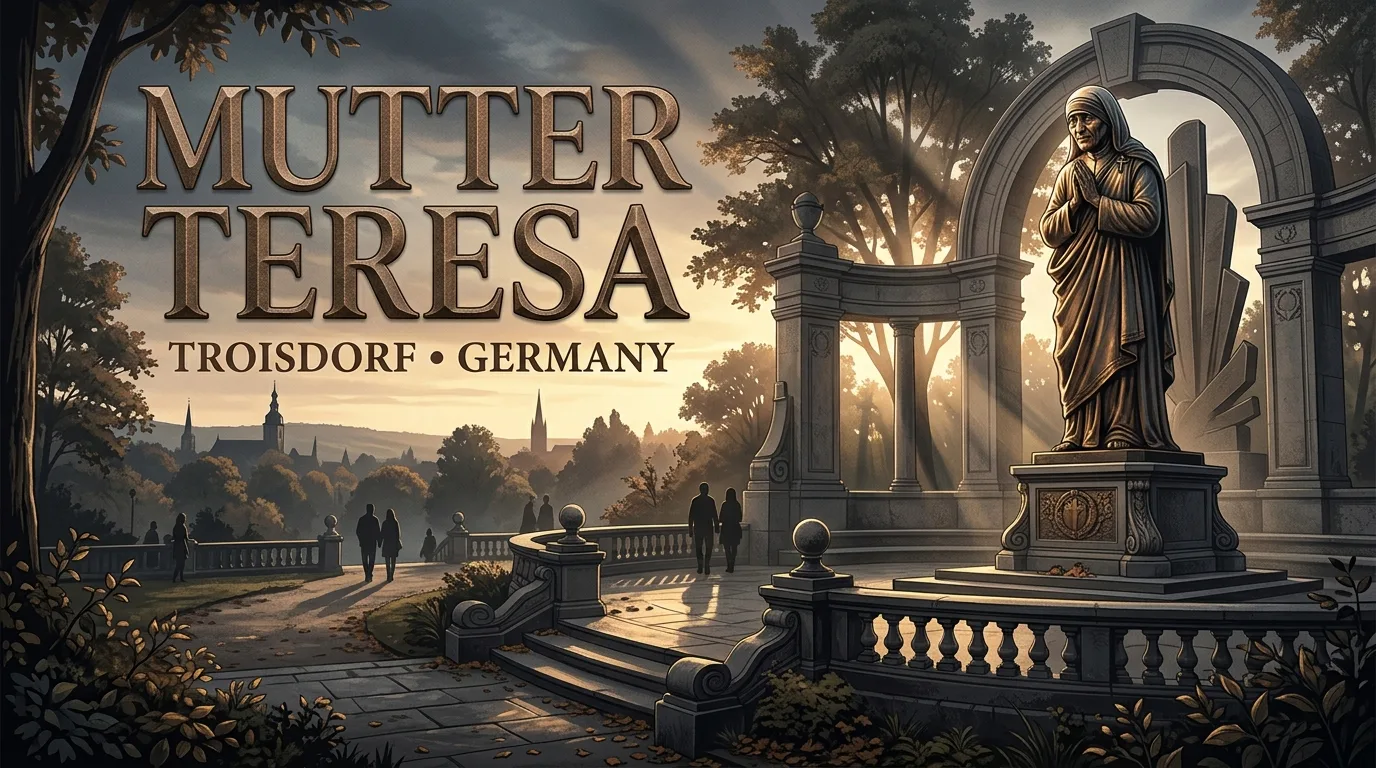
The bronze statue Mutter Teresa has stood since 5 September 2025 in front of the Catholic parish church of St. Mariä Himmelfahrt in the Troisdorf district of Spich and has become a quiet yet powerful symbol of compassion and intercultural connection. The life-size figure depicts the saint holding a child’s hand and carrying a spoon that collects rainwater and symbolically passes it on to the child – a strong image of hope, care and the simple act of sharing. Donated by the brothers Tuli and Nushi Istrefi, who fled Kosovo as teenagers in 1992 and found a new home in Troisdorf, the statue expresses the gratitude of the Albanian community and recalls the universal values for which Mother Teresa stood. For visitors exploring Troisdorf, a short stop is worthwhile not only because of the artistic quality but also because the site invites reflection on humanity and links the story of a saint with local integration history. The statue is freely accessible and blends harmoniously with the neo-Gothic church, itself a listed building.
History of Mutter Teresa
The statue Mutter Teresa in Troisdorf-Spich was solemnly inaugurated on 5 September 2025, the anniversary of the saint’s death. The date was chosen deliberately: on 5 September 1997 Agnes Gonxha Bojaxhiu, better known as Mother Teresa, died in Calcutta. The bronze figure was initiated by the brothers Tuli and Nushi Istrefi, who have been active as restaurateurs in Spich since 2003 and run the Aroma-Café and Pasta-Time among other businesses. They had fled the war in the former Yugoslavia and Kosovo in 1992 as young people and received support and a new home in Troisdorf. By donating the statue they wished to express their gratitude to their adopted home and at the same time honour the most famous Albanian personality.
The life-size bronze sculpture was created by their brother Tali Istrefi, an internationally active sculptor living in Albania who has already produced further Mother Teresa statues in Kosovo, Midland in Canada, Pfaffenhofen and Stuttgart. At the inauguration Mayor Alexander Biber, Father Hermann Josef Zeyen, representatives of the Albanian embassy in Berlin and the Kosovar consulate in Düsseldorf as well as numerous citizens from Troisdorf and the Albanian community were present. The mayor described the statue as a lasting symbol of charity and understanding between cultures and quoted the well-known saying of the saint: “Not all of us can do great things, but we can all do small things with great love.”
Mother Teresa herself was born on 26 August 1910 in Skopje (then Ottoman Empire, today North Macedonia) as Agnes Gonxha Bojaxhiu into an Albanian Catholic family. She joined the Loreto Sisters in 1928, went to India and founded the Missionaries of Charity in 1950. In 1979 she received the Nobel Peace Prize for her work among the poorest of the poor. She was beatified in 2003 and canonised by Pope Francis in 2016. The Troisdorf statue continues this legacy and makes the saint’s message tangible in a local, everyday setting. It does not stand in a museum but in the public space in front of the church, where passers-by, parishioners and visitors can encounter it every day.
Highlights of Mutter Teresa
The outstanding feature of the statue Mutter Teresa is its symbolic design. The life-size bronze shows the saint in her characteristic attitude of care: with one hand she leads a child, with the other she holds a spoon. When it rains the spoon fills with water that then drips to the child – a poetic yet practical image of the transmission of help and hope. These details turn the figure into more than a simple commemorative statue; they tell a story and invite close observation.
The placement directly in front of the neo-Gothic church of St. Mariä Himmelfahrt at Niederkasseler Straße 10 strengthens the effect. The church itself was built between 1858 and 1860 to plans by district architect Eduard Gustav Joseph Court and is a listed building. It suffered severe damage in the Second World War, especially during the bombing raid of 11 March 1945, and was later restored. The combination of the historic church building and the modern, thematically charged sculpture creates a special contrast and a quiet atmosphere of reflection in the public realm.
Another highlight is the intercultural dimension. The Istrefi family of donors represents the Albanian and Kosovar community in Troisdorf, which has integrated here while making its heritage visible. The statue is therefore also a sign of successful integration and mutual respect. Visitors can view the figure at any time of day and in any weather; it is especially impressive in the rain when the water symbol becomes active, or in the evening when the surrounding lighting gently emphasises the bronze. Proximity to Bleimops-Platz, a central meeting point in Spich with its own fountain figure recalling local traditions, allows the visit to the statue to be combined with a short walk through the district.
For photographers and culturally interested guests the statue offers clear, striking lines and a calm, dignified presence. It is not a conventional tourist magnet but a place of contemplation particularly suited to quiet moments – whether before or after a service, during a stroll or as a deliberate stop on a route through Spich. The quality of the work by Tali Istrefi, who has portrayed Mother Teresa several times before, guarantees artistic merit and an authentic representation of the saint.
Opening Hours, Tickets & How to Get to Mutter Teresa
The statue Mutter Teresa stands in the public space in front of the church of St. Mariä Himmelfahrt and is therefore freely accessible around the clock, 365 days a year. There are no opening hours, no admission fee and no ticket requirement. Visitors can view, photograph and linger at the figure at any time without being bound by closing times or ticket desks. Only during larger church events or special celebrations may the immediate forecourt be more crowded or briefly closed; as a rule access remains unrestricted.
Getting there is straightforward. By car take the A 59, exit Troisdorf, and follow the signs into the Spich district. The address is Niederkasseler Straße 10, 53842 Troisdorf. Parking is available in the vicinity, including at the Spich S-Bahn station (P+R) and in the surrounding streets. By public transport take the S-Bahn to Troisdorf-Spich station and walk a few minutes to the church. Bus lines additionally connect Spich with the centre of Troisdorf and neighbouring places. Cyclists will find the district easy to reach, and the routes are relatively flat.
Accessibility is good because the statue stands on the forecourt and no steps or narrow passages need to be negotiated. People with limited mobility can approach without difficulty and view the figure at close range. As it is a free public monument, neither guided tours nor reserved time slots are required. Anyone wishing to visit the church itself should check the parish service times; the statue remains independent of these and is accessible regardless. Groups are simply asked to show consideration for ongoing parish activities and residents.
Attractions Near Mutter Teresa
Immediately next to the statue Mutter Teresa stands the neo-Gothic church of St. Mariä Himmelfahrt itself, which is worth a visit and provides the historical setting for the sculpture. Only a few steps away is Bleimops-Platz with its fountain figure recalling the old Spich tradition of “Moggelen”; it is a popular meeting point for local residents. Historic half-timbered houses such as Haus Heep and Et Hüsje as well as the former manor house of Haus Broich (1620) and Haus Spich convey an impression of the older local history.
A little further but still easily reachable is the natural monument Spicher Hohlstein, a remarkable quartzite rock that has given rise to legends and archaeological finds. Visitors with more time should continue to the centre of Troisdorf and visit Burg Wissem. There they will find Europe’s unique Picture Book Museum, the Museum of Town and Industrial History (MUSIT) and the Wahner Heide Portal. The complex with park, deer enclosure and sensory experience field is a central excursion destination of the town. The Wahner Heide itself, one of the most species-rich nature reserves in North Rhine-Westphalia, begins nearby and invites longer walks. In this way a visit to the Mutter Teresa statue can easily be combined with culture, history and nature experiences in Troisdorf.
Where to stay in Troisdorf, Germany
Compare current hotel prices and find the right place to stay.