Weißhaus
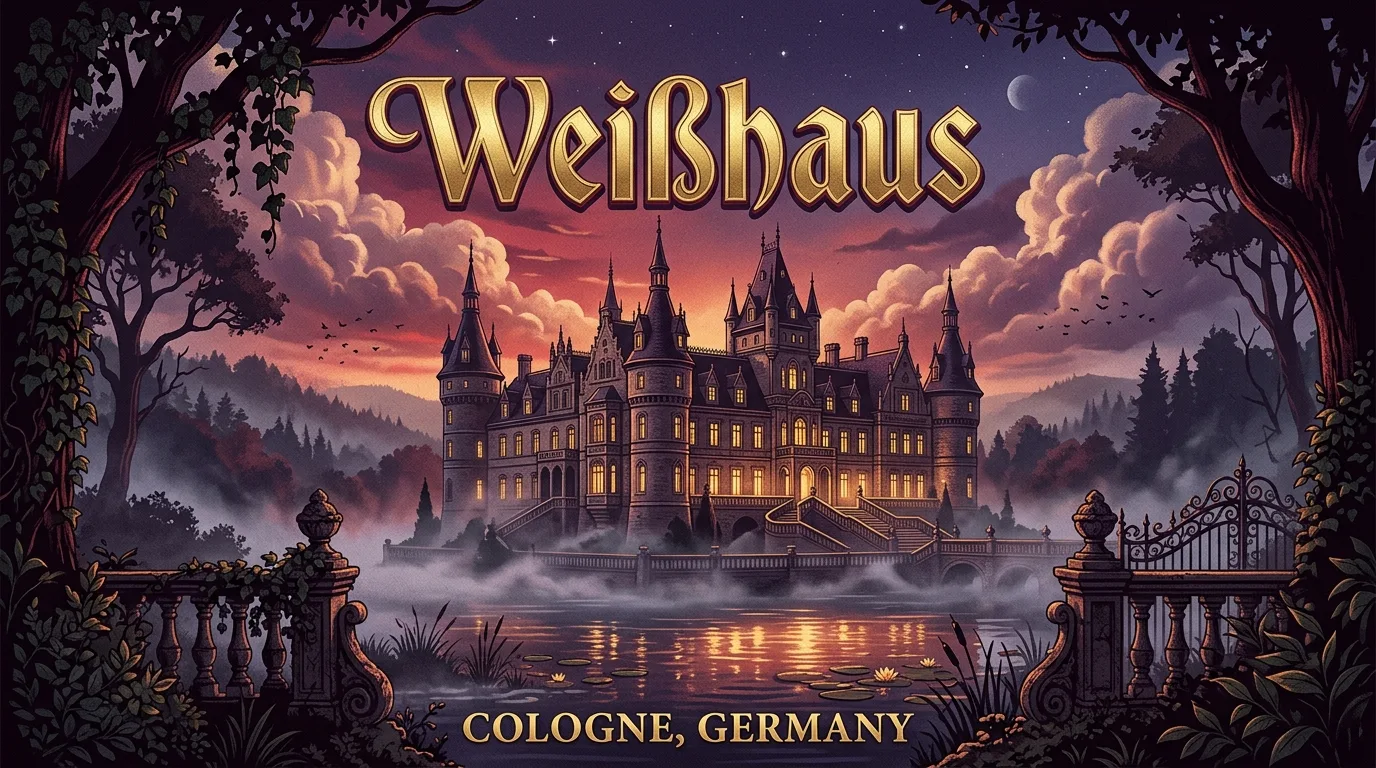
Tucked away in Cologne's Sülz district, between the Inner Green Belt and the popular Decksteiner Weiher lake, stands the Weißhaus, one of the city's most unusual listed buildings. At first glance it looks like a romantic moated castle from another century, yet it is in fact the result of more than 600 years of rebuilding, destruction, and restoration. The two-story manor house, with its curved mansard roof, octagonal staircase tower, and water-encircled grounds, is one of Cologne's quiet, almost hidden treasures. Although the estate is now privately owned and cannot be entered by the public, its silhouette can still be admired from the surrounding paths, and its history tells a great deal about the development of the city from the monastic era to the present day.
History of Weißhaus
The earliest documented mention of the estate dates back to 1378, when it belonged to the Benedictine Abbey of Sankt Pantaleon, which had been founded as early as 957. Records from 1468 refer to a building called "Zu dem Wyssenhuys," from which the name still used today is derived. The site's turbulent history began soon afterward: in 1474, during the Burgundian Wars, as the army of Charles the Bold advanced on Cologne, the estate was destroyed. A further setback followed in 1584, when a fire once again razed the buildings. It was not until 1613 to 1619 that Abbot Henricus Spichernagel had the Weißhaus completely rebuilt, and the tower dating from this construction phase survives to this day and still defines the appearance of the complex. In 1658 the Duffesbach, a small tributary stream, caused a significant flood, which led to the estate being rebuilt as a fortified moated castle surrounded by a water-filled ditch. In 1669, Abbot Aegidius Romanus had the property expanded into a representative summer residence for the abbey, and the ornate wrought-iron railing of the northeastern arched bridge, still visible today, dates from this period. Following secularization in the wake of the Napoleonic Wars, the former monastic property passed into state ownership, and in 1843 the building underwent a Neoclassical remodeling. A decisive turning point came in 1849, when the Cologne merchant Johann Adam Jansen purchased the estate and commissioned the renowned architect Vincenz Statz to carry out an extensive Neo-Gothic redesign. The accompanying castle chapel was solemnly consecrated on November 10, 1857, by Cardinal Johannes von Geissel. In May 2019, the roughly 20,800-square-meter complex changed hands for about six million euros: entrepreneur Adam Szpyt, founder of Bett1.de, acquired the Weißhaus, which has remained closed to the public ever since.
Highlights of Weißhaus
Even though the interior of the Weißhaus is now reserved exclusively for its private owners, the architecture still offers plenty to make a walk along the edge of the property worthwhile. The manor house itself presents a two-story structure with a striking curved mansard roof, typical of the representative remodeling campaigns of the 17th and 19th centuries. Particularly eye-catching is the octagonal staircase tower with its Baroque cap, rising elegantly above the roofline and dating back to the rebuilding phase between 1613 and 1619, making it one of the oldest surviving elements of the complex. The entire estate is encircled by a roughly 5,600-square-meter water-filled moat, giving the Weißhaus its character as a genuine moated castle, a rarity within Cologne's cityscape. Two masonry arched bridges span this moat, connecting the interior to the surrounding parkland; the northeastern bridge is especially notable for its ornate wrought-iron railing from around 1669, a relic of the expansion carried out under Abbot Aegidius Romanus. Inside, which was only rarely open to visitors, the Neo-Gothic castle chapel stands out above all, its cross-rib vaults adorned with tempera paintings depicting religious scenes, including the Annunciation, the Nativity, and the Presentation at the Temple. The chapel's stained-glass windows illustrate scenes from the Magnificat and were created in the Cologne workshop of Johann Anton Friedrich Baudri, one of the most important glass painters in the Rhineland during the 19th century. The surrounding parkland, with its mature trees blending harmoniously into the Inner Green Belt, makes the exterior grounds of the Weißhaus one of the most picturesque spots in Cologne-Sülz, even though the buildings themselves cannot be toured.
Opening Hours, Tickets & How to Get to Weißhaus
Since 2019 the Weißhaus has been privately owned, and neither the interior nor the garden is open to the public. There are no fixed opening hours, no admission fee, and no way to purchase tickets, since the estate is used exclusively as a private residence. Visitors can nonetheless view and photograph the striking facade, tower, and moat from the public paths along Weißhausstraße and from the adjoining Green Belt, which is especially rewarding in the soft morning and evening light. Getting there is straightforward: Cologne's Stadtbahn light rail lines 9 and 18 conveniently serve the area, stopping at Sülzburgstraße or Weißhausstraße, from where the site is just a few minutes' walk away. The Weißhaus is also well connected by bicycle via the paths of the Inner Green Belt, which cross through several Cologne districts. Drivers will find limited parking along the adjoining residential streets in Sülz, though visiting by public transport is recommended since the area is subject to traffic calming. Those planning a visit should treat it as part of a longer walk through the Green Belt, since the Weißhaus itself only warrants a few minutes' stop, while the surrounding parkland invites a much longer stay.
Attractions Near Weißhaus
Just a few minutes' walk from the Weißhaus lies the Decksteiner Weiher, one of the most popular recreational spots in western Cologne, its shores lined with cafés, sunbathing lawns, and walking paths. The Inner Green Belt, on whose grounds the Weißhaus stands, links numerous other green spaces and former fortification areas, making it ideal for longer walks or cycling tours across the city. Close by is also the Cologne City Forest (Stadtwald) with its large open grounds, wildlife enclosure, and observation tower offering sweeping views over the western districts. The Sülz district itself, known for its lively bar and restaurant scene around Berrenrather Straße, is a great place to stop for refreshments after a walk. Those interested in university architecture will find the sports facilities and institutes of the University of Cologne just a few minutes away, its campus extending right up to the Green Belt. The Cologne Botanical Garden and the Vorgebirgspark are also reachable by bicycle within a reasonable time and together with the Weißhaus form a scenic green route through the southwestern and western quarters of the city.
Where to stay in Cologne, Germany
Compare current hotel prices and find the right place to stay.