Volksgarten
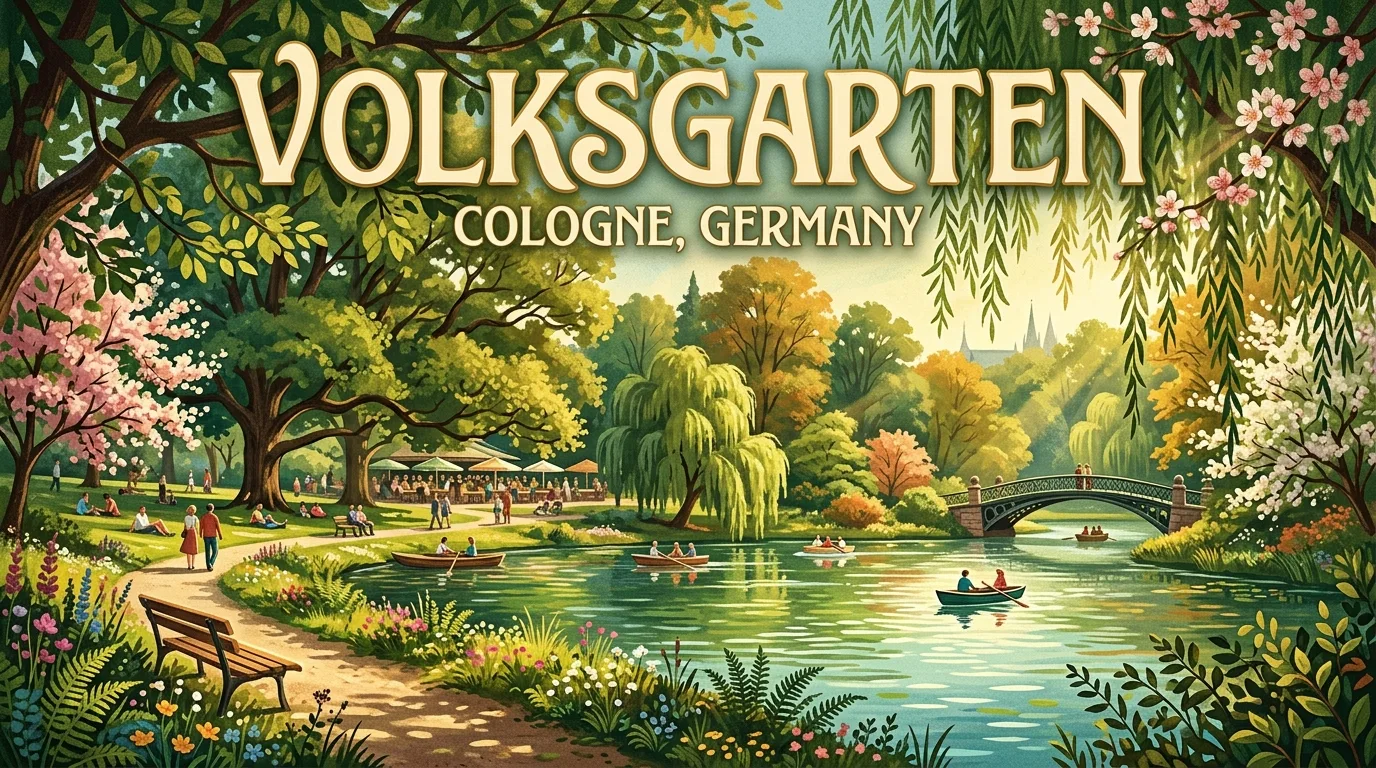
Volksgarten in Cologne is one of the most popular green spaces in the southern part of the city and forms the green heart of the Südstadt district within Cologne-Neustadt-Süd. Covering almost 13.9 hectares, the park combines classic late-19th-century landscape architecture with vibrant everyday recreation: walkers, joggers, families with children, and visitors renting rowing boats all share the sweeping paths that wind around the artificial Kahnweiher lake. Framed by Volksgartenstraße to the north, Vorgebirgswall to the south, Eifelstraße and Eifelplatz to the west, and Vorgebirgstraße to the east, Volksgarten sits in the middle of a densely built residential quarter and has served as a local recreation area for the people of Südstadt for more than 130 years. Visitors wanting to experience Cologne beyond the old town will find here a blend of garden artistry, military-industrial history, and urban daily life that few other parks in the city can match.
History of Volksgarten
The history of Volksgarten begins on the site of the former Fort Paul, also known as Fort IV, a Prussian fortress built between 1816 and 1825 and named after Grand Duke Paul Friedrich of Mecklenburg. After the Franco-Prussian War of 1870/71, the fortification lost its military relevance due to the city's expanding development and the close proximity of railway lines, prompting the City of Cologne to release the grounds for civilian use. In November 1887, the city officially commissioned landscape architect Adolf Kowallek to design the new park after he won a municipal competition in which Eduard Hoppe placed second. Construction began in January 1888, and on March 12, 1890, Volksgarten was ceremonially opened to the public. The name itself reflects the idea of a garden for the people, accessible to all social classes, in contrast to the exclusive aristocratic gardens of earlier eras. A monument within the park commemorates Cologne merchant Wilhelm Kaesen, who played a key role in acquiring the land needed for the project. Over the following decades, despite two world wars and considerable urban change throughout Südstadt, Volksgarten remained a stable green space, repeatedly restored and adapted to modern recreational needs while retaining its historic character as a late-19th-century landscape garden.
Highlights of Volksgarten
The central highlight of Volksgarten is the roughly 1.3-hectare Kahnweiher lake, where generations of visitors have rented pedal boats and rowing boats, accompanied by a beer garden along its banks. Starting in early 2025, the lake underwent a comprehensive renovation that increased its maximum depth to four meters, reducing summer overheating and algae growth. Historic bridges and shaded promenades wind around the water, making this stretch one of the most photogenic spots in Cologne's park landscape. The site's military past is still visible today in the imposing main gateway of the former fortress with its two round towers, remnants of a lunette fortification, and crescent-shaped earthworks that once protected against explosions, lending the park a uniquely layered historical topography. Another architectural gem is the Orangerie, originally built in 1841 as the fortress's munitions depot before being converted into a greenhouse. After the University of Cologne was re-established in 1919, the building temporarily housed the Botanical Institute; today the Orangerie serves as a versatile cultural venue hosting concerts, film screenings, and theatrical productions. Expansive lawns, mature tree stands, a children's playground, and numerous seating areas make Volksgarten a place where both locals and visitors settle in for picnics, jogging, or simply relaxing in nature. Especially during the summer months, the park transforms into a lively meeting point for the entire Südstadt neighborhood, while in spring, blossoming chestnut and cherry trees give it a quieter, almost romantic character.
Opening Hours, Tickets & How to Get to Volksgarten
As a public green space managed by the City of Cologne, Volksgarten is freely accessible year-round and every day; there are no fixed opening hours for the park itself, though facilities at the Kahnweiher such as the boat rental and the beer garden follow seasonal hours, typically running from morning until late evening during the summer months. Admission to the park is free of charge. Getting there by public transport is straightforward: Stadtbahn lines 15 and 16 stop at Eifelplatz station directly on the park's western edge, from where the main entrance is just a few minutes' walk away. Bus routes serving Südstadt also bring visitors close to Volksgartenstraße and Vorgebirgswall. Cyclists benefit from well-developed bike lanes along Luxemburger Straße and Eifelstraße. Drivers will find parking available on the surrounding residential streets, though Südstadt enforces metered parking zones at certain times, so checking current signage on site is advisable. Since Volksgarten lies right in the middle of the residential district, it is also easily reached on foot from Cologne's old town or from Chlodwigplatz, making it an ideal stop during a city walk.
Attractions Near Volksgarten
Just a few minutes' walk from Volksgarten lies Chlodwigplatz with the historic Severinstorburg, one of the last surviving medieval city gates of Cologne, offering a striking contrast to the late-19th-century park nearby. From there, the lively Severinstraße runs straight through the Severinsviertel, one of Südstadt's most traditional yet buzzing neighborhoods, filled with owner-run shops, cafés, and pubs. Heading toward the Rhine, about 15 to 20 minutes on foot brings visitors to Rheinauhafen with its iconic Kranhäuser crane houses, as well as the Chocolate Museum, one of Cologne's most visited attractions. Cologne's old town and the world-famous Cologne Cathedral are also within comfortable walking or cycling distance and pair well with a visit to Volksgarten. Families may also enjoy a detour to the nearby Agnesviertel or to Ubierring, where additional small green spaces and dining options await. Residents of Südstadt particularly value Volksgarten as a spot for a morning run, a leisurely picnic beneath old plane trees, or a quiet pause after browsing the local Sunday flea markets, while photographers appreciate the interplay of water, historic masonry, and dense tree cover in every season. This central location makes Volksgarten an ideal starting point for discovering the diversity of Cologne's Südstadt, combining historic architecture, green relaxation, and urban flair in a single walk.
Where to stay in Cologne, Germany
Compare current hotel prices and find the right place to stay.