Tünnes und Schäl Denkmal
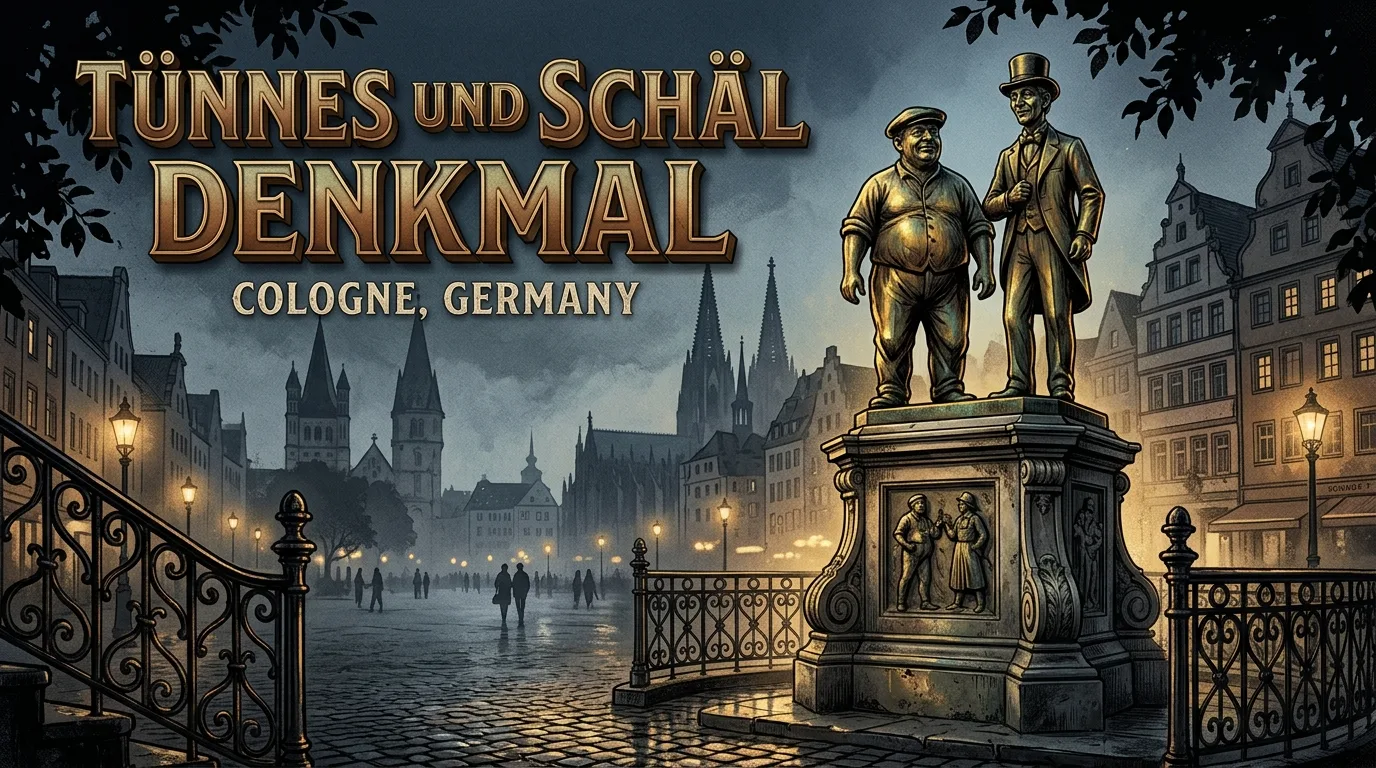
On the façade of the Gürzenich, Cologne's historic festival hall just a few steps from the Romanesque church of Groß St. Martin, visitors encounter the Tünnes und Schäl Denkmal - one of the most endearing and distinctly folk-rooted bronze sculptures in Cologne's old town. Unlike the city's grand ruler monuments, this work is not dedicated to high politics but to Rhineland humour and Cologne's dialect culture: it depicts the two best-known characters of the long-standing Hänneschen puppet theatre, the city's oldest puppet stage. Tünnes, the good-natured, cunningly simple countryman, and Schäl, the cross-eyed, self-important know-it-all, have embodied two fundamental facets of the Cologne popular character for more than two centuries and have long since become "Kölsche Originale" themselves - fictional figures revered by the people of Cologne almost as if they were real historical personalities. The monument at the Gürzenich is thus a place where Cologne's theatrical tradition, dialect culture, and post-war urban reconstruction all come together in a single, compact spot.
History of Tünnes und Schäl Denkmal
To understand the significance of the Tünnes und Schäl Denkmal, one must first look at the history of its two main characters. In 1802, the Bonn-born tailor Johann Christoph Winters founded the so-called Hänneschen-Theater in Cologne, a hand-puppet stage still considered the oldest of its kind in the city and permanently housed at the Eisenmarkt since 29 July 1938. The character of Tünnes - the Cologne short form of the first name Anton - belonged to the theatre's core cast from the very beginning and embodied the down-to-earth, good-natured countryman in his typical blue clothing. The character of Schäl was only added in the 1850s, according to tradition as a reaction to Winters' rivalry with a competing puppeteer on the opposite bank of the Rhine, an area tellingly nicknamed "Schäl Sick" - the squinting, or "wrong," side - in Cologne vernacular. The name Schäl itself derives from the Cologne dialect term for "squinting" and colloquially also describes someone who acts in a false or cunning manner. Over the decades, both characters became so popular within Cologne's entertainment culture that their fame extended far beyond the theatre itself - appearing in carnival celebrations, in Cologne dialect literature, and even as informal code names within the city's public transport system. To permanently honour this unique popularity, the Austrian sculptor Wolfgang Wallner created a four-metre-high bronze figure group of the two characters in 1950, complemented by typical façade motifs of Cologne's old-town houses. The work was created in connection with the reconstruction of the Gürzenich, which had been severely damaged during the Second World War. This late-Gothic festival hall, originally built between 1441 and 1447, was faithfully rebuilt between 1952 and 1955 under the direction of architect Rudolf Schwarz following its wartime destruction. The monument thus found its permanent place at the Gürzenich and has remained there ever since, a visible sign that even amid the reconstruction of a representative festival hall, Cologne's humour and its own theatrical tradition were not forgotten.
Highlights of Tünnes und Schäl Denkmal
The centrepiece of the monument is the unmistakable contrast between the two characters: Tünnes, depicted with a round, good-natured face, a prominent nose, and simple, rustic clothing that marks him as a down-to-earth, honest type, stands in direct contrast to Schäl, who, with his black, more refined-looking garment and self-assured posture, plays the conceited know-it-all who considers himself far more educated and clever than he actually is. It is precisely this tension between rustic honesty and urban self-importance that has made the two figures beloved by the people of Cologne for generations. Particularly worth seeing is the craftsmanship of Wolfgang Wallner's bronze work, who did not depict the two figures in isolation but embedded them within a small backdrop of typical Cologne old-town houses - a detail that lends the monument additional narrative depth and firmly anchors the two characters within the urban context from which they originate. Its placement directly at the Gürzenich, just a short walk from the striking twin-tower façade of Groß St. Martin, creates a particularly evocative interplay between late-Gothic architecture and folk-rooted bronze art. Visitors wishing to explore Cologne's theatrical culture further will find interesting parallels at the nearby Eisenmarkt, where the Hänneschen-Theater still regularly stages performances featuring Tünnes, Schäl, and other recurring characters such as the quick-witted Hänneschen himself, his friend Bärbelchen, and the rascal Speimanes - all figures who bring typical Cologne traits to life on stage in the fictional town of "Knollendorf." Another curious detail: pictorial representations of Tünnes and Schäl can also be found on Cologne Cathedral itself, above a side portal on the side facing the main railway station - evidence of just how deeply rooted the two figures are in the city's collective memory.
Opening Hours, Tickets & How to Get to Tünnes und Schäl Denkmal
Since the Tünnes und Schäl Denkmal is mounted on the freely accessible outer façade of the Gürzenich in a public street, it can be visited at any time and free of charge - there are no fixed opening hours, no admission fee is charged, and no reservation is necessary. Visitors can therefore discover the figure group spontaneously while strolling through the old town, ideally combined with a visit to Groß St. Martin or a walk along the nearby Rhine promenade. Getting there is straightforward, as the Gürzenich sits right in the heart of historic Cologne: from the main railway station, the location can be reached on foot in about ten to fifteen minutes, passing Cologne Cathedral and winding through the narrow lanes of the old town. Alternatively, visitors can take the stadtbahn to the Heumarkt or Appellhofplatz stop, from where the Gürzenich is just a few minutes' walk away. Since the entire area around Groß St. Martin and the Gürzenich is largely designed as a pedestrian zone, travelling without a car is generally recommended; drivers, however, will find several paid parking garages nearby, for instance at the Heumarkt or along the Rhine riverbank. Visitors wishing to experience Tünnes and Schäl quite literally "come to life" can combine their visit to the monument with a performance at the nearby Hänneschen-Theater on the Eisenmarkt, where the two characters still regularly appear on the puppet stage today.
Attractions Near Tünnes und Schäl Denkmal
Its location at the Gürzenich makes the Tünnes und Schäl Denkmal a perfect stop on a walking tour of Cologne's old town. Just a few steps away rises the Romanesque church of Groß St. Martin with its unmistakable four-tower design, which together with Cologne Cathedral defines the city's skyline as seen from the Rhine. The Gürzenich itself, where the monument is located, is a significant fifteenth-century late-Gothic festival hall that still hosts numerous events today, including Cologne's famous carnival sessions. Just a short walk away lies the Hänneschen-Theater on the Eisenmarkt, the actual home stage of Tünnes and Schäl, where visitors can experience the two characters in genuine puppet-theatre performances. The Alter Markt with its historic Cologne town hall and the Heumarkt with its imposing Reiterstandbild Friedrich Wilhelm III. are also in the immediate vicinity, inviting a further detour into Cologne's monument and urban history. Heading toward the Rhine, the riverside promenade with views of the Hohenzollern Bridge is just a few minutes away, while the world-famous Cologne Cathedral, with its Gothic towers - which also features a pictorial representation of the two characters - can be reached in about ten minutes on foot. The monument therefore sits right at the centre of one of the densest clusters of attractions in the entire city.
Where to stay in Cologne, Germany
Compare current hotel prices and find the right place to stay.