Stadtwald
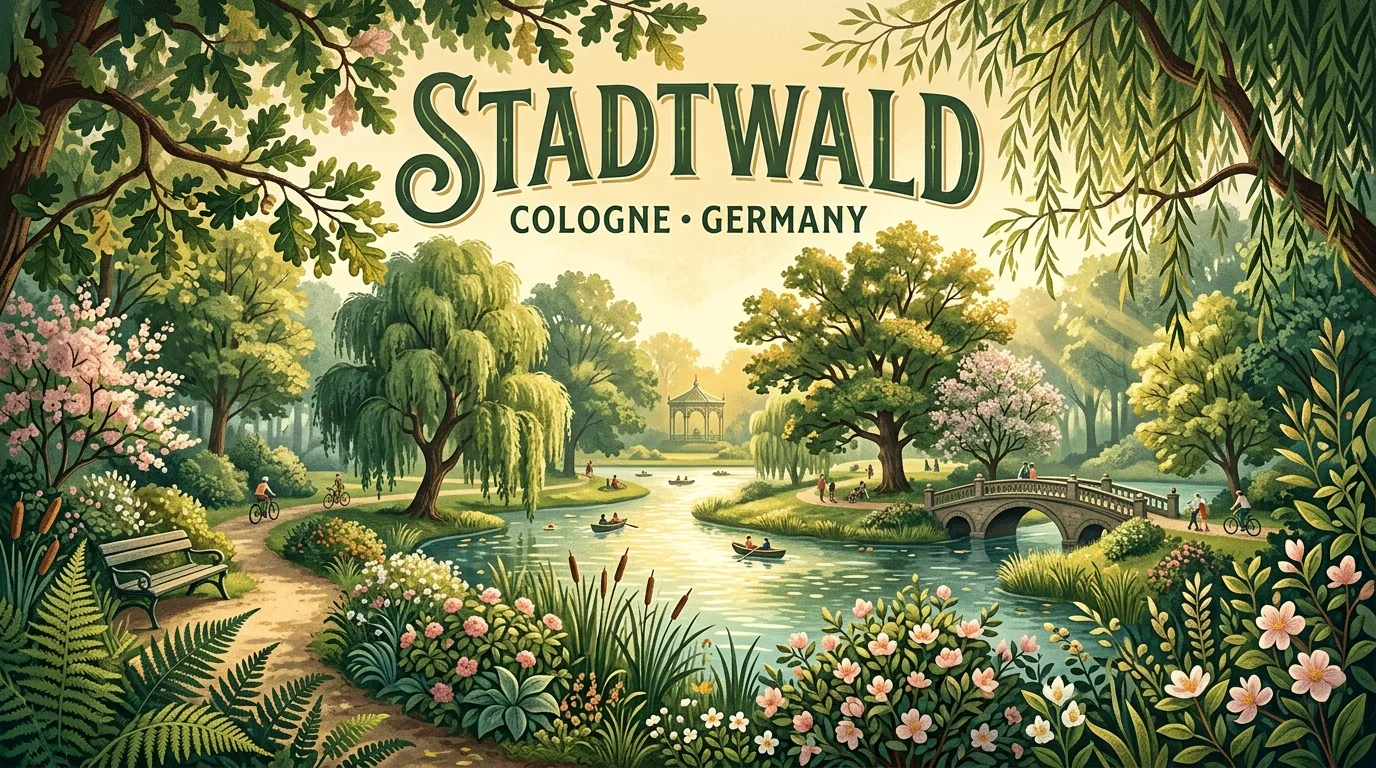
The Kölner Stadtwald, located in the Lindenthal district, covers a total area of around 205.3 hectares, making it one of the largest and oldest deliberately designed park landscapes in Cologne and the green heart of the city's west side. The expansive grounds are bounded by Fürst-Pückler-Straße, Friedrich-Schmidt-Straße, Militärringstraße, and Dürener Straße, forming an almost self-contained wooded park area that is used daily by joggers, families, cyclists, and horseback riders. Unlike a naturally grown forest, the Stadtwald was deliberately conceived at the end of the 19th century as an urban park landscape, skillfully weaving together semi-natural woodland sections, broad meadows, several ponds, and a wildlife enclosure. This combination of designed nature and genuine recreational value has made the Stadtwald one of the most popular destinations for both locals and visitors looking to escape the bustle of the city center for a few hours.
History of Stadtwald
The history of the Kölner Stadtwald officially begins in 1895, when the City of Cologne acquired the necessary land on the western edge of the city to create a large, publicly accessible park landscape for its growing population. On July 4, 1895, the design plan by municipal garden director Adolf Kowallek was officially approved; his approach, rooted in historicism, combined classic elements of landscape gardening with practical recreational areas. Construction of the central main pond, covering roughly 3.9 hectares with its two islands and striking fountain, began as early as March 1896, and the pond remains the visual centerpiece of the park to this day. By around 1900, the Stadtwald was largely complete in its basic layout, although work on paths, plantings, and secondary facilities continued until about 1920. The total cost of the project amounted to approximately 2.5 million Goldmark, an enormous municipal investment for its time. From 1917 onward, during the tenure of then-mayor Konrad Adenauer, the renowned garden architect Fritz Encke took over further development of the park, adding, among other features, a roughly 750-meter connecting canal completed in 1920 that links the main pond to a smaller pond to the west. Also historically significant is the Hofgut Kitschburg, an estate first documented as early as 1669, which later served as a summer residence and was eventually incorporated into the park grounds during its landscaping. In 1899, the Stadtwald hosted the so-called "Patriotic Festival Games," drawing around 40,000 spectators, evidence of the park's early importance as an event venue. A darker chapter of more recent history is marked by a memorial stone from 1977, commemorating the kidnapping of industrialist Hanns Martin Schleyer by the Red Army Faction, in which four people were killed.
Highlights of Stadtwald
The undisputed centerpiece of the Stadtwald is the large main pond with its two small islands and fountain, surrounded by wide promenade paths and attracting numerous waterfowl in summer. Six bridges from different construction periods span the ponds and the connecting canal, inviting visitors to discover the park from ever-changing perspectives. A particular highlight is the roughly eight-hectare wildlife enclosure, established as early as 1908, which still houses deer and other native wildlife that can be observed up close. Sports-minded visitors will find tennis courts, extensive riding trails used by the nearby equestrian club, and a 400-meter cycling track that is regularly used for training and competitions. Two long-established restaurants within the park invite visitors to rest after an extended walk and rank among the most popular destinations in Lindenthal. A freight railway line operated by the Häfen und Güterverkehr Köln AG, running toward Frechen, also crosses the park, lending the grounds a distinctive, almost rural character. The historic Hofgut Kitschburg, with its mature old trees, forms an architecturally appealing contrast to the open, expansive meadows found throughout the rest of the park. The Stadtwald offers a different experience in every season: blooming meadows and fresh greenery in spring, shaded retreats beneath old tree canopies in summer, vividly colored foliage along the promenades in autumn, and quiet, often frost-covered landscapes in winter, making the park a rewarding destination well beyond the warmer months.
Opening Hours, Tickets & How to Get to Stadtwald
As a public municipal park landscape, the Stadtwald is freely accessible around the clock throughout the year, and no admission fee is charged. Only the two restaurants, along with any riding or tennis facilities, have their own seasonally variable opening hours, which are best checked directly on site or by phone. The park is well served by public transport, with several tram and bus lines stopping around Militärringstraße, Dürener Straße, and Fürst-Pückler-Straße, each leading directly to the outer boundaries of the grounds. A central access point is located at Friedrich-Schmidt-Straße 99, while another popular entrance lies at the intersection of Rautenstrauchstraße and Fürst-Pückler-Straße, close to the Wüllnerstraße stop. Drivers will find parking along the adjacent streets as well as at a number of official parking areas, though busy conditions should be expected on sunny weekends. By bicycle, the Stadtwald is comfortably reachable from almost any part of Cologne via the well-developed cycling paths along the Inner Green Belt, making it a popular stopover for bike tours through the western part of the city. Within the park, wide, gravel-bound main paths ensure comfortable access even with strollers or bicycles, while smaller dirt trails lead through more natural sections. Dogs may run freely in most areas but should be kept on a leash near the wildlife enclosure and the open meadows.
Attractions Near Stadtwald
Directly adjacent to the Stadtwald lies the University of Cologne, whose vibrant student atmosphere fills the surrounding streets of Lindenthal with numerous cafés and small restaurants. Just a few minutes' walk away is the Aachener Weiher, together with the neighboring Hiroshima-Nagasaki-Park, another popular green space that combines perfectly with a walk through the Stadtwald. Heading south, visitors can quickly reach the Forstbotanischer Garten, whose collection of native and exotic trees offers an interesting scientific contrast to the more recreation-focused design of the Stadtwald. The Vorgebirgspark and other green spaces in southwestern Cologne are also comfortably reachable from here on foot or by bike via the Inner Green Belt. For those wishing to switch from nature to culture, Cologne's city center, with its famous Cathedral, the Museum Ludwig, and the historic old town, is just about 20 to 25 minutes away by bus or train, offering a completely different but equally rewarding Cologne experience.
Where to stay in Cologne, Germany
Compare current hotel prices and find the right place to stay.