St. Pantaleon
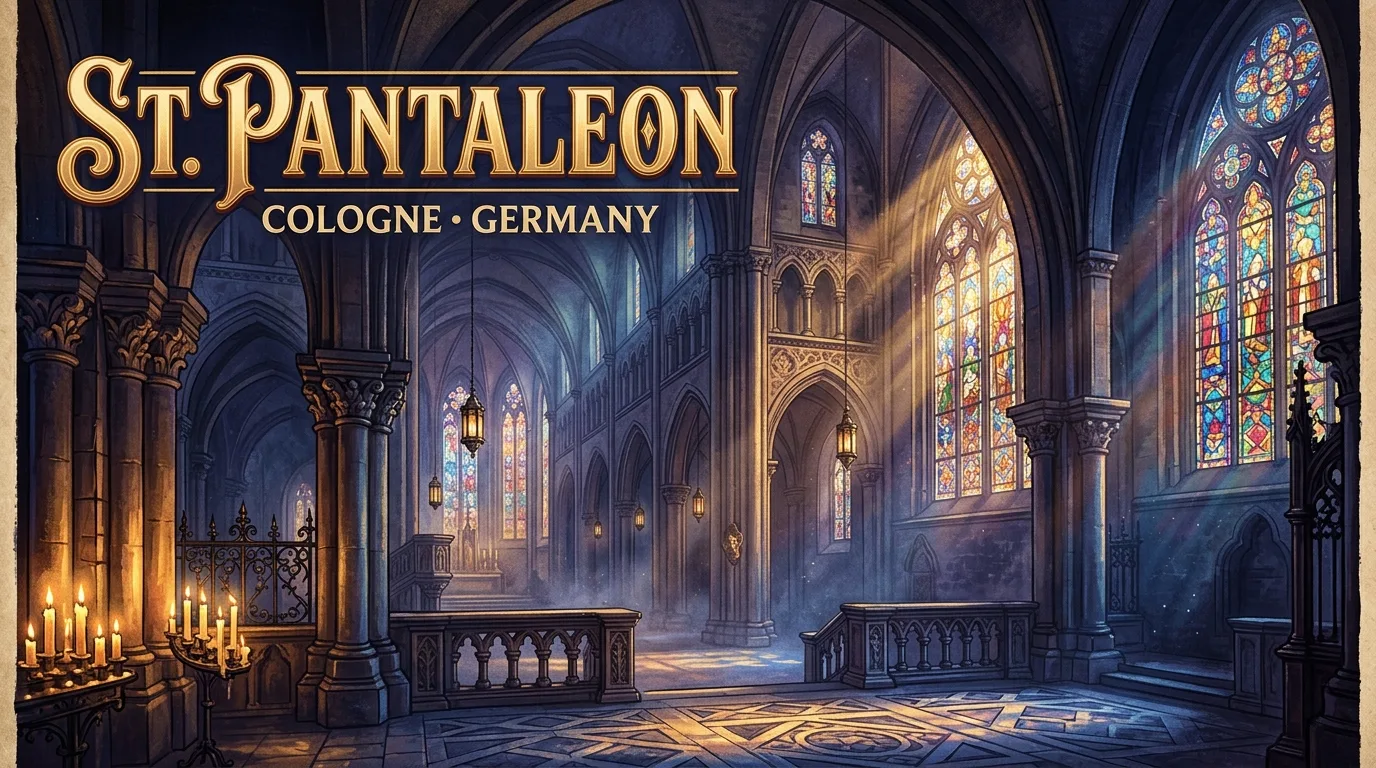
Just a short walk south of Cologne's old town, in the lively district of Altstadt-Süd, stands St. Pantaleon, one of the oldest surviving churches in the city — a building whose roots reach back to the tenth century and the age of the Ottonian emperors. Its massive westwork is visible from afar and ranks among the most important surviving examples of Ottonian architecture north of the Alps, making the church instantly recognizable on Cologne's skyline. Stepping inside St. Pantaleon means stepping into more than a thousand years of history: from its founding as a Benedictine monastery, through its role as the burial place of the Byzantine empress Theophanu, to its careful reconstruction after the destruction of the Second World War. As one of the twelve great Romanesque basilicas of Cologne, St. Pantaleon belongs to a unique ensemble of medieval sacred buildings unmatched anywhere else in Europe, offering visitors a rare combination of art history, spirituality, and urban heritage.
History of St. Pantaleon
The history of St. Pantaleon begins in the year 955, when Archbishop Bruno of Cologne, a younger brother of Emperor Otto I, founded a Benedictine monastery on the Pantaleonsberg hill. Generous donations allowed actual construction of the church to begin in 957, with an initial single-nave building that marked the transition from Carolingian to Ottonian architectural style. Bruno himself, who died in 965, found his final resting place in the crypt, exactly as he had requested.
The further development of the church owes much to the Byzantine empress Theophanu, wife of Emperor Otto II. She stayed in Cologne almost every year between 985 and 990 and actively supported the construction of the church's striking westwork, which was completed by around 980. When Theophanu died on 15 June 991, she was buried, as she herself had wished, inside St. Pantaleon; her white marble sarcophagus in the westwork, created in 1965 by sculptor Sepp Hürten, still commemorates the empress who had come to the West from Byzantium.
Around 1160, Abbot Wolbero had the originally single-nave Ottonian church expanded into a three-aisled basilica, decisively shaping the building's current layout. Further furnishings were added during the late medieval and Baroque periods, including the late-Gothic choir screen and an eighteenth-century Baroque interior. St. Pantaleon suffered severe damage during the Second World War, and reconstruction continued into the 1960s, when the church received its distinctive coffered ceiling with 94 glass panels designed by artist Dieter Hartmann. To this day the church is maintained and actively used by the Catholic parish of St. Pantaleon.
Highlights of St. Pantaleon
The most striking feature of St. Pantaleon is undoubtedly its monumental westwork, one of the outstanding examples of Ottonian architecture anywhere in Europe. The facade was originally adorned with large-scale figures of the titular saints Cosmas, Damian, and Pantaleon, together with a Majestas Domini and flanking angels — an exceptionally ambitious pictorial program for the tenth century. Inside the church, the late-Gothic choir screen from the early sixteenth century draws every visitor's eye: this delicate barrier separates the choir from the nave and simultaneously carries the organ.
That organ deserves special attention. Its Baroque case from 1652 is considered the oldest surviving organ facade in Cologne, a seven-bay structure decorated with gilded volutes and cherub heads. The current instrument, installed in 1963 by the organ-building firm Klais, has three manuals, pedal, and 58 stops, filling the nave with a remarkably rich sound during concerts.
The choir area and side chapels hold numerous medieval works of art: a fifteenth-century Pietà, a crowned Madonna holding the Christ child with an imperial orb — possibly a reference to Empress Theophanu herself — and the twelfth-century shrines of Saints Maurinus and Albinus, whose design shows the influence of the famous goldsmith Nikolaus von Verdun. The ensemble is completed by a Crucifixion painting by the Korbach Franciscan painter from around 1520 and a triptych from the circle of Barthel Bryn the Elder dated 1550.
Last but not least, the four-bell bronze peal cast in 1956/57 impresses visitors, led by the mighty Pantaleon bell weighing 3,000 kilograms, standing in the tradition of the medieval Christina bell. The crypt, burial place of Archbishop Bruno, together with a modern chapel from 2006 dedicated to Opus Dei founder Josemaría Escrivá, round off a visit to St. Pantaleon and show just how alive this thousand-year-old site remains today.
Opening Hours, Tickets & How to Get to St. Pantaleon
St. Pantaleon is located at Am Pantaleonsberg 8, 50676 Cologne, on the corner with the street Am Weidenbach, where visitors will also find the entrance gate. A team of volunteer attendants usually opens the church to individual visitors on weekdays around midday and in the afternoon; visits during these hours are possible without prior registration as long as no Mass, rosary, or silent adoration is taking place. To help cover the upkeep of this historic building, individual visitors are asked for a flat contribution of 1 euro per person. Groups of eight or more should register in advance with the parish office, which also arranges knowledgeable guided tours covering the history of the former Benedictine monastery as well as themed tours on Empress Theophanu, Archbishop Bruno, or the church's Baroque alterations. Current dates, contact details, and further visitor information are available on the parish website at sankt-pantaleon.de; the parish office can also be reached by phone at +49 221 3166655 or by email.
Getting to St. Pantaleon is easiest with Cologne's public transport network: tram lines 15 and 16 stop within a few minutes' walk at the Chlodwigplatz and Ulrepforte stations respectively. From the main railway station and from Cologne Cathedral, the church can be reached on foot in about 20 to 25 minutes, or more quickly by a short tram ride. Street parking is available in the surrounding Altstadt-Süd neighborhood, though much of the district operates under resident-parking restrictions, so visitors arriving by car should allow extra time to find a space.
Attractions Near St. Pantaleon
The area around St. Pantaleon offers an excellent introduction to the diversity of Cologne's Altstadt-Süd district. Just a few minutes' walk away lies the Severinsviertel, one of Cologne's most traditional neighborhoods, home to the medieval Severinstorburg city gate, numerous brewery pubs, and a lively local tavern culture. Chlodwigplatz, named after the Frankish king Clovis, has long served as an important transport hub and is also a popular meeting point with cafés and restaurants. For a contrast to the medieval fabric of St. Pantaleon, the nearby Rheinauhafen harbor district showcases Cologne's modern side with its striking Kranhaus crane buildings. The medieval city fortifications can still be experienced at the Ulrepforte, a well-preserved defensive tower of Cologne's old city wall. A walk toward the Rhine along the nearby Severinsbrücke bridge rewards visitors with sweeping views over the river and the Deutz side of the city. The world-famous Cologne Cathedral, with its twin Gothic towers, lies roughly 1.5 to 2 kilometers north of St. Pantaleon and is easily reached on foot or by tram, making it simple to combine both churches into a single day's sightseeing.
Where to stay in Cologne, Germany
Compare current hotel prices and find the right place to stay.