Römisch-Germanisches Museum
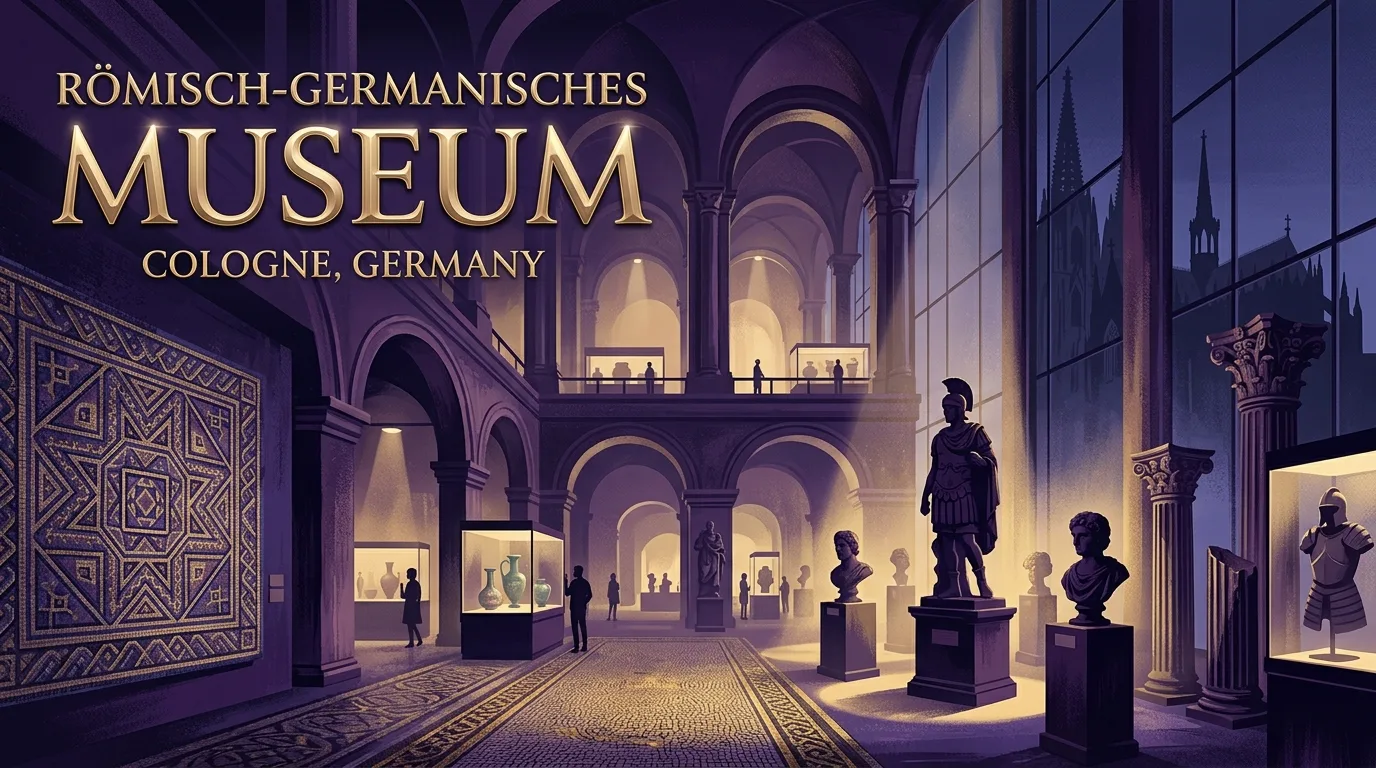
In the heart of Cologne's Altstadt-Nord district, just a short walk from the cathedral, the Römisch-Germanisches Museum preserves one of Germany's most important archaeological treasures: evidence of Colonia, the Roman city from which modern Cologne grew. At the center of the collection stands the world-famous Dionysus Mosaic, a floor mosaic covering more than 70 square meters that was discovered by chance during the construction of an air-raid shelter. Through glass, jewelry, tombstones, and everyday objects, the museum documents the lives of the people who settled along the Rhine around 2,000 years ago, revealing just how deep the city's Roman roots run. One important note for visitors: the traditional building on Roncalliplatz is currently undergoing extensive renovation, so the collection is temporarily on display at another location in central Cologne - anyone planning a visit should check the current exhibition venue in advance.
History of the Römisch-Germanisches Museum
The roots of the Römisch-Germanisches Museum reach back to 1946, when the Roman and Germanic departments of the Wallraf-Richartz-Museum were merged with holdings from the Museum für Vor- und Frühgeschichte to form an independent institution. The real impetus for the museum's founding, however, came in 1941, when a chance discovery was made during the construction of an air-raid shelter near the cathedral: workers uncovered an exceptionally well-preserved Roman floor mosaic, later known as the Dionysus Mosaic, depicting the wine god and his mythological retinue and dated to around 220-230 CE. The mosaic survived the war protected within the bunker and became the defining centerpiece of the new collection. The museum first opened to the public on November 24, 1961, initially still inside the former cathedral bunker itself. It was not until 1974 that the collection moved into a purpose-built structure designed by architects Heinz Röcke and Klaus Renner, erected directly above the original find site, whose striking concrete facade shaped the appearance of Roncalliplatz for decades. Since 2019, this building has been closed due to serious structural issues and is undergoing a fundamental renovation and expansion; as an interim solution, the collection moved to the so-called Belgisches Haus near Neumarkt, which opened as a temporary venue in November 2019. The renovation of the historic building, budgeted at around 177 million euros, has since faced repeated delays, meaning a return to the original Roncalliplatz site is not expected before the end of the decade. Visitors are therefore advised to always check the currently valid exhibition venue before planning a museum visit.
Highlights of the Römisch-Germanisches Museum
The undisputed centerpiece of the collection remains the Dionysus Mosaic, a floor mosaic covering more than 70 square meters, laid with extraordinary craftsmanship, which once decorated the dining room of a wealthy Roman town house and depicts the wine god Dionysus surrounded by figures from his mythological entourage. Almost equally impressive is the funerary monument of Lucius Poblicius, a roughly 15-meter-tall, tower-like monument that a Roman legionary veteran had built for himself and his family, today faithfully reconstructed and conveying the sheer monumentality of Roman funerary culture along the Rhine. The collection also includes one of the most extensive assemblages of ancient glass in the world: Cologne was a significant center of glass production in Roman times, and delicate drinking vessels, decorative glass, and window panes testify to a highly developed craft that was exported across the empire. Further exhibits include jewelry, coins, tools, and grave goods that together paint a vivid picture of everyday life in Colonia Claudia Ara Agrippinensium, as Cologne was officially named when it was elevated to city status in 50 CE. A particularly atmospheric stop is the so-called Ubiermonument, part of the oldest surviving stone structures north of the Alps, dating to the 1st century CE, which is open to visitors once a month, on the first Thursday from 2 to 5 p.m. Because the permanent exhibition is currently limited by the spatial constraints of the interim venue at Belgisches Haus, only a selection of the collection's overall holdings - which number well over 200,000 objects - is on display, yet the tour through the compact rooms remains an impressive journey through two millennia of urban history.
Opening Hours, Tickets & How to Get to the Römisch-Germanisches Museum
Because the historic building on Roncalliplatz is closed for ongoing renovation, the Römisch-Germanisches Museum currently welcomes visitors at the Belgisches Haus on Cäcilienstraße, just a short walk from Neumarkt. There, the collection is open Wednesday through Monday from 10 a.m. to 6 p.m., with Tuesdays closed. On the first Thursday of the month - except on public holidays - opening hours extend until 10 p.m., offering the chance for a quieter evening visit. Admission costs 6 euros for adults and 3.50 euros at the reduced rate; organized school groups are admitted free of charge. Since the interim venue is considerably smaller than the original museum building, waiting times can occur during busy periods, so larger groups are advised to register in advance. Getting there is straightforward: from the main railway station or the cathedral, Neumarkt is reachable on foot in about 15 minutes, and several tram lines also stop at Neumarkt, just steps from the Belgisches Haus. Because of nearby utility works, minor disruptions in the immediate surroundings are possible from time to time, so it is worth checking the official website before your visit, particularly since both the opening hours and the timeline for returning to the original Roncalliplatz site may still change.
Attractions Near the Römisch-Germanisches Museum
The interim venue near Neumarkt sits right in the middle of Cologne's bustling shopping district. From there, the lively Hohe Straße leads directly toward the cathedral, lined with shops and cafés perfect for a stroll. After about a ten-minute walk, visitors reach Roncalliplatz, where the original, currently scaffolded museum building stands right next to Cologne Cathedral - a glimpse of the construction site gives a sense of the scale of the ongoing renovation. Directly opposite stands Museum Ludwig with its world-renowned Picasso collection, making it easy to combine both museums into a single day. The historic Cologne City Hall, with its Gothic tower, and the adjoining Alter Markt square with its colorful facades are also just a few minutes' walk away. Visitors interested in the city's further Roman history can also find remnants of the ancient city wall and the edge of the Roman harbor scattered throughout the old town, still visible in places within the modern streetscape. For a break, the Alter Markt offers traditional brewery pubs where top-fermented Kölsch is served in its characteristic slim glasses.
Where to stay in Cologne, Germany
Compare current hotel prices and find the right place to stay.