Rheinpark
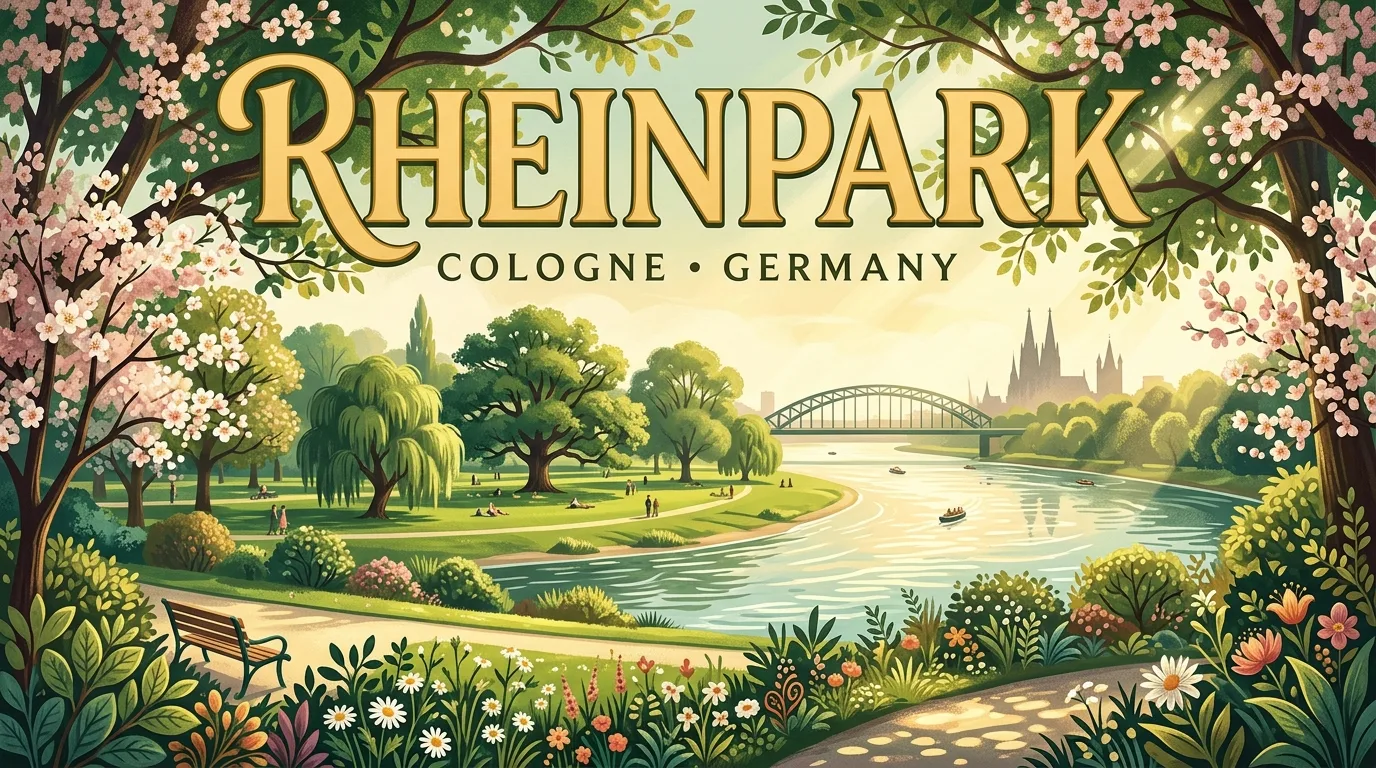
Rheinpark is one of Cologne's most important green spaces, stretching along the right bank of the Rhine between the districts of Deutz and Mülheim, directly facing the old town and Cologne Cathedral across the water. With its sweeping lawns, string of fountains, sculptures and themed gardens, it ranks among the most visited parks in the city. Unlike many classic nineteenth-century city parks, Rheinpark was only laid out in the twentieth century and has been substantially redesigned more than once, most notably for the 1957 Bundesgartenschau, Germany's federal garden show. Today it blends recreation with event culture: footpaths wind past the Cologne Cable Car station, the open-air Tanzbrunnen stage and the park's miniature railway, while families picnic on the open meadows and joggers and cyclists follow the riverside promenade. Rheinpark is therefore not only a green lung for the densely built right bank of Cologne, but also a place with its own layered history, protected as a listed garden monument since 1989.
History of Rheinpark
The origins of Rheinpark date back to the early twentieth century. Around 1907 the City of Cologne acquired the riverside land on the right bank from the military, which had previously used it as a drill and exercise ground. Under the direction of Cologne's garden director at the time, Fritz Encke, an initial generous park layout was completed by 1913, intended to give the rapidly growing right-bank districts of Deutz and Mülheim a representative green space along the river. The design followed the principles of the landscape park popular in many German cities at the time, with curving paths, water features and groups of trees.
The decisive transformation came in 1957, when Cologne hosted the Bundesgartenschau, the federal horticultural show. For this nationally significant event the park was substantially extended and redesigned, and many of the features that still define it today date from this phase: the circular fountain installation by hydraulic engineer Theo Breddermann, comprising fourteen individual fountains, ten of which are arranged in a ring; the artificial waterfall and rock-framed basin created by Josef Jaekel; and the rose garden surrounding the small Adenauerteich pond. The park's miniature railway, which has carried visitors along a narrow-gauge track through part of the grounds since 1971, also dates from this period of expansion, as do numerous sculptures by noted twentieth-century artists, including works by Gerhard Marcks and Georg Kolbe, which remain scattered across the grounds to this day.
Since 1989 Rheinpark has been protected as a listed garden monument, permanently preserving the historic structure created for the Bundesgartenschau. In 2007 the park received the honorary prize of the German Federal Garden Show Society and was voted "Germany's Most Beautiful Park" in a public poll, recognition of the careful stewardship of its historic fabric and the continuous maintenance of the grounds. The City of Cologne still manages Rheinpark as public parkland today, carrying out careful, targeted modernisation where needed, such as the technical overhaul of the adjoining Cologne Cable Car.
Highlights of Rheinpark
Rheinpark's best-known feature is almost certainly the Cologne Cable Car, which opened for the 1957 Bundesgartenschau and is often described as one of the first public river-crossing cable cars in Europe. Running for roughly 935 metres, the gondola ride takes about six minutes to cross the Rhine, linking Rheinpark with the left-bank district of Riehl, home to Cologne Zoo and the Flora botanical garden. Following a technical incident in 2017, the system underwent an extensive modernisation costing around €1.2 million and resumed operation in March 2019; it now runs seasonally between spring and autumn.
Right on the riverbank stands the Tanzbrunnen, an open-air stage with capacity for up to 12,500 visitors that has hosted concerts, festivals and open-air events since the 1950s and remains one of the city's most important event venues. Close by, the circular fountain arrangement with its fourteen individual water features produces an impressive interplay of light, water and movement, particularly on warm summer evenings when the jets are illuminated. The artificial waterfall with its rock-framed basin offers another, quieter retreat amid the otherwise open lawns.
Garden lovers will find the rose garden around the Adenauerteich densely planted with numerous historic and modern rose varieties that bloom from early summer into autumn, while the adjoining Mediterranean Garden, with oleander, lavender and sun-drenched water basins, creates an unexpectedly southern atmosphere for the Rhineland. Families and children particularly enjoy the park's play hill, with its slides and climbing elements, as well as the miniature railway, which has run along a child-friendly narrow-gauge line through part of the grounds since 1971. Visitors who prefer a quieter pace will repeatedly come across sculptures by significant twentieth-century artists on long walks along the riverside promenade, including works by Gerhard Marcks and Georg Kolbe placed among the lawns and tree groups. At the southern edge of the park, the Claudius-Therme spa invites visitors to relax in indoor and outdoor pools and saunas with views over the Rhine.
Opening Hours, Tickets & How to Get to Rheinpark
Rheinpark itself, as public parkland belonging to the City of Cologne, is freely accessible year-round and around the clock; there are no fences, gates or admission charge for simply spending time in the park. Visitors can therefore use the sweeping lawns, paths and themed gardens free of charge at any time, though a daytime visit is recommended to fully appreciate the garden layouts and fountains. Several facilities within the park, however, operate on their own independent schedules and in some cases charge admission: the Cologne Cable Car runs seasonally between March and November, the park's miniature railway mainly operates on weekends and during the summer months, and the Claudius-Therme is an independently run thermal spa requiring a separate entrance fee. For current operating times and prices for the cable car, the miniature railway and the Tanzbrunnen events calendar, it is worth checking the relevant operators' own pages directly, since schedules can vary by season and weather.
Rheinpark lies on the right bank of the Rhine between Deutz and Mülheim and is easy to reach by public transport. The nearest light-rail stops are "Deutz/Messe Köln" and "Köln Messe/Deutz" station, both within a short walk of the park, while several bus routes along the Deutz riverside also stop close to the main entrances. Cyclists can reach the park via the well-developed Rhine cycle path, which runs along both banks of the river and offers popular panoramic views of the old town and the cathedral. Visitors arriving by car will find several paid car parks and garages around Koelnmesse and the Lanxess Arena, since Rheinpark itself has no large dedicated car park of its own. The park also combines easily with a longer walk or cycle ride along the entire right-bank riverside promenade.
Attractions Near Rheinpark
Just a short walk from Rheinpark stands the striking KölnTriangle, a high-rise tower with a public observation deck roughly 103 metres above the ground, offering sweeping panoramic views over Cologne, the Rhine and the old town with its cathedral. Directly adjoining the park is the Koelnmesse trade fair complex together with the neighbouring Lanxess Arena, one of Germany's largest multi-purpose venues, which regularly hosts international concerts and sporting events. The Cologne Cable Car, or the nearby Zoo Bridge, provides a convenient connection to the left-bank district of Riehl, home to the long-established Cologne Zoo and the city's Flora botanical garden, making it easy to combine both parks into a single day out. On the opposite bank, within clear sight of the park, lies Cologne's historic old town with Cologne Cathedral, the Hohenzollern Bridge and the Museum Ludwig, all reachable within a short time via the pedestrian bridge or the cable car. The right-bank district of Deutz itself, with its restaurants, cafés and the historic St. Heribert parish church, also invites a relaxed stroll before heading back along the riverside.
Where to stay in Cologne, Germany
Compare current hotel prices and find the right place to stay.