Rautenstrauch-Joest-Museum
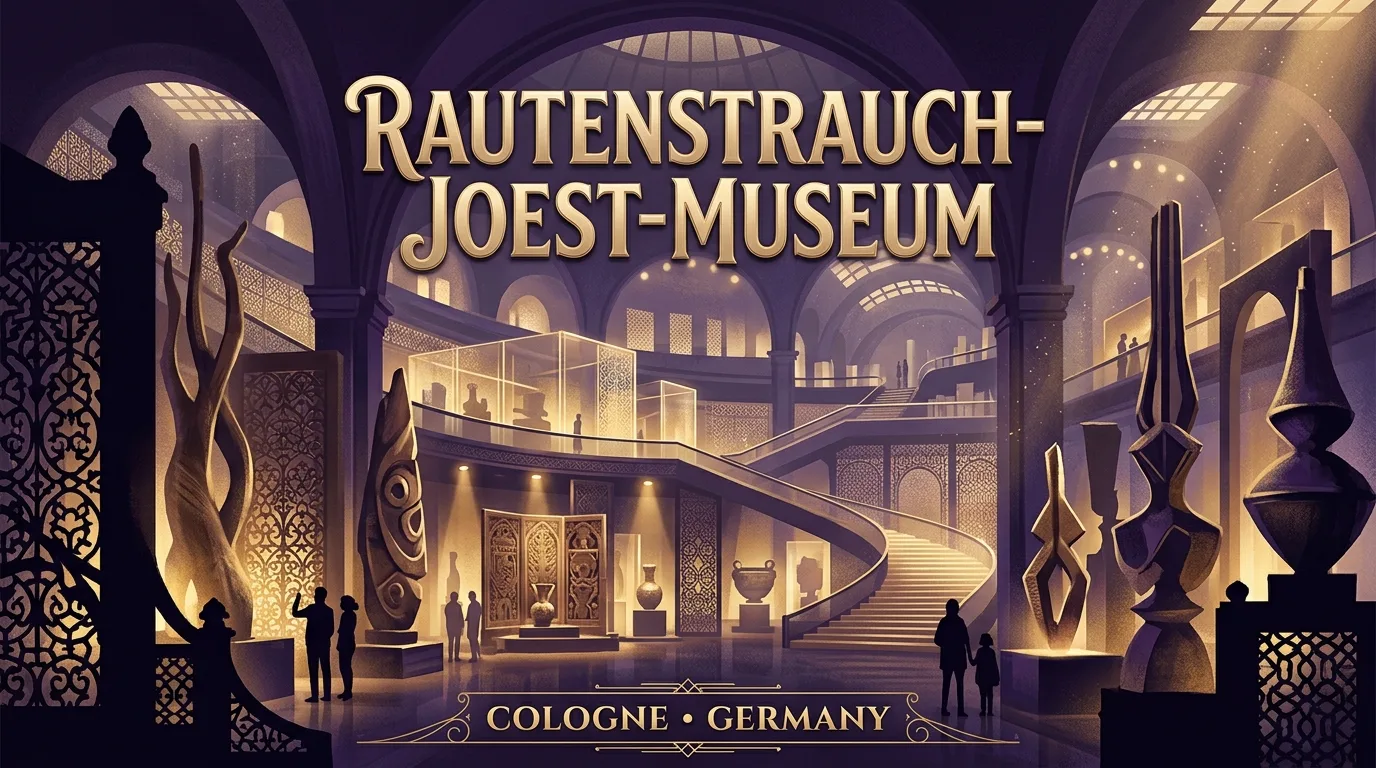
Right on Neumarkt, one of Cologne's most central squares, the Rautenstrauch-Joest-Museum uses roughly 3,600 square metres of thematic galleries to show how people on every continent live, believe, display status and deal with death. Founded in 1901 and open to the public since 1906, this museum of ethnology is one of Germany's largest ethnographic collections, today holding around 60,000 objects and about 100,000 historical photographs from Africa, Asia, the Americas and Oceania. Visitors are greeted in the foyer by the museum's largest single object, a striking 7.5-metre-tall rice granary from the Sa'dan Toraja people of Sulawesi, Indonesia, while a Javanese gamelan orchestra of more than 50 instruments sets the tone for the rest of the visit. Since reopening at its current location in autumn 2010, the museum has combined a cross-cultural presentation of life beyond Europe with a critical, internationally recognised engagement with its own colonial collecting history. Rotating special exhibitions, interventions by contemporary artists and an active provenance-research programme make the Rautenstrauch-Joest-Museum one of the most dynamic museums in the city.
History of Rautenstrauch-Joest-Museum
The history of the Rautenstrauch-Joest-Museum begins with Wilhelm Joest, a world traveller and son of a Cologne sugar manufacturer, who assembled a private collection of more than 3,500 ethnographic objects on his journeys. After his early death in 1897, he left the collection to his sister Adele, who lived in Cologne and was married to Eugen Rautenstrauch. In memory of her brother and her husband, who died shortly afterwards, Adele Rautenstrauch donated the collection to the city of Cologne in 1899 along with funding for a dedicated museum building, which was founded in 1901 and opened in 1906 in Cologne's Südstadt district on Ubierring. The museum's founding years coincided with the height of the German colonial movement, and a significant part of its historical collection dates from before the First World War; Julius Lips directed the museum from 1928 to 1934. During the Second World War, the building's north wing was destroyed down to the ground floor, and despite an extension in the early 1960s, the available space soon proved too small for the collection and its exhibitions. The catastrophic Cologne floods of 1993 and 1995 then rendered the underground storage depots unusable, making an entirely new building unavoidable. After fifteen years of planning and construction, the Rautenstrauch-Joest-Museum has presented a completely redesigned, cross-cultural permanent exhibition at Neumarkt since autumn 2010. The reopening brought the museum numerous awards, most notably the Council of Europe Museum Prize in 2012, a nomination for the European Museum of the Year Award that same year, and admission to the Excellence Club of Best in Heritage in 2013. Since returning a mummified Toi Moko head to Aotearoa/New Zealand in 2018, its first restitution, the museum has actively confronted its colonial collecting history and works closely with experts from the countries its objects originate from.
Highlights of Rautenstrauch-Joest-Museum
The permanent exhibition of the Rautenstrauch-Joest-Museum is titled "Der Mensch in seinen Welten" ("Humankind in its Worlds") and is divided into two main sections: "Grasping the World" explores the European gaze on other cultures as reflected in historical travel accounts, art and museums themselves, while "Shaping the World" presents diverse ways of life around the globe, from why living in a tipi was so practical to the meaning of ancestor figures and Maori tattoos. Among the collection's standout objects is the Sulawesi rice granary visible from the foyer, carved in the 1930s from wood, bamboo and rattan by the renowned carver Ne'Kambane. On the first floor, visitors learn more about founding collector Wilhelm Joest and the 1899 donation that started the museum, while the art department on the same floor brings together particularly refined objects from around the world; an installation by artist Nando Nkrumah, set up in 2020, critically addresses structural racism. The second floor houses further sections on clothing and jewellery, death and the afterlife, and belief. The regional strengths of the collection are considerable: Oceania alone accounts for around 18,500 objects, with a focus on Papua New Guinea and the Solomon Islands, while the Africa collection comprises roughly 15,000 objects, concentrated on the Democratic Republic of Congo, Cameroon, Tanzania, Togo and Namibia. The museum is further enriched by rotating special exhibitions and contemporary art interventions - currently the special show "r e t u r n," running from 17 September to 6 December 2026, which creates a new space between past and future inside the museum - as well as by its own gamelan ensemble, which visitors can even play themselves during dedicated workshops.
Opening Hours, Tickets & How to Get to Rautenstrauch-Joest-Museum
According to the current information on the museum's official website, the Rautenstrauch-Joest-Museum is open Tuesday to Sunday from 10 am to 6 pm, Thursdays until 8 pm, and on the first Thursday of every month even until 10 pm; on public holidays the regular hours of 10 am to 6 pm apply. The museum is closed on Mondays. Admission to the permanent exhibition costs 7 euros for adults and 4.50 euros at the reduced rate; groups of ten or more pay 4.50 euros per person. A particularly popular option is the combined ticket, priced at 10 euros or 7 euros reduced, which covers both the Rautenstrauch-Joest-Museum and the neighbouring Museum Schnütgen - a natural pairing, since both institutions share the same building complex on Cäcilienstraße. The museum is located at Cäcilienstraße 29-33, 50667 Köln, just steps from Neumarkt, one of the most important transport hubs in central Cologne, served by numerous light-rail lines. From there it is only a few minutes' walk to the Hohe Straße pedestrian shopping street and Cologne Cathedral. For questions, the museum can be reached by phone at 0221 / 221 - 313 56 or by email at [email protected]; exact details on online ticketing and any special opening hours during temporary exhibitions should always be checked on the official website before a visit, as these can change depending on the current programme.
Attractions Near Rautenstrauch-Joest-Museum
Its central location on Neumarkt makes the Rautenstrauch-Joest-Museum an excellent starting point for further discoveries in central Cologne. Within the very same building complex on Cäcilienstraße stands Museum Schnütgen, home to one of Europe's most important collections of medieval sacred art, which can easily be visited afterwards thanks to the combined ticket, without any time pressure. Via the Hohe Straße and Schildergasse pedestrian zones, Cologne Cathedral, Museum Ludwig and the Wallraf-Richartz-Museum on the Rhine are all just a few minutes away, while Kolumba and the Römisch-Germanisches Museum in Altstadt-Nord are also within walking distance. Visitors looking for something quieter will find small cafés, bookshops and the historic lanes of the southern old town close to Neumarkt. The Rhine promenade, with the Hohenzollern Bridge and views of the Cologne cable car, is also just a short tram ride or a longer walk away, making it an easy way to round off a day of museum-hopping in Cologne.
Where to stay in Cologne, Germany
Compare current hotel prices and find the right place to stay.