NS-Dokumentationszentrum im EL-DE-Haus
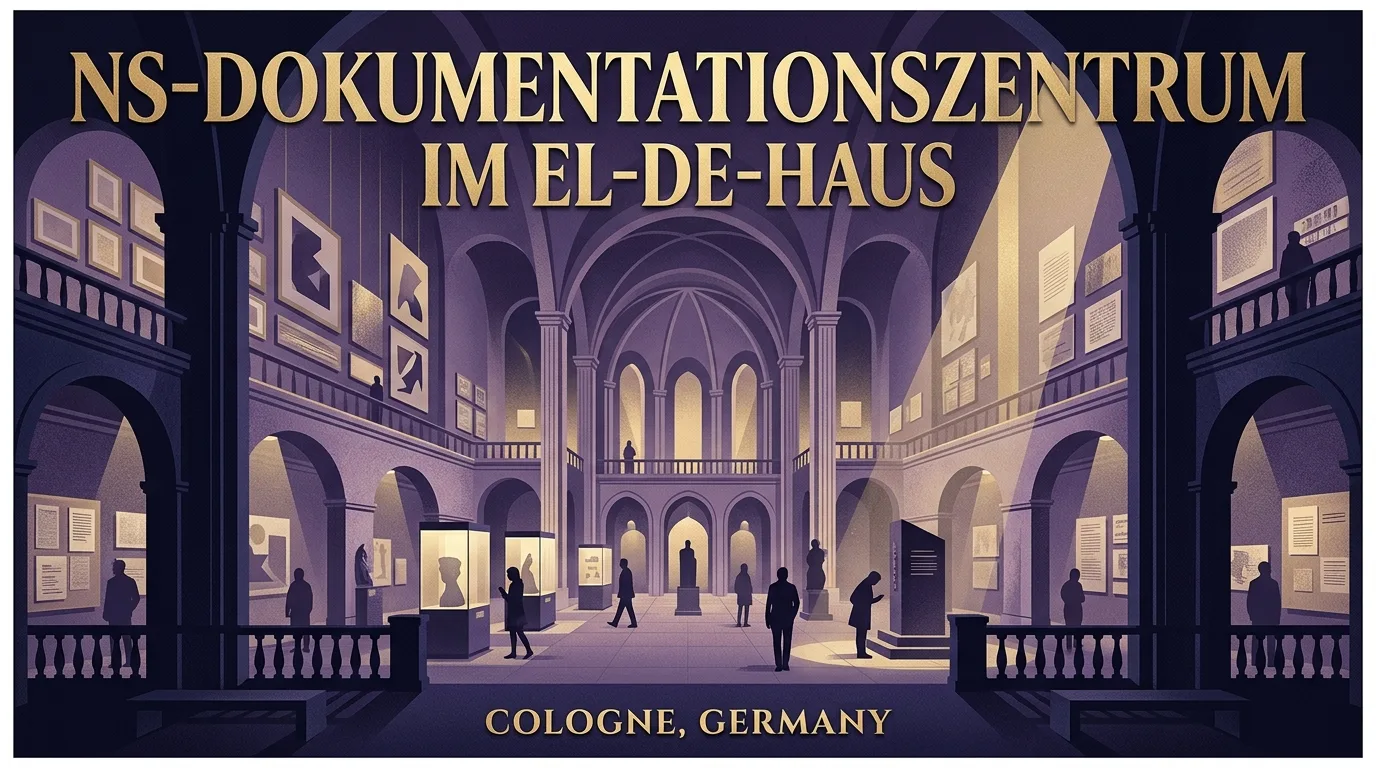
The NS-Dokumentationszentrum im EL-DE-Haus is Cologne's central memorial and educational site dealing with the history of National Socialism and ranks among the most important institutions of its kind in Germany. The building on Appellhofplatz served as the headquarters of the Cologne Gestapo from 1935 to 1945, and its basement functioned as a holding prison where thousands of men and women were interrogated, mistreated, and held before deportation or execution. Today the permanent exhibition "Cologne under National Socialism" spans several floors of the historic building and traces the history of persecution, resistance, and everyday life under the Nazi dictatorship, while the original prison cells in the basement, with their hundreds of inscriptions left by inmates on the walls, rank among the most powerful memorial sites in North Rhine-Westphalia. The NS-Dokumentationszentrum im EL-DE-Haus sees itself not only as a museum but as an active site of learning and research with an extensive education program for schools and adults alike.
History of NS-Dokumentationszentrum im EL-DE-Haus
The building was constructed in 1934/35 by the Cologne jewelry dealer Leopold Dahmen, whose initials "El-De" still give the house its name today. Even before construction was finished, the Gestapo requisitioned the modern commercial building and established its Cologne headquarters there, supplemented by an improvised prison in the basement. Between 1935 and 1945, an estimated more than ten thousand people passed through the building's cells, including resistance fighters, forced laborers, Jews, Sinti and Roma, as well as people persecuted as so-called "race defilers" and deserters; numerous Gestapo death sentences were carried out in the inner courtyard, particularly against Soviet and Polish forced laborers in the final months of the war. After the war ended, the building continued to serve various administrative purposes until a citizens' initiative in the 1970s fought successfully for the preservation of the prison cells and their inscriptions. A first memorial site was established in the basement in 1979, followed in 1981 by the opening of the NS-Dokumentationszentrum as a municipal institution with a formal museum mandate. Since then, the permanent exhibition has been revised and expanded several times, most recently with a stronger focus on individual biographies of victims and on digital forms of presentation; a gradual modernization of individual exhibition areas is still ongoing, without restricting regular museum operations. The institution has been closely intertwined with Cologne's urban history for decades and works closely with national-level Holocaust and Nazi-era memorial organizations.
Highlights of NS-Dokumentationszentrum im EL-DE-Haus
The central highlight is the original prison in the basement with its 29 cells, whose walls bear hundreds of inscriptions, drawings, and names left by inmates - harrowing, immediate testimonies from the final days of many prisoners' lives, now preserved behind protective glass and made accessible to visitors. The permanent exhibition "Cologne under National Socialism," on the second and third floors, documents the Nazi seizure of power, the persecution of political opponents, the deportation of Cologne's Jewish population, and everyday life and the end of the war in the city through photographs, documents, and personal objects. A dedicated section addresses civilian and military resistance, including the Cologne Edelweiss Pirates youth groups, some of whose members were shot in the courtyard of the EL-DE-Haus - a memorial plaque in the historic inner courtyard commemorates those executed there. The institution's own archive and library are open to researchers and relatives of victims and have enabled numerous biographical reconstructions over the past decades. Regular special exhibitions explore individual aspects such as forced labor in Cologne's industrial enterprises, the persecution of homosexual people, or the history of individual Cologne families under the Nazi regime. For school classes and groups, the house offers guided tours and project days that lead directly to the original sites in the basement, creating an immediate, largely unmediated access to history rarely preserved in this form at any other memorial site in Germany.
Opening Hours, Tickets & How to Get to NS-Dokumentationszentrum im EL-DE-Haus
The NS-Dokumentationszentrum im EL-DE-Haus is open Tuesday to Friday from 10am to 6pm, and Saturday, Sunday and public holidays from 11am to 6pm; on the first Thursday of each month the doors stay open until 10pm, with free admission for Cologne residents that evening. The site is closed on Carnival Thursday (Weiberfastnacht), Christmas Eve, Christmas Day, Boxing Day, New Year's Eve, and New Year's Day. Standard admission costs 4.50 euros, with a reduced rate of 2.00 euros for students, trainees, people with a disability rating of 50 percent or more plus one companion, volunteer service participants, and recipients of unemployment or basic income benefits; children and young people living in Cologne, Köln-Pass holders, and members of ICOM and the German Museums Association are admitted free of charge. The building is located in Altstadt-Nord directly on Appellhofplatz, just a few minutes' walk from Cologne's city hall and main train station. By tram, visitors can reach the Appellhofplatz stop via lines 3, 4, 5, and 16, or alternatively the Rathaus stop. Since the old town is largely car-free, public transport is the recommended way to arrive; public parking garages are available within reasonable walking distance at the edge of the old town.
Attractions Near NS-Dokumentationszentrum im EL-DE-Haus
Appellhofplatz sits centrally in Cologne's Altstadt-Nord, close to numerous other historic sites. Just a short walk away stands Cologne's city hall with its Gothic Rathausturm, beneath which the archaeological museum MiQua, dedicated to Cologne's Jewish history, is currently being built. Cologne Cathedral with its Shrine of the Three Kings and the neighboring Römisch-Germanisches Museum are a few minutes' walk away, as is Museum Ludwig with its collection of modern art. The Wallraf-Richartz-Museum & Fondation Corboud is also just a short stroll away, although it is currently closed due to extensive construction work. Visitors seeking a quieter moment after the moving visit to the EL-DE-Haus will find numerous traditional brewery pubs and cafés in the surrounding old-town streets. The Rhine riverfront promenade, with views of the Hohenzollern Bridge, is also reachable on foot in about ten minutes through the old town. Visitors wishing to engage more deeply with the subject can also make use of the museum's educational media library, which provides films, interviews, and teaching materials designed for classroom use.
Where to stay in Cologne, Germany
Compare current hotel prices and find the right place to stay.