Neumarkt
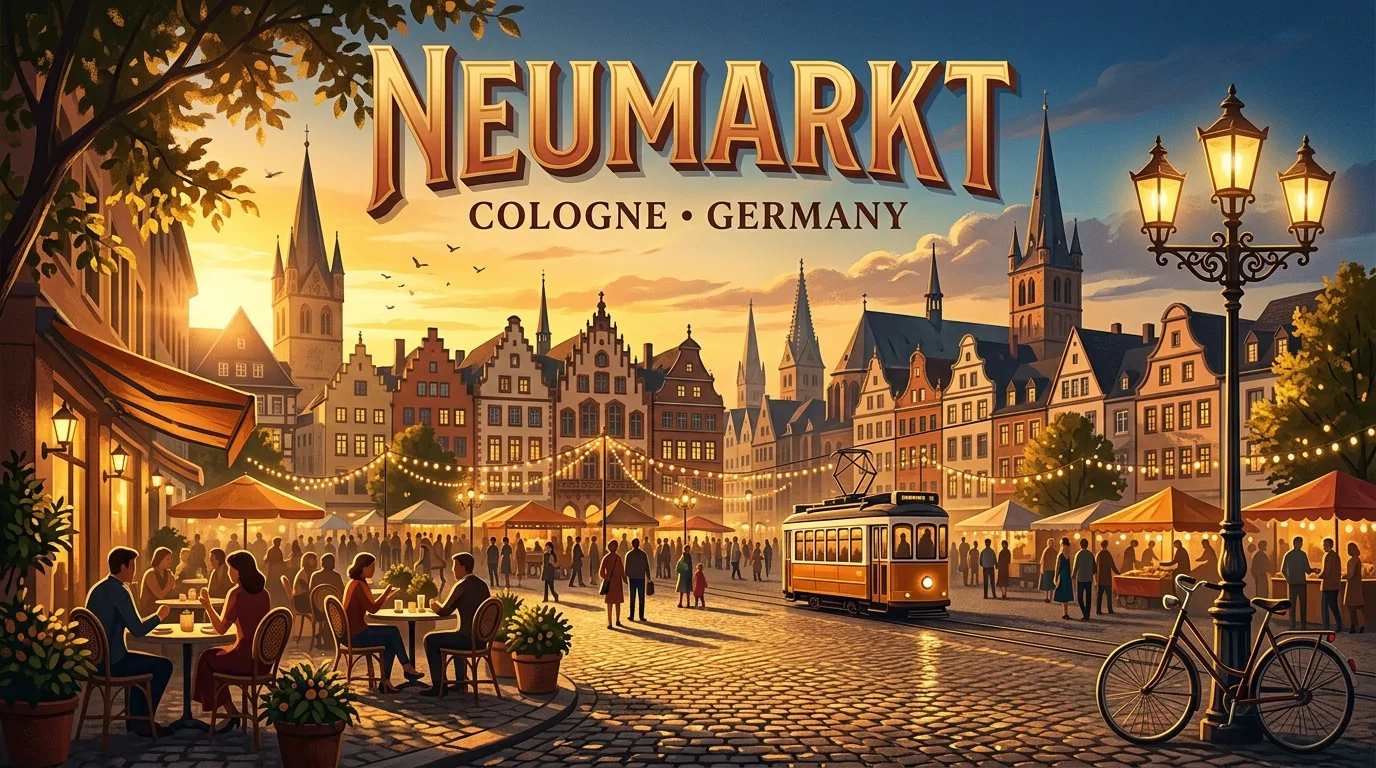
Neumarkt is the largest square in Cologne's Altstadt, covering around 27,000 square meters in the heart of the Altstadt-Süd district, just a few minutes' walk from Hohe Straße and Rudolfplatz. Despite its central location and proximity to the city's main shopping streets, Neumarkt has kept the character of a spacious, green urban square framed by historic churches, museums, and commercial buildings. Its name reflects the square's original function as a "new market," created in the Middle Ages to relieve pressure on the overcrowded Alter Markt. Today, Neumarkt is a lively meeting point for locals and tourists alike: office workers sit on benches in the sun at lunchtime, families gather around the fountains in the afternoon, and the square's landmark sculpture, Dropped Cone, has long been a fixture of any stroll through central Cologne.
History of Neumarkt
Neumarkt's documented history begins in 1076, when Archbishop Hildolf designated the square as in novo mercato to relieve the cramped Alter Markt; the area originally served as a market for horses, poultry, and cattle just outside the medieval city. As early as 1197, the square hosted a knightly tournament held at the request of Count Florenz of Hainaut, underlining its early role as a large, open gathering place. In 1392, the city built its first windmill on Neumarkt, a structure nearly 18 meters tall with a diameter of 10 to 12 meters that shaped the skyline for generations. Significant religious buildings grew up around the square: a predecessor of today's St. Aposteln church already existed in 965, and its striking west tower was begun in 1170. The Dominican convent of St. Gertrud received a three-aisled church in 1257, and the St. Agnes hospital with its own chapel followed in 1308/1309. Grand secular buildings shaped Neumarkt as well: the Hackeneyscher Hof at numbers 8 to 10 was built between roughly 1510 and 1520 as a palace-like residence where Emperor Charles V stayed in 1520 and 1531, while Napoleon Bonaparte reportedly spent two nights in the Blankenheimer Hof, built in 1758, before the building was demolished in 1912. In 1763, the city's first permanent theater, the Deutsche Schaubühne, opened on Neumarkt, followed by the opening of the Cologne Stock Exchange on 1 October 1830. A darker chapter in the square's history is tied to the Bing department store, which opened in 1909: in 1939, the Jewish Bing family was forced under Nazi persecution to sell the business to the city far below its true value, and the building later served as the city's health office. In 1943, the police headquarters on the square was completely destroyed in air raids.
Highlights of Neumarkt
Today, the best-known artwork on Neumarkt is Dropped Cone, an upside-down ice cream cone more than ten meters tall created by artists Claes Oldenburg and Coosje van Bruggen, which has crowned the roof of the Neumarkt-Galerie since 2001 and become an unofficial Cologne landmark in its own right. Equally striking is the Richmodisturm at number 6, a memorial tower topped with two stone horse heads, built in 1928 and faithfully rebuilt in 1958 after wartime destruction; it commemorates the medieval legend of Richmodis, a Cologne woman believed dead who was said to have freed herself alive from her own grave. Also architecturally impressive is the cultural center that opened on Neumarkt in 2010, housing the Rautenstrauch-Joest-Museum of world cultures in a striking new building 88.5 meters long and 24 meters tall that still blends harmoniously with its historic surroundings. Directly opposite stands the Käthe Kollwitz Museum, showing the artist's work since 1985, while the Lew Kopelew Forum, founded in 1999, is dedicated to German-Russian dialogue. Art lovers will also find the historic Kunsthaus Lempertz auction house, one of the oldest art dealers in Europe, right on the square. The massive Romanesque church of St. Aposteln, with its imposing west tower, closes off the square's southwestern side and ranks among Cologne's twelve great Romanesque churches. The spacious green area at the center of the square offers a place to rest, centered on a fountain with three jets first built in 1956; after being decommissioned in 1997, a fully renewed fountain went back into operation in 2025 and once again invites visitors to linger. The Neumarkt-Galerie, opened in 1998 with roughly 37,000 square meters of retail space, together with numerous cafés lining the square, also make Neumarkt one of the most important shopping and rest spots in the entire city center.
Opening Hours, Tickets & How to Get to Neumarkt
As a public square, Neumarkt is freely accessible at all times and charges no admission; only the surrounding museums, such as the Rautenstrauch-Joest-Museum and the Käthe Kollwitz Museum, keep their own opening hours, generally from Tuesday to Sunday, with regular ticket prices. Thanks to its central location in Altstadt-Süd, the square is easy to reach on foot, just a few minutes from Hohe Straße or Schildergasse. The best connection, however, is the underground light-rail station Neumarkt, in operation since 6 October 1969 and served by several lines, which means the square can be reached directly from almost anywhere in Cologne without changing trains. Numerous bus lines also stop nearby. Travelers arriving by car should take the Cologne Ring toward the city center, where a large public parking garage is available directly beneath the square and within the adjoining Neumarkt-Galerie. Cyclists will find plenty of bicycle parking around the square. The best time to visit is late morning or early afternoon, when both the green areas and the surrounding cafés are at their liveliest, although it can get considerably busier around Hohe Straße on designated shopping Saturdays. Travelers hoping to photograph Dropped Cone and the Richmodisturm undisturbed are best advised to come on a weekday morning.
Attractions Near Neumarkt
Just a few steps from Neumarkt begins Hohe Straße, one of Cologne's oldest and busiest shopping streets, leading directly to Cologne Cathedral. Heading south, visitors quickly reach Rudolfplatz, with its medieval Hahnentorburg gate and lively nightlife along the Ring boulevards. The Cäcilienkirche, home to the Museum Schnütgen of medieval art, is also within walking distance and pairs well with a visit to the Rautenstrauch-Joest-Museum. To the north, Schildergasse, another major shopping street, leads all the way to Alter Markt and the town hall. Travelers seeking cultural variety will find one of Cologne's finest Romanesque buildings right on the square itself in St. Aposteln, while the nearby Belgisches Viertel, with its independent boutiques, cafés, and bars, offers a clear contrast to Neumarkt's shopping atmosphere. For a green getaway, the nearby Hiroshima-Nagasaki-Park is likewise within walking distance of Neumarkt.
Where to stay in Cologne, Germany
Compare current hotel prices and find the right place to stay.