Museum Ludwig
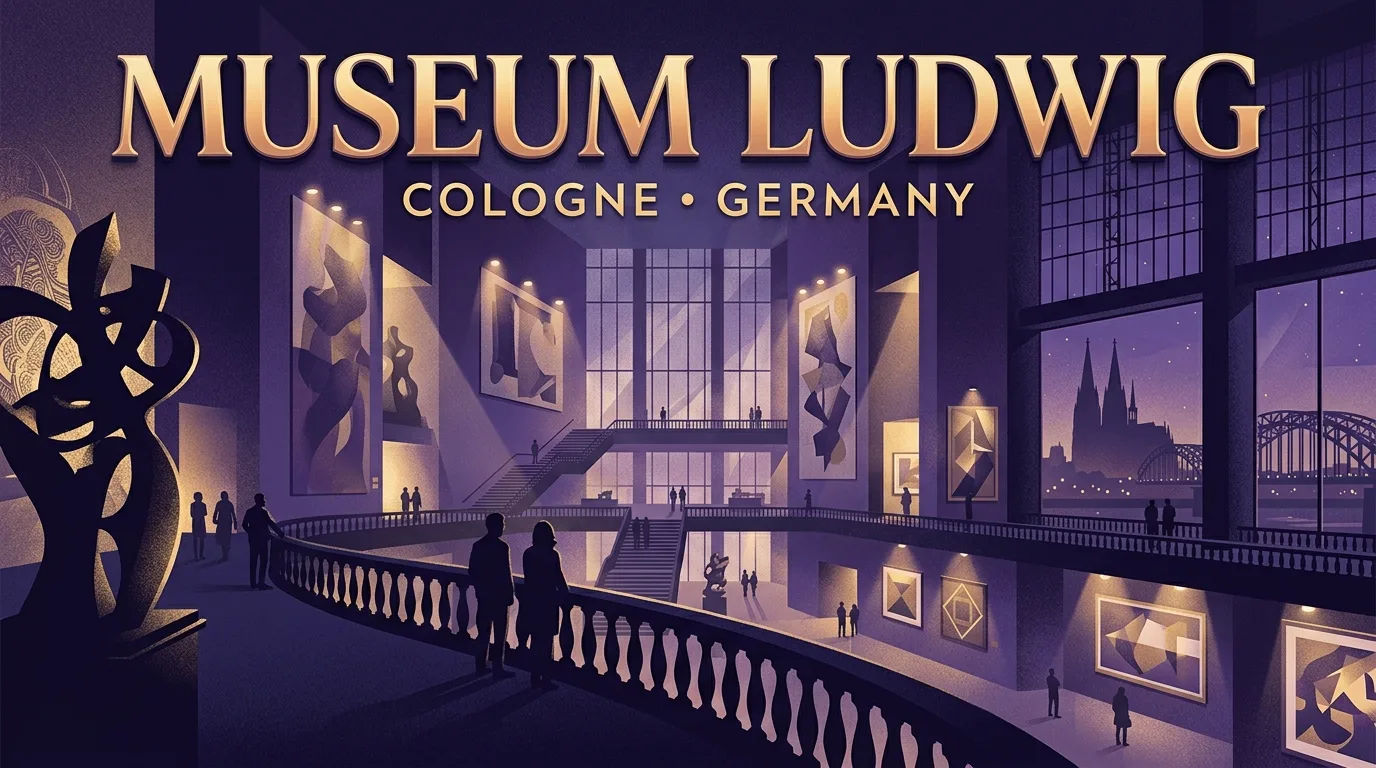
A few steps from Cologne Cathedral, right on the so-called Domplatte near the main train station, stands Museum Ludwig - one of Europe's most important museums for modern and contemporary art. Wander through its generous galleries and you will find works by Pablo Picasso, Andy Warhol, Max Ernst, and Alexander Rodchenko hanging in close dialogue with photographs spanning a century and a half. Museum Ludwig takes its name from the collector couple Peter and Irene Ludwig, whose 1976 donation laid the foundation for one of Germany's most wide-ranging art collections. Today the museum is considered essential for anyone interested in twentieth- and twenty-first-century art, and it forms one of the architectural landmarks of Cologne's Altstadt-Nord district, standing in the literal shadow of the Gothic cathedral.
History of Museum Ludwig
The story of Museum Ludwig begins not with a building but with a gift. In 1976, the Aachen-based collectors Peter and Irene Ludwig donated around 350 artworks to the city of Cologne, the majority of them Pop Art pieces by Andy Warhol, Roy Lichtenstein, and Claes Oldenburg - artists barely shown in Europe at the time. The donation was so extensive that it changed the name of the existing Wallraf-Richartz-Museum, which briefly became the Wallraf-Richartz-Museum/Museum Ludwig, before the collection gained its own building and independent identity in 1986. That year, the collection moved into a purpose-built structure designed by Cologne architects Peter Busmann and Godfrid Haberer, situated directly beside the cathedral. The building is instantly recognizable by its distinctive sawtooth roofs, and its interior volume of roughly 260,000 cubic meters roughly equals that of the cathedral itself. Even before the Ludwig donation, the city already held an important foundation of Expressionist art through the Haubrich Collection: Cologne lawyer Josef Haubrich donated about 90 works by German Expressionists in 1946, including paintings by Ernst Ludwig Kirchner and Erich Heckel, many of which had been branded "degenerate" and persecuted under National Socialism. In 1977, the Agfa Photo-Historama added one of the world's largest collections devoted to the history of photography, comprising roughly 70,000 original prints and historic cameras documenting the medium since the 1840s. Over the following decades, further acquisitions, long-term loans, and gifts - particularly in Russian avant-garde art from 1905 to 1935 - expanded the holdings further, establishing Museum Ludwig as one of the internationally most respected institutions for modern art.
Highlights of Museum Ludwig
The heart of the collection is its Picasso department, which, with several hundred paintings, sculptures, ceramics, and graphic works, ranks as the third-largest Picasso collection in the world, after the museums in Paris and Barcelona. Visitors encounter pieces from nearly every phase of the artist's career, from Cubist compositions to the playful late ceramics Picasso produced in his final years in Vallauris. Directly adjoining this is one of Europe's most extensive Pop Art collections: Andy Warhol's silkscreens, including portraits and his well-known death-and-disaster motifs, hang alongside works by Roy Lichtenstein, Claes Oldenburg, and James Rosenquist. The Haubrich Collection places German Expressionism in dialogue with this American art - paintings by Ernst Ludwig Kirchner, Erich Heckel, and Otto Dix testify to both the flourishing and the violent suppression of this movement under National Socialism. For anyone interested in photography, the museum's dedicated photography collection is a highlight in its own right: the Agfa Photo-Historama displays daguerreotypes from the 1840s alongside the systematic portrait series of August Sander, whose project "People of the 20th Century" documents Weimar-era German society with unprecedented clarity. Russian avant-garde art is represented through works by Alexander Rodchenko and El Lissitzky, revealing the radical visual language forged between revolution and Stalinist repression. Alongside the permanent collection, Museum Ludwig regularly stages major temporary exhibitions that connect contemporary positions with its historical holdings - recent and upcoming shows have explored transatlantic connections in modern art and presented monographic surveys of younger artists. Visitors are well advised not only to set aside time for the permanent galleries but also to check the current special-exhibition program before their visit.
Opening Hours, Tickets & How to Get to Museum Ludwig
Museum Ludwig is open Tuesday to Sunday, including public holidays, from 10 a.m. to 6 p.m.; the museum is closed on Mondays. An exception is the first Thursday of every month (unless it falls on a public holiday), when the museum stays open until 10 p.m. - a popular slot for a relaxed evening visit away from weekend crowds. Standard admission to the permanent collection costs 15.40 euros for adults and 10.40 euros at the reduced rate; children and teenagers under 18 are admitted free of charge. On the extended Thursday evening, a special rate of 7 euros applies from 5 p.m. onward, and residents of Cologne are admitted free of charge all day - a reflection of how strongly the museum sees itself as an institution for its own city. Tickets can be booked conveniently through the museum's online shop, which is particularly advisable during popular temporary exhibitions. Because opening hours and prices can change, it is worth checking the official website shortly before your visit. In terms of getting there, Museum Ludwig could hardly be more central: Cologne's main railway station is a few minutes' walk away, as is the Dom/Hauptbahnhof stop served by numerous tram and bus lines. Visitors arriving by car will find several parking garages nearby, though given the central location, public transport is generally the more practical option.
Attractions Near Museum Ludwig
Museum Ludwig's location on the Domplatte makes it an ideal starting point for exploring Cologne's Altstadt-Nord district. Right next door rises Cologne Cathedral, with its striking 157-meter towers - a visit inside the cathedral or a climb to its viewing platform combines easily with a museum visit. A short walk away stands the building on Roncalliplatz traditionally home to the Römisch-Germanisches Museum and its famous Dionysus Mosaic; due to extensive renovation work, the collection is currently displayed at the Belgisches Haus near Neumarkt. Heading toward the Rhine, the route crosses the Hohenzollern Bridge, whose fences are covered with thousands of padlocks left by couples, making it one of the city's most photographed spots. The Cologne Philharmonic Hall, whose roof lies directly beneath Museum Ludwig, is also part of the immediate Domplatte ensemble. For a riverside stroll, the Rhine promenade offers lovely views of the old town and the cathedral - a relaxing way to end a morning spent among the galleries.
Where to stay in Cologne, Germany
Compare current hotel prices and find the right place to stay.