Kolumba – Kunstmuseum des Erzbistums
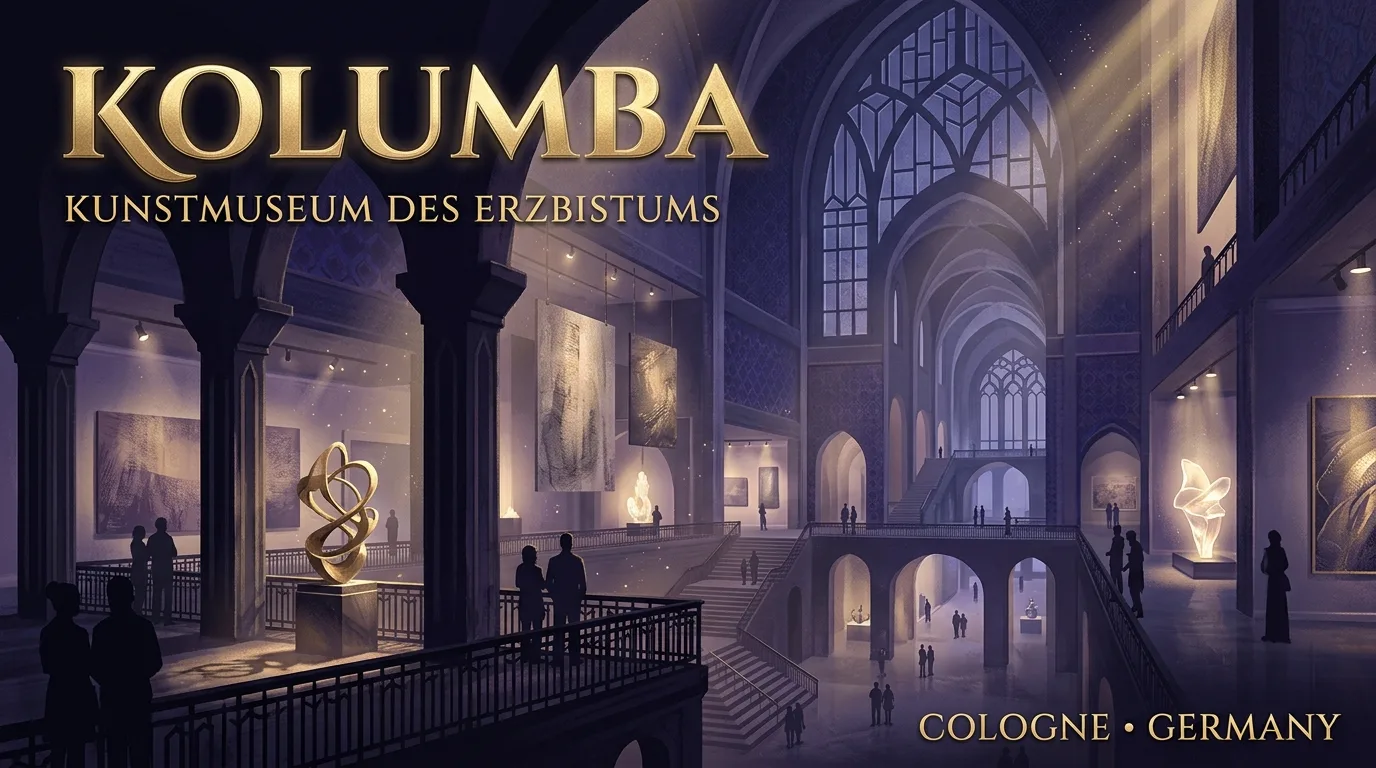
In the heart of Cologne's Altstadt-Nord district, just a short walk from Cologne Cathedral and the main train station, stands one of Germany's most architecturally striking museums: Kolumba – Kunstmuseum des Erzbistums. Opened in 2007 to designs by Swiss architect Peter Zumthor, the building rises directly above the excavated foundations of the late-Gothic parish church of St. Kolumba, almost completely destroyed during Allied bombing raids in the Second World War, and above the small chapel "Madonna in the Ruins," built by architect Gottfried Böhm in 1950. Inside, the museum weaves together archaeological layers spanning Roman, medieval and early-modern Cologne with an art collection ranging from late antiquity to the present day. Rather than a fixed permanent display, Kolumba presents an entirely new, thematically connected exhibition every single year, so that even returning visitors keep discovering fresh dialogues between ancient relics, Gothic sculpture and contemporary art. This fusion of archaeological site, modern sacred architecture and ever-changing collection display makes Kolumba one of the most contemplative yet intense museum experiences in the city.
History of Kolumba – Kunstmuseum des Erzbistums
The history of Kolumba – Kunstmuseum des Erzbistums reaches far beyond the current building. The museum is the successor to the Archdiocesan Museum of Cologne, an institution whose roots go back to the second half of the 19th century and whose directors included Johann Baudri, Friedrich Baudri, Alexander Schnütgen, Franz Bock, Hermann J. Schmitz, Arnold Steffens, Jakob Eschweiler, Wilhelm Neuß, Joseph Hoster and Walter Schulten. Alexander Schnütgen, whose collection of medieval art later gave its name to today's Schnütgen Museum, helped shape the sacred-art collecting tradition that Kolumba continues to this day. Under director Joachim M. Plotzek, an international architecture competition for a new building on Kolumbastraße was launched in 1997, which Peter Zumthor won. After an intensive planning period that included a dedicated workshop year in 2001, the foundation stone was laid in 2003, the topping-out ceremony followed in 2006, and the new building was consecrated in 2007. Central to both the urban and spiritual concept of the design was how to treat the ruins of the Gothic church of St. Kolumba, almost entirely destroyed during the air raids on Cologne in 1943. As early as 1950, Cologne architect Gottfried Böhm had already built the small octagonal chapel "Madonna in the Ruins" directly within these ruins – an early sign of post-war reconstruction that Zumthor deliberately incorporated into his new building rather than concealing it. Beneath today's museum floor, archaeologists uncovered continuous layers of settlement from Roman times through the Middle Ages to the present, and these excavated remains are still preserved and accessible to visitors. Since opening in 2007, an anniversary the museum celebrated ten years later in 2017, Kolumba has been regarded internationally as one of the most significant examples of contemporary sacred and museum architecture in Germany.
Highlights of Kolumba – Kunstmuseum des Erzbistums
Even from the outside, Kolumba – Kunstmuseum des Erzbistums is instantly recognisable by its distinctive façade, built from a slender brick format developed specifically for the building and laid with irregular openings that let daylight filter into the interior at constantly shifting intensities. On the ground floor, a circuit leads visitors through the excavated archaeological layers, past Roman foundations and medieval masonry and alongside Gottfried Böhm's chapel "Madonna in the Ruins," before staircases rise into the tall, variously proportioned exhibition halls on the upper floors. Among the collection's most frequently cited groups of works are medieval reliquary crosses, Romanesque and Gothic Madonna figures, liturgical goldsmith work, and a remarkable group of illuminated books of hours, including the Laval Book of Hours, the Bruges Book of Hours and the Manderscheid Book of Hours, among the most valuable manuscripts in the collection. These historical holdings are placed in dialogue with modern and contemporary art in each year's newly curated exhibition: in recent years Kolumba has shown works by Andy Warhol, Richard Serra, Wolfgang Laib, Joseph Marioni, Hans Josephsohn, Leiko Ikemura, Paul Thek and Terry Fox alongside medieval sculpture and early Christian Coptic textiles from Egypt. Visitors also value the museum's purpose-built experiential spaces such as the "Night Space Silence" and the "Art Space Sound," rooms where art, architecture and acoustics are deliberately combined to invite quiet concentration. As in every previous year, the current annual exhibition is built around a new curatorial theme that recasts the entire collection, so that even regular visitors experience the museum completely anew each time they return.
Opening Hours, Tickets & How to Get to Kolumba – Kunstmuseum des Erzbistums
According to the museum's official website, Kolumba – Kunstmuseum des Erzbistums is open daily from 12 noon to 5 pm, with the museum closed on Tuesdays. Guided tours before noon or after 5 pm are available only by prior arrangement. The museum also closes from the Thursday before Lent (Weiberfastnacht) through Ash Wednesday, on Christmas Eve and Christmas Day, and on New Year's Eve and New Year's Day. Because the exhibition is completely rebuilt every year, Kolumba additionally closes for several weeks in late summer – most recently from mid-August to mid-September – so visitors should check the exact dates on kolumba.de before planning a visit. Admission costs 8 euros for adults and 5 euros at the reduced rate; visitors under 18 are admitted free of charge. Regular visitors can buy an annual season ticket, valid from the date of purchase, for 30 euros, or 20 euros at the reduced rate. Reduced rates apply to pupils, trainees, students, members of the International Association of Art (IAA), people doing voluntary service, Cologne Pass holders, and people with disabilities together with their carer; no reduction is available for groups. Tickets are sold exclusively at the museum's ticket desk, as there is no online advance sale. Kolumba is located at Kolumbastraße 4, 50667 Köln, right in the Altstadt-Nord district and only about an eight-minute walk from Cologne's main train station. The nearest light-rail stop is Appellhofplatz (Breite Straße exit), with bicycle racks available close by, while drivers are best served by the Brückenstraße or Opera Passage parking garages.
Attractions Near Kolumba – Kunstmuseum des Erzbistums
Its location in the heart of Altstadt-Nord makes Kolumba – Kunstmuseum des Erzbistums an excellent starting point for a day of museum-hopping in central Cologne. Within a few minutes' walk, visitors can reach Cologne Cathedral and its treasury, as well as the Römisch-Germanisches Museum, which documents the city's Roman-era history. The Wallraf-Richartz-Museum and Museum Ludwig, with their collections of European painting and modern art, are also just a short stroll away along the Rhine. Close to the neighbouring Appellhofplatz stop stands the NS-Dokumentationszentrum, housed in the former EL-DE-Haus, which documents the history of Nazi persecution in Cologne. Visitors wishing to explore Gothic sacred art further will find the Schnütgen Museum on Cäcilienstraße, barely a ten-minute walk to the south, home to one of Europe's most important collections of medieval church art. The shopping street Breite Straße, the Alter Markt with its historic town hall, and the Rhine promenade with views of the Hohenzollern Bridge are all within easy walking distance too, making it simple to combine a visit to Kolumba with other highlights of the old town.
Where to stay in Cologne, Germany
Compare current hotel prices and find the right place to stay.