Historisches Rathaus
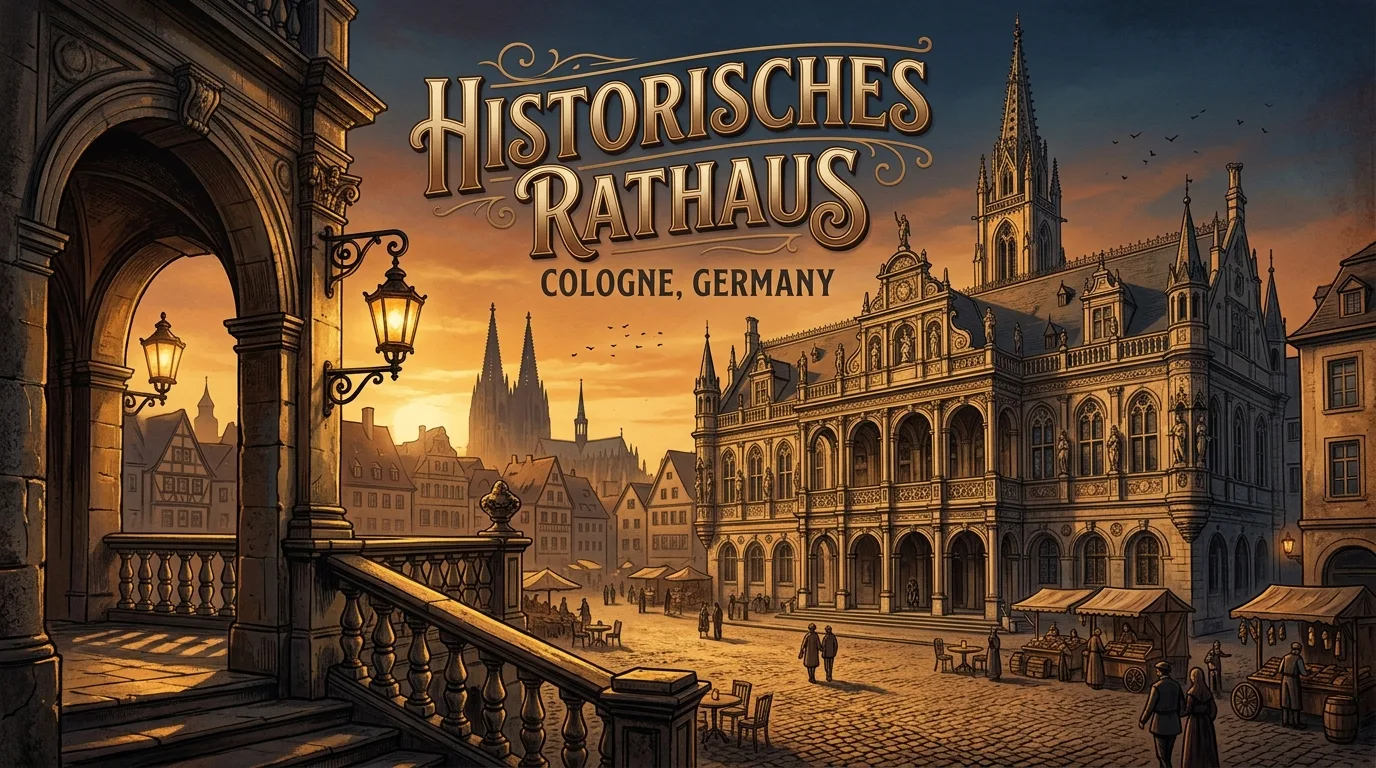
In the very heart of Cologne's old town, just a short walk from Alter Markt and the banks of the Rhine, stands the Historisches Rathaus - a building ensemble that has grown over more than eight centuries and still serves today as the seat of the city administration. Based on its surviving architectural fabric, it is considered the oldest city hall in Germany. Here, a late-Gothic tower, an ornate Renaissance loggia, the Dutch-style Spanischer Bau and archaeological remains of a Roman praetorium merge into a unique architectural palimpsest. Anyone walking through the narrow Rathausgasse onto Rathausplatz is confronted with a building that has survived Hanseatic assemblies, imperial visits, wartime destruction and an elaborate postwar reconstruction, yet never lost its original function as the political center of the city. For visitors to Cologne, the Historisches Rathaus is therefore far more than an administrative building: it is a stone history book that tells of the medieval heyday of the trading city as much as of its destruction and rebuilding in the twentieth century.
History of Historisches Rathaus
The documented history of the site goes back to 1135/1152, when a "domus in qua cives conveniunt" - a house where citizens gathered - was first mentioned in written records. By around 1149, this meeting house stood in what was then the city's Jewish quarter. The oldest surviving part of the complex, the Gothic council hall, dates to around 1330 and replaced an earlier Romanesque building. As early as 1349, the building was damaged during the pogroms against the Jewish community, a dark chapter inseparable from the site's history. A defining moment occurred on 19 November 1367 in the Hansasaal, where numerous Hanseatic cities formed an alliance against the Danish king Waldemar IV, underlining Cologne's political weight within the late-medieval urban league. Between 1407 and 1414, the imposing Ratsturm, or council tower, was built under the direction of the treasurer and master builder Roland von Odendorp. Standing 61 meters tall, with two square lower stories and two octagonal stories above, the tower recalls Dutch belfries in form and originally served to safely store the city's charters, privileges and bonds. Between 1569 and 1573, the council commissioned an elaborate Renaissance loggia for the west facade, costing around 110,000 gold guilders and decorated with reliefs and marquetry. The Löwenhof courtyard was created in 1540/41 by master builder Laurenz von Kronenberg as an open arcaded court and was enclosed in 1548 during an expansion toward Alter Markt; its name recalls the legend of mayor Hermann Gryn fighting a lion, a symbol of the citizenry's power struggle against clerical and patrician rivals. Between 1608 and 1615, master mason Matthias von Gleen built the Spanischer Bau in Dutch late-Renaissance style, named after peace negotiations held there by the Spanish League in August 1623. After the French occupation (1794-1811) and the transfer to Prussian rule in 1815, the Rathaus remained the city's political center. The Second World War devastated Cologne: roughly 90 percent of the inner city was destroyed, and the Hansasaal burned out completely. Reconstruction stretched from the 1950s to the completion of the rebuilt Spanischer Bau in 1956 under senior building officer Theodor Teichen and city building director Franz Löwenstein, with excavations during the works also uncovering the foundations of the ancient Roman praetorium.
Highlights of Historisches Rathaus
The Ratsturm is the building's unmistakable landmark: its facades once again carry historical figure programs. Originally around 80 stone figures adorned the tower, most of which had badly weathered by 1800. Between 1988 and 1995, 124 replacement figures were installed, but these had to be removed again in 2006 due to conservation problems; since July 2008, new figures carved from Savonnières limestone have decorated the tower. A particular favorite among visitors is the "Platzjabbeck," a grotesque head wearing a slouch hat that sticks out its tongue on the east side of the tower every hour on the hour - a figure dating to the 15th century that has been mechanically animated since 1913. Since 1958, the tower has also housed a carillon of 48 bronze bells weighing 14 tons in total, donated by Cologne's guilds and prominent citizens, including Konrad Adenauer. Melodies from a repertoire of 24 pieces ring out daily at 9, 12, 3 and 6 pm; at noon, the carillon plays Karlheinz Stockhausen's "Tierkreis - 12 Melodien der Sternzeichen," a globally unique pairing of medieval architecture and contemporary composition. Inside, the Hansasaal impresses with its restored high-Gothic form: the south wall depicts the "Nine Worthies" according to the teachings of Augustine - three pagans (Alexander the Great, Hector, Julius Caesar), three Jews (Judas Maccabeus, David, Joshua) and three Christians (Godfrey of Bouillon, King Arthur, Charlemagne) - while the north wall shows eight prophet figures based on models from around 1440. The ornate marquetry portal was created around 1600 by Melchior von Reidt. The Löwenhof, with its Gothic rib-vaulted ambulatory and Baroque alabaster Petersbrunnen fountain, invites visitors to linger, while in the Spanischer Bau the exposed Roman foundation remains of the praetorium offer a rare glimpse into the city's antiquity. The piazzetta in front of the Rathaus, a roughly 900-square-meter plaza, is a popular meeting point and also the best vantage point to take in the building's varied facades at a glance.
Opening Hours, Tickets & How to Get to Historisches Rathaus
The forecourt, the piazzetta and the exterior facades with the Ratsturm, the Renaissance loggia and the Löwenhof can be viewed free of charge at any time, since these are publicly accessible plazas within the pedestrianized old town. As the Rathaus continues to serve as the active seat of Cologne's city administration, access to historic interior spaces such as the Hansasaal is generally limited to the administration's usual business hours on weekdays and can be further restricted by council sessions, weddings or events; closed interiors should be expected on weekends and public holidays. For a visit to the tower interior and the historic halls, it is advisable to check current guided tour dates directly with KölnTourismus or the official City of Cologne website, since interior visits are usually only possible as part of organized tours and both schedules and any fees can vary. The Historisches Rathaus sits centrally in the old town at Rathausplatz 2, 50667 Köln, only about 600 meters, or a ten-minute walk, from Cologne Cathedral. By public transport, the most convenient stops are the Stadtbahn stations Appellhofplatz or Heumarkt, served by several KVB lines, from where it is just a short walk through the narrow lanes of the old town. Since the historic core is entirely pedestrianized, arriving by bus, train or on foot is recommended over driving.
Attractions Near Historisches Rathaus
The Historisches Rathaus's location in the middle of the old town makes it an ideal starting point for a walk through historic Cologne. Just about 300 meters away stands the Gürzenich, the late-Gothic festival hall whose turbulent history is closely intertwined with that of the Rathaus. Also nearby is the Romanesque church of Groß St. Martin, whose distinctive four-tower crossing, together with the Ratsturm, defines the old town's skyline. A few minutes further on foot brings you to Alter Markt and Fischmarkt by the Rhine, two of the city's oldest squares lined with traditional breweries and restaurants. The Overstolzenhaus on Rheingasse, one of the best-preserved Romanesque patrician houses in Germany, is also only about 500 meters away and well worth a detour. Culturally minded visitors can take a short walk to Cologne Cathedral, about ten minutes to the northwest, which together with the Rathaus illustrates the city's historic power center, with secular and ecclesiastical authority standing side by side. The Rhine promenade, with views of the Hohenzollern Bridge and the Kranhäuser in Rheinauhafen, is also within comfortable walking distance and makes for a relaxed way to end a tour of the old town.
Where to stay in Cologne, Germany
Compare current hotel prices and find the right place to stay.