Groß St. Martin
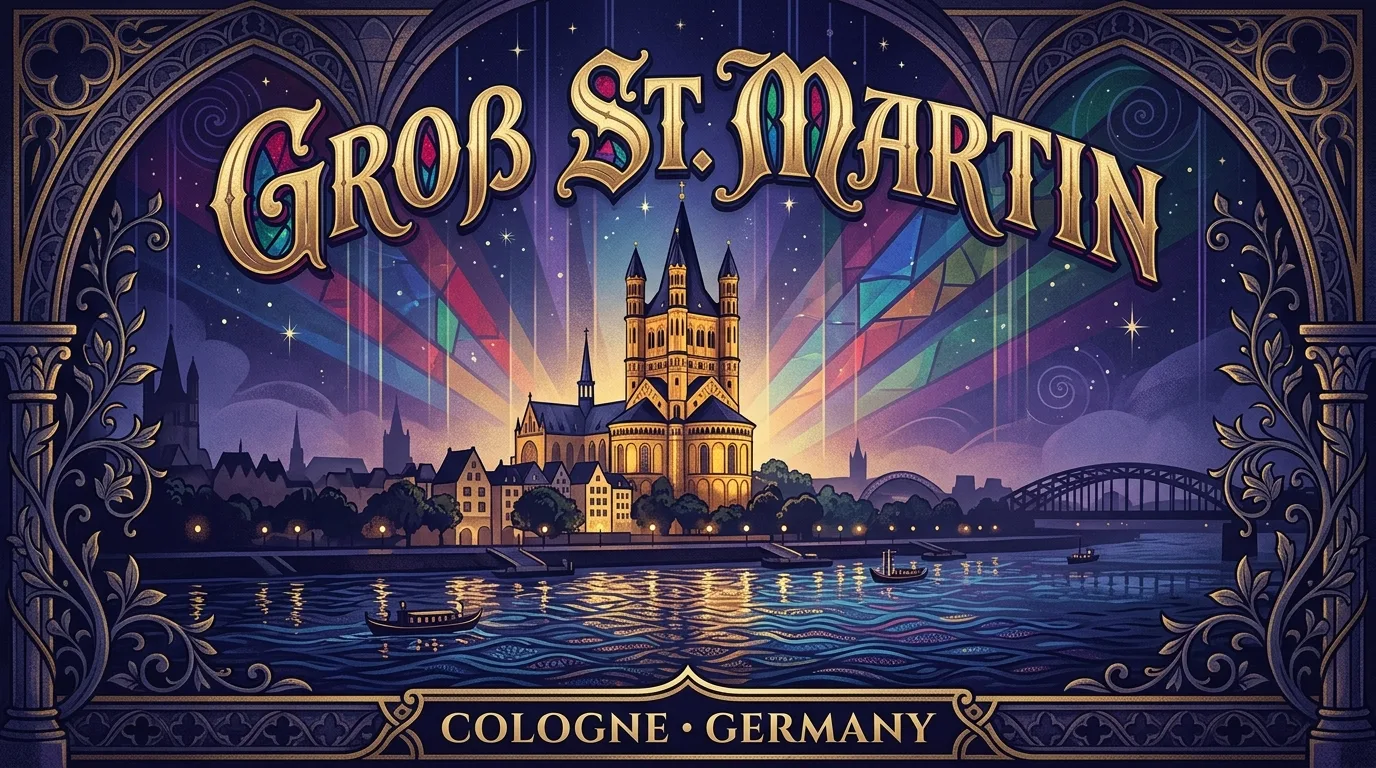
Groß St. Martin forms one of the most recognizable silhouettes along the Cologne riverfront, and together with Cologne Cathedral it makes up the city's most photographed postcard view. This Romanesque church rises in the heart of the Altstadt-Nord district on what was once a Rhine island, the so-called Martinsinsel, just steps from the colorful half-timbered houses of the Fischmarkt. Its striking crossing tower, flanked by four slender corner turrets, reaches a height of roughly 75 meters and has served sailors and travelers on the Rhine as a landmark for centuries. As one of the twelve great Romanesque churches of Cologne, Groß St. Martin ranks among the most important examples of medieval sacred architecture in Germany and still displays the characteristic triconch choir that makes Cologne's Romanesque heritage so distinctive. Anyone exploring the old town should not miss a stop at this church, since it brings together Cologne's urban history, Roman remains below ground, and impressive architecture in a remarkably compact space.
History of Groß St. Martin
The origins of Groß St. Martin lie on a small island in the Rhine that in Roman times apparently held warehouses and harbor installations; excavations in the crypt uncovered the foundations of a late-Roman storage building that can still be viewed today. According to tradition, around the year 700 the Frankish mayor of the palace Pippin the Middle and his wife Plectrude had a first small church built on this spot. What is historically certain is that around 960 Archbishop Bruno, a brother of Emperor Otto the Great, founded a canonry here, which he soon handed over to Benedictine monks who built a monastery with an attached monastic church. After the great fire of 1150, which destroyed large parts of Cologne, construction of today's church began around that same year, making it one of the major works of the Hohenstaufen building period in Cologne. The choir was solemnly consecrated by Archbishop Philipp I of Heinsberg in 1172, while the distinctive crossing tower was completed during the 13th century. With the secularization that followed the French occupation, the monastery was dissolved in 1802 and the remaining 21 monks had to leave the building, though the church survived as a parish church. Between 1843 and 1875 a comprehensive restoration took place with the involvement of cathedral architect Ernst Friedrich Zwirner, during which missing tower elements were also completed. On the night of 31 May 1942, during the first large-scale Allied air raid on Cologne involving more than a thousand bombers, the tower and large parts of the nave were almost completely destroyed by incendiary bombs. Reconstruction dragged on from 1948 into the 1980s; in 1985 the then Archbishop of Cologne, Joseph Höffner, consecrated the new altar, in which relics of Saint Bridget of Sweden, Saint Sebastian, and Saint Engelbert of Cologne were laid to rest. Since 2009 the church has been cared for by the Monastic Fraternities of Jerusalem, a community that maintains a monastic life in the middle of the big city.
Highlights of Groß St. Martin
The architectural centerpiece of the church is the imposing triconch choir to the east, where three semicircular apses are grouped around the crossing — a design also found at St. Maria im Kapitol and St. Aposteln and considered typical of Cologne's Romanesque churches. Rising above it is the distinctive crossing tower with its four slender flanking turrets, whose silhouette, together with the cathedral's towers, shapes the unmistakable Cologne skyline seen from the Rhine. Inside, the tall, sober nave impresses visitors, having been deliberately fitted with restrained modern furnishings after wartime destruction in order to let the Romanesque fabric of the building take center stage. The view into the crossing is particularly striking, where light falling through the high-set Romanesque windows accentuates the massive round-arched arcades. In the crypt beneath the choir, visitors can see the wall remains of a late-Roman storage building from the era of Colonia's Rhine harbor, which vividly illustrate the site's millennia-long history of use. The high altar, consecrated in 1985, holds relics of important saints and forms the liturgical center of today's parish church. From outside, a walk around the building rewards visitors with views of its different building phases: the sturdy Romanesque foundations, the more Gothic-looking window openings of later alterations, and the tower elements added in the 19th century that give the structure its complete present-day silhouette. Groß St. Martin is especially atmospheric in the early evening, when the setting sun over the Rhine lights up its facade and the building is mirrored in the river — a scene that has drawn photographers and painters for generations.
Opening Hours, Tickets & How to Get to Groß St. Martin
Groß St. Martin is freely open to visitors outside of service times, and admission is free. Regular visiting hours run Tuesday to Thursday from 13:00 to 17:25, Friday and Saturday both in the morning from 10:00 to 12:30 and in the afternoon from 13:00 to 17:25, and on Sunday from 13:00 to 18:00. The crypt with its Roman wall remains can be visited on weekdays until about 17:00 and on Sunday afternoons until 18:00, always outside of prayer times; visits are generally not possible during ongoing services. Group visits should be arranged in advance through the responsible parish office, and current opening times or any short-notice changes are published on the website of the Catholic parishes of Cologne's city center. The address is An Groß St. Martin 9, 50667 Köln, right in the middle of the car-free old town. The easiest way to get there is on foot, just a few hundred meters from the main railway station or from Cologne Cathedral, or alternatively via the Heumarkt light-rail stop, which is served by several lines. Parking in the immediate surroundings is scarce and metered, so for day visitors arriving by train or public transport is far more advisable than coming by car.
Attractions Near Groß St. Martin
The church directly borders the picturesque Fischmarkt, with its colorful half-timbered houses right on the Rhine bank, one of the most photographed squares in Cologne's old town and a popular spot for a Kölsch outdoors. Just a few minutes' walk away stands the Old Town Hall with its Gothic tower and the Praetorium beneath it, the remains of the Roman governor's palace. Heading south, visitors quickly reach the Heumarkt square and, from there, the Chocolate Museum at the Rheinauhafen harbor. Walking north along the Rhine promenade takes about ten minutes to reach Cologne Cathedral and the adjoining Romano-Germanic Museum. The Hohenzollern Bridge, with its thousands of padlocks, and piers for Rhine river cruises are also within comfortable walking distance. The whole old-town quarter around Groß St. Martin is characterized by narrow lanes, traditional breweries, and small shops, making it easy to combine a visit to the church with a relaxed stroll through historic central Cologne.
Where to stay in Cologne, Germany
Compare current hotel prices and find the right place to stay.