Fort IV
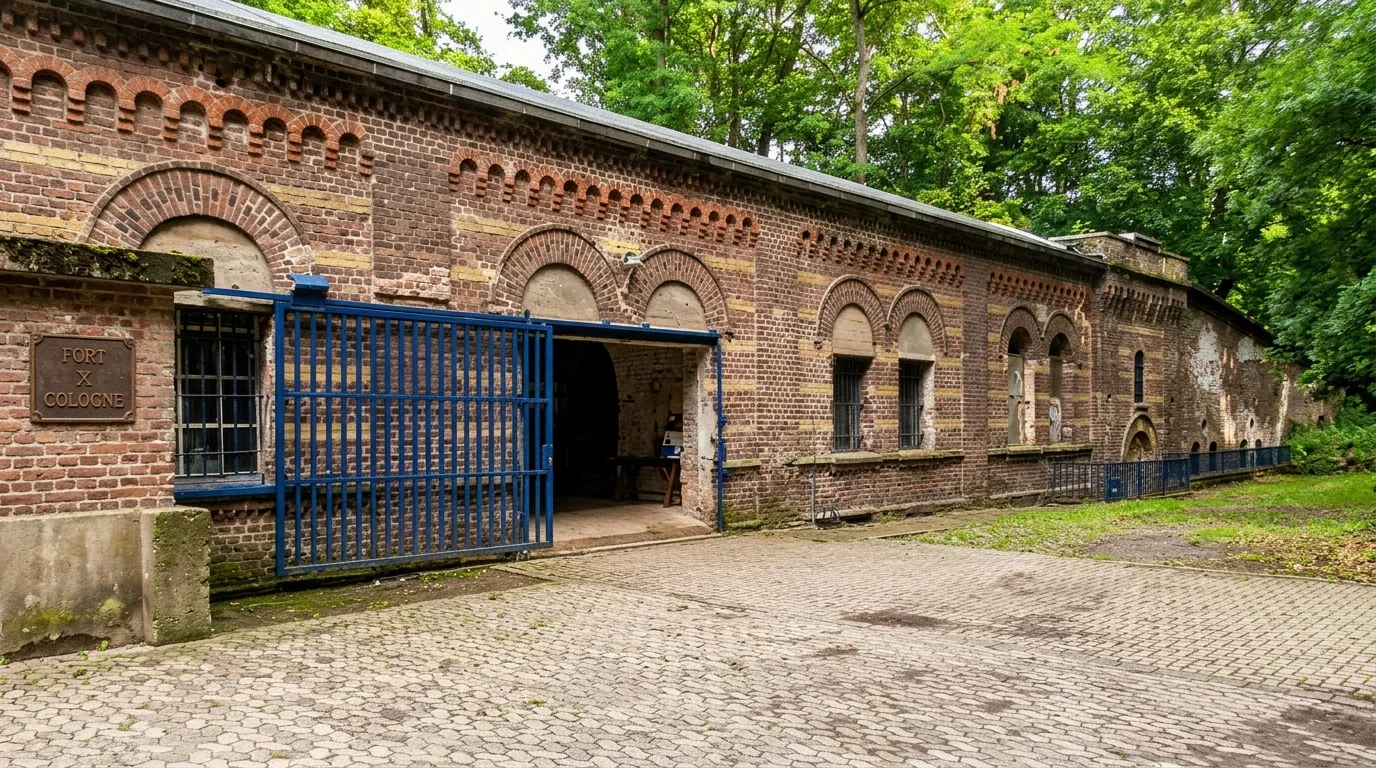
In Cologne's Bocklemünd district, close to the railway embankment in the northwest of the city, lies Fort IV, a massive fortification, parts of which are covered by earthen ramparts, recalling the era when Cologne was one of the most heavily fortified cities in the German Empire. Unlike the smaller forts of the inner fortress ring from the first half of the 19th century, Fort IV belongs to the large structures of the outer fortress ring, built around Cologne under Prussian rule in the 1870s and 1880s. With its sprawling ramparts, hidden casemates, and underground passages, Fort IV ranks today among the most impressive surviving testimonies of Cologne's military history and is a popular destination for history enthusiasts and families, particularly during guided tours held as part of the Day of Open Monuments.
History of Fort IV
After Cologne's early 19th-century inner fortress ring had largely lost its protective military value due to the rapid development of artillery technology, Prussia decided in the 1870s to surround Cologne with a second, considerably more distant outer fortress ring. This outer ring was built between 1873 and 1886 and consisted of a chain of large forts, intermediate works, and connecting fortifications positioned much farther from the city center, in order to account for the growing range of modern artillery. Fort IV in Bocklemünd was constructed around 1875 as part of this expansion program and was designed according to the then-modern "Biehler" unified fort system, which relied on a compact, heavily protected design with extensive earthen ramparts. The complex measures roughly 330 by 210 meters overall, and its walls reach a thickness of up to three meters in places, offering considerable resistance even to more modern artillery fire. With the end of the First World War and the provisions of the Treaty of Versailles of 1919, the outer fortress ring likewise lost its military function; large parts of Cologne's fortifications were demilitarized in the following decades, partly dismantled, or put to new civilian uses. Fort IV, however, remained largely intact as a structure and today ranks among the better-preserved large forts of the outer ring, even though its underground areas were scarcely accessible to the public for a long time. Only in recent decades has public interest in the complex as a historical monument grown significantly again. During this time, local history associations and volunteers have contributed a great deal toward making parts of the underground passages accessible once more and toward compiling knowledge about the construction period, the techniques used, and the fort's original garrison for a wider audience, so that Fort IV is perceived today not merely as a structure but as a living site of memory for Cologne's Prussian garrison history.
Highlights of Fort IV
The most striking feature of Fort IV is its expansive grounds, covered in grass and earthen ramparts, beneath which lies an extensive network of casemates, ammunition chambers, and connecting passages known during guided tours as the "catacombs of Fort IV," ranking among the most impressive underground structures in Cologne. The massive walls, up to three meters thick, together with the characteristic layout of the Biehler system, clearly illustrate how Prussian military engineers responded in the late 19th century to the growing penetrating power of modern artillery. Above ground, a calm parkland landscape dominated by trees and meadows now prevails, forming an appealing contrast to the defensive substance beneath it and making Fort IV a popular place for walks, nature observation, and short exploratory outings. Regularly on the Day of Open Monuments, volunteer history enthusiasts and local associations open parts of the otherwise inaccessible underground areas for guided tours, during which visitors can experience the narrow passages, storage rooms, and firing embrasures up close. For families and school groups, Fort IV thus offers an especially vivid introduction to Cologne's fortress history, since, unlike many other historic sites, the massive, almost entirely underground dimension of Prussian defensive architecture can be experienced directly here. Together with the other surviving forts of the outer ring, Fort IV forms an important building block for understanding just how strongly Cologne was shaped by its role as a fortress city in the 19th century.
Opening Hours, Tickets & How to Get to Fort IV
Fort IV is not a continuously open museum with fixed daily hours; its underground areas and casemates can primarily be visited as part of organized guided tours, offered regularly on the Day of Open Monuments as well as on occasional special dates arranged by local history associations. The above-ground park area around the ramparts, by contrast, is freely and permanently accessible at no charge and can be used for a walk year-round. The complex is located on Freimersdorfer Weg in Cologne's Bocklemünd district, postal code 50829, near the local railway embankment. By public transport, Fort IV is easily reached via KVB light rail lines 3 and 4 to the Bocklemünd stop, from which the site is just a short walk away. By car, access is via the surrounding main roads in western Cologne; sufficient parking is generally available near the complex. Since the underground sections are in places narrow, uneven, and not wheelchair-accessible, visitors joining a guided tour should wear sturdy footwear and check the specific access conditions in advance; the above-ground green area itself, however, is well suited for a relaxed, unrestricted walk at any time.
Attractions Near Fort IV
Near Fort IV lies the Pesch district, with several historic farm complexes such as the Kriegshof, the Paulshof, and the Heribertshof, as well as the site known as Die Pescher Vorburg, which together form a small ensemble of rural building history in northwestern Cologne and combine well with a visit to Fort IV. Cologne's Outer Green Belt also runs close by, offering numerous cycling and walking paths that provide excellent opportunities to combine a visit to the fort with a longer exploration of the city's green spaces. Those with a broader interest in Cologne's Prussian fortress history can extend the route to other surviving forts of the outer ring, which are spread across the west and north of the city and together convey an impressive picture of Cologne's former role as a fortress city. To round off the excursion, the nearby Fühlinger See offers recreational and watersports facilities that provide a pleasant contrast to the military-historical character of Fort IV and make for a relaxing afternoon.
Where to stay in Cologne, Germany
Compare current hotel prices and find the right place to stay.