Fischmarkt
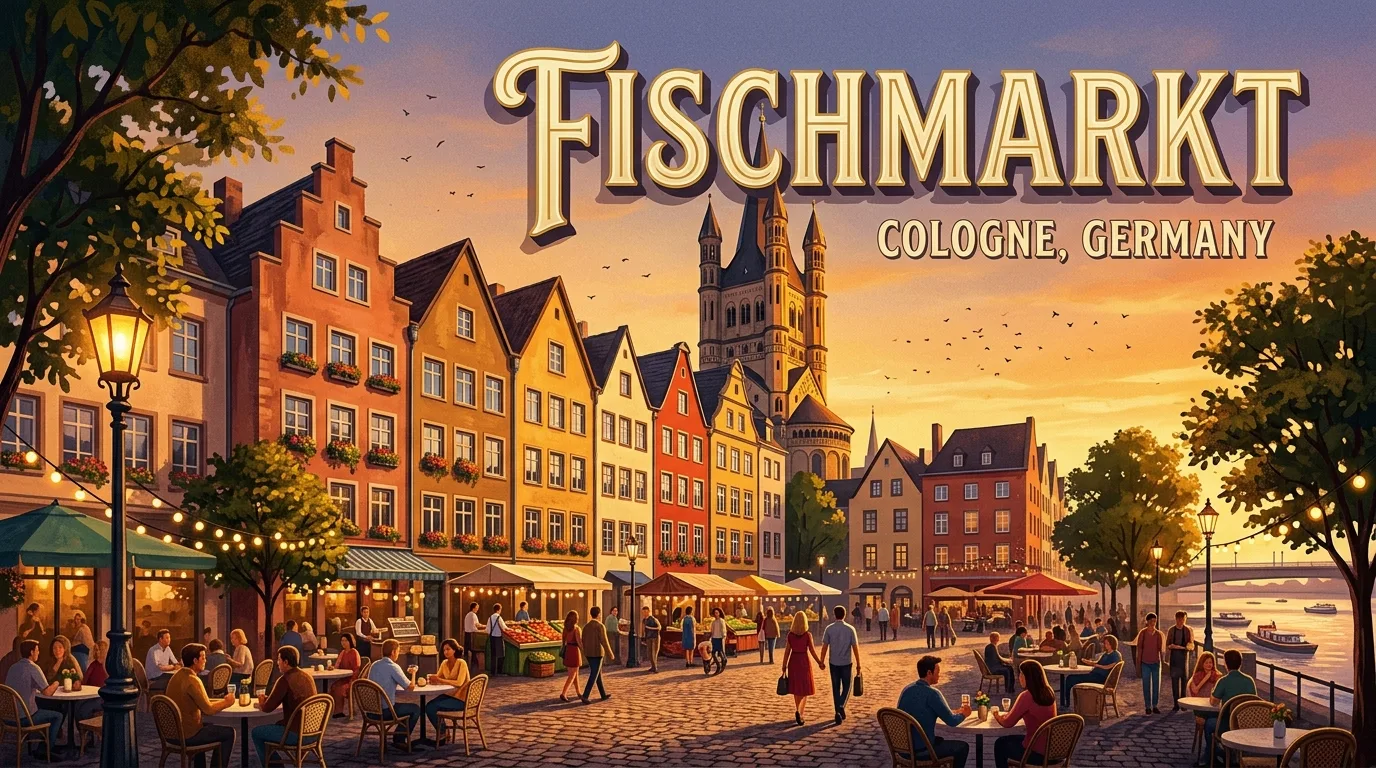
Fischmarkt is one of the most atmospheric squares in Cologne's Altstadt, tucked right against the bank of the Rhine between the Romanesque church of Groß St. Martin and the river itself. From a distance, visitors are drawn to the unbroken row of narrow, steep-gabled houses that line the square like a colorful backdrop, long regarded as one of the most photographed sights in the city. The name points directly to the square's original purpose: for centuries, fresh fish caught in the Rhine and brought from farther afield was traded here, before the square gradually turned into a place for socializing during the 19th and 20th centuries. Today, locals and visitors alike sit on the stone steps leading down to the river on mild evenings, while restaurants and cafés in the ground floors of the historic houses set out tables and small pavilions. In a very small space, Fischmarkt combines medieval urban history, Rhineland conviviality, and one of the finest river views in all of Cologne.
History of Fischmarkt
The history of Fischmarkt stretches back nearly a thousand years: around the year 1100, the first buildings appeared between Lintgasse and Mühlengasse, likely on land that once belonged to a Benedictine abbey. Documents from the 12th century already refer to the square by its Latin name, forum piscium, underlining its early role as a trading place for fish. A decisive economic boost came in 1259, when the city of Cologne was granted the so-called Stapelrecht, or staple right: merchants passing through were required to offer their goods, including fish, for sale before continuing their journey, which considerably boosted trade at Fischmarkt. By the 13th century, the square occupied the land between the collegiate church of Groß St. Martin and the medieval city wall, right in the heart of the densely populated Martinsviertel quarter. In the 15th century, when Cologne had grown to roughly 40,000 inhabitants and ranked among the largest cities north of the Alps, locals commonly referred to the square as up dem Vyschmarte. At the beginning of the 19th century, under French administration, the square was briefly known by the French name Marché aux Poissons before the German name returned to everyday use. From the middle of the 19th century onward, the square gradually lost its function as an open-air trading place, as commerce increasingly shifted into permanent shops in the surrounding buildings. The five narrow Stapelhäuschen with their distinctive pointed gables, which still define the square's appearance today, were roughly 90 percent destroyed during the Second World War and were later rebuilt faithfully to their original design to preserve the historic character of the square.
Highlights of Fischmarkt
The unmistakable highlight of Fischmarkt is the picturesque row of Stapelhäuschen, whose narrow, brightly painted facades and distinctive pointed gables evoke Cologne's medieval architecture. Although two of the five historic houses were demolished in May 2024 after their structural fabric was deemed beyond repair, the overall ensemble remains one of the most beloved photo spots in the entire Altstadt. Rising directly behind the houses is the massive Romanesque church of Groß St. Martin, whose striking crossing tower helps define Cologne's skyline alongside the Cathedral and can be seen from many points along the riverfront. The real charm of Fischmarkt, however, lies in how architecture and river come together: broad stone steps lead straight down to the Rhine and, especially on warm evenings, turn into an informal grandstand where people of all ages gather for a picnic, an after-work beer, or simply to watch the boats go by. Since the Rheinufertunnel opened on 5 November 1982 after roughly three years of construction, through-traffic has run underground, allowing a calm, car-free riverfront to develop at Fischmarkt and in the adjoining Rheingarten between the Deutzer Brücke and Hohenzollernbrücke bridges. The restaurants and cafés housed in the historic buildings make full use of this space, setting out tables, chairs, and small pavilions that invite visitors to linger with a view of the river and the Deutz skyline on the opposite bank in almost any weather. At the blue hour, when the facades of the Stapelhäuschen and the illuminated silhouette of Groß St. Martin are mirrored in the water of the Rhine, Fischmarkt shows its most photogenic side and is considered by many locals to be one of the most romantic spots in the entire old town.
Opening Hours, Tickets & How to Get to Fischmarkt
Fischmarkt is a public open-air square that can be visited free of charge at any time of year, so there are no fixed opening hours, although the surrounding restaurants and cafés keep their own hours that vary by season. The best time to visit is in the late afternoon and evening, especially from spring through autumn, when the sun sets over the Rhine and the terraces are at their liveliest; travelers who prefer a quieter atmosphere should come in the morning, when only a few people are strolling along the riverbank. Fischmarkt sits right in the heart of the Altstadt and is therefore very easy to reach on foot, just a few minutes' walk from Cologne Cathedral or from Alter Markt. By public transport, the closest stops are Heumarkt and Rathaus, both served by several light-rail lines, from where it is only a short walk down to the riverfront. The stop at Breslauer Platz/Hauptbahnhof is also within walking distance via the Hohenzollernbrücke bridge. There is no dedicated parking directly at the square because of the dense historic building, but several public parking garages are available nearby in the Altstadt, including near Heumarkt and close to Cologne Cathedral. Arriving by Rhine excursion boat is particularly recommended, since many sightseeing cruises pass directly in front of Fischmarkt and offer an excellent view of the historic row of houses from the water.
Attractions Near Fischmarkt
Right next to Fischmarkt rises the Romanesque church of Groß St. Martin, one of Cologne's twelve great Romanesque churches, whose striking crossing tower is visible from afar and which invites a stroll through the surrounding Martinsviertel with its narrow medieval lanes. Just a few minutes' walk away lies Alter Markt, with its historic town hall tower and numerous traditional brewery taverns serving Kölsch straight from the cask. Heumarkt, one of the largest squares in the Altstadt and home to the equestrian monument of Friedrich Wilhelm III, is likewise within easy walking distance. A popular promenade runs along the Rhine both north toward the Hohenzollernbrücke and the main train station and south toward the Malakoffturm tower and the Rheingarten park. Travelers wanting to experience the Rhine from the opposite bank can cross the Hohenzollernbrücke on foot and reach the Köln Triangle in Deutz, with its popular observation deck. Cologne Cathedral, Germany's most visited landmark, is also only about a ten-minute walk away and can easily be combined with a visit to Fischmarkt.
Where to stay in Cologne, Germany
Compare current hotel prices and find the right place to stay.