DITIB Zentralmoschee
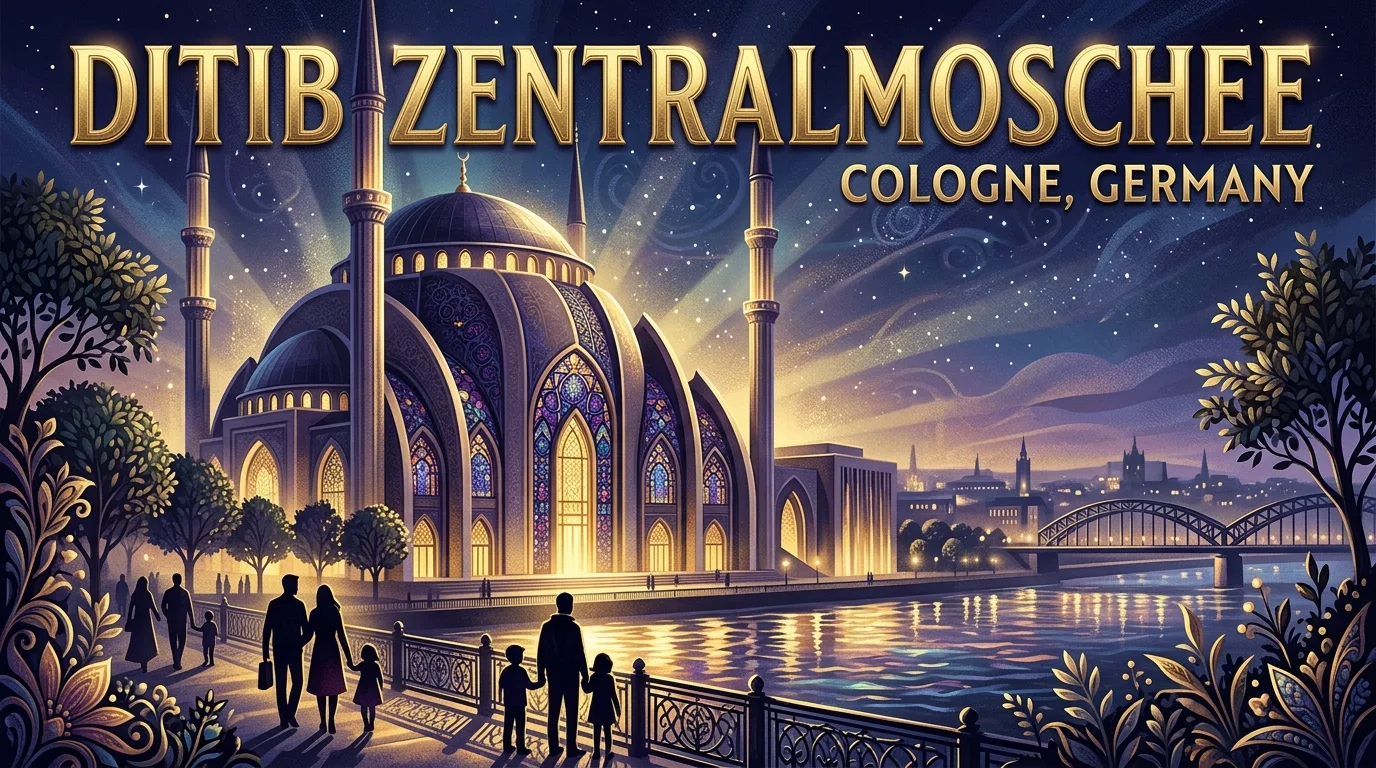
In the heart of Cologne's vibrant Ehrenfeld district stands one of Germany's most striking religious buildings: the DITIB Zentralmoschee. With its glass dome, two slender minarets, and light-filled interior, the DITIB Zentralmoschee has, since its completion, marked a turning point in the relationship between Muslim community life and the urban landscape of the Rhineland. Designed by Cologne-based architect Paul Böhm, son of Pritzker Prize laureate Gottfried Böhm, the building combines a modern, transparent architectural language with traditional elements of mosque design, making it a talking point far beyond the Turkish-Muslim community. The DITIB Zentralmoschee sits directly on the bustling Venloer Straße, only a few kilometers from Cologne's historic city center and Cologne Cathedral, making it both a religious center and an architectural landmark. Visitors interested in sacred architecture, interfaith dialogue, or the recent urban history of Cologne will find in the DITIB Zentralmoschee a place where faith, society, and architecture come together in an unusually open way.
History of DITIB Zentralmoschee
The history of the DITIB Zentralmoschee begins long before the first spade hit the ground. The Turkish-Islamic Union for Religious Affairs, known by its German acronym DITIB, was founded in 1984 as an umbrella organization for Turkish-Muslim communities in Germany and grew over the following decades into the country's largest Islamic religious association. As its membership in Cologne expanded, the desire grew for a representative house of worship that would go beyond the makeshift backyard mosques used until then. In 2006, DITIB launched an architectural competition, which was won by a design from Paul Böhm. The proposal triggered a lively, at times controversial, public debate in Cologne: a survey conducted in June 2007 found that 35.6 percent of respondents fully supported the project, 27.1 percent supported it on the condition that its size be reduced, and 31.4 percent opposed it regardless of any design changes. As a result of these discussions, the originally planned capacity of around 2,000 worshippers was reduced to approximately 1,200. Cologne's city council granted planning approval on August 28, 2008, with the formal building permit following on November 7 of that year. The ground-breaking ceremony took place on November 7, 2009, in the presence of roughly 2,000 guests, and the topping-out ceremony followed on February 2, 2011. After years of interior construction, the prayer hall beneath the dome was used for prayer for the first time on June 9, 2017, during Ramadan. The DITIB Zentralmoschee was officially inaugurated on September 29, 2018, in the presence of Turkish President Recep Tayyip Erdoğan and numerous representatives from politics and religious life, bringing to a close a process that had lasted roughly twelve years from competition to opening.
Highlights of DITIB Zentralmoschee
The architectural centerpiece of the DITIB Zentralmoschee is its striking glass dome, which spans the central prayer hall with a diameter of approximately 25 meters and a height of around 36.5 meters. Unlike classical Ottoman domed mosques, this dome is not built from solid masonry but from a delicate steel-and-glass structure that lets daylight flood almost unfiltered into the interior, giving the prayer hall an extraordinary sense of lightness. With this transparency, Paul Böhm deliberately sought to create a counter-image to closed, outwardly sealed sacred buildings, making openness visible as an architectural statement. The dome is flanked by two slender minarets, each 55 meters tall, which shape the skyline of Ehrenfeld from afar while also emphasizing the vertical connection between the complex's five levels. On the ground floor of the DITIB Zentralmoschee, a lively bazaar and entrance area with shops and a café welcomes all visitors, regardless of religion or background. A central light well visually links all the floors and leads up to the library, seminar and lecture rooms, and the prayer hall itself. The complex's total usable floor area amounts to roughly 16,500 square meters spread across five levels, including an underground car park. Particularly notable is the interplay of exposed concrete, glass, and wood, which gives the building an almost weightless appearance despite its monumental scale. Regularly changing exhibitions, for instance on photography or interfaith dialogue, add a cultural dimension to the architectural experience and keep the DITIB Zentralmoschee a lively venue beyond its religious function. For anyone interested in architecture, looking up into the dome from the plaza level remains one of the most memorable moments of a visit.
Opening Hours, Tickets & How to Get to DITIB Zentralmoschee
The DITIB Zentralmoschee can be visited as part of public guided tours, which are typically offered on Wednesdays, Fridays, Saturdays, and Sundays at 3:15 pm and last about an hour. The meeting point is usually the information desk on the plaza level of the ground floor. In addition to architecture, the tours cover the basics of Islam and interfaith dialogue, and are aimed at individual visitors as well as school groups and larger parties. Group visits should be registered in advance through the online request form on the Moscheeforum website, since capacity is limited. Admission to the tours and to the exhibitions inside the building is free of charge; this is an offering in the spirit of interfaith dialogue rather than a commercial ticketing system. Because the DITIB Zentralmoschee is an active house of worship, visiting hours may be restricted around the five daily prayer times and especially during Friday prayers, so visitors are advised to confirm current times by phone or via the official website before arriving. As with visits to other religious buildings, modest and respectful clothing is recommended, and inside the prayer hall itself it is customary to remove one's shoes and, for women, to wear a headscarf; appropriate guidance and loaner scarves are usually available at the entrance. Getting to the DITIB Zentralmoschee is straightforward thanks to its central location on Venloer Straße in Cologne-Ehrenfeld: several Stadtbahn light-rail lines serve the surrounding area, and Cologne-Ehrenfeld station, with connections to suburban and regional trains, is within walking distance. Visitors arriving by car can use the underground car park within the complex; from Cologne's main train station and the city center, the mosque can be reached in roughly fifteen to twenty minutes.
Attractions Near DITIB Zentralmoschee
The Ehrenfeld district, home to the DITIB Zentralmoschee, has transformed in recent years from a former working-class and industrial quarter into one of Cologne's most creative and multicultural neighborhoods. Right outside its doors, Venloer Straße stretches out with a dense mix of Turkish, Arab, Asian, and German shops, cafés, and restaurants, offering an authentic glimpse into Cologne's everyday multicultural life. Just a few minutes' walk away lies the Helios-Gelände, a former hospital site now home to artist studios, start-ups, galleries, and restaurants, and one of the trendiest spots to spend an evening in western Cologne. Cologne-Ehrenfeld station, an important transport hub, is likewise close by and makes a good starting point for exploring the district further. Visitors heading from the DITIB Zentralmoschee toward the city center can reach Cologne's old town, with its well-known sights such as Cologne Cathedral, the Rhine riverside promenade, and the Hohenzollern Bridge, within about fifteen minutes by Stadtbahn. The lively Belgian Quarter, with its boutiques and bars, as well as Rudolfplatz and its landmark Hahnentorburg gate tower, lie roughly halfway between Ehrenfeld and the city center and make a pleasant stop along the way. A visit to the DITIB Zentralmoschee therefore combines well with a stroll through one of Cologne's most dynamic districts and an excursion into the historic old town.
Where to stay in Cologne, Germany
Compare current hotel prices and find the right place to stay.