Bayenturm
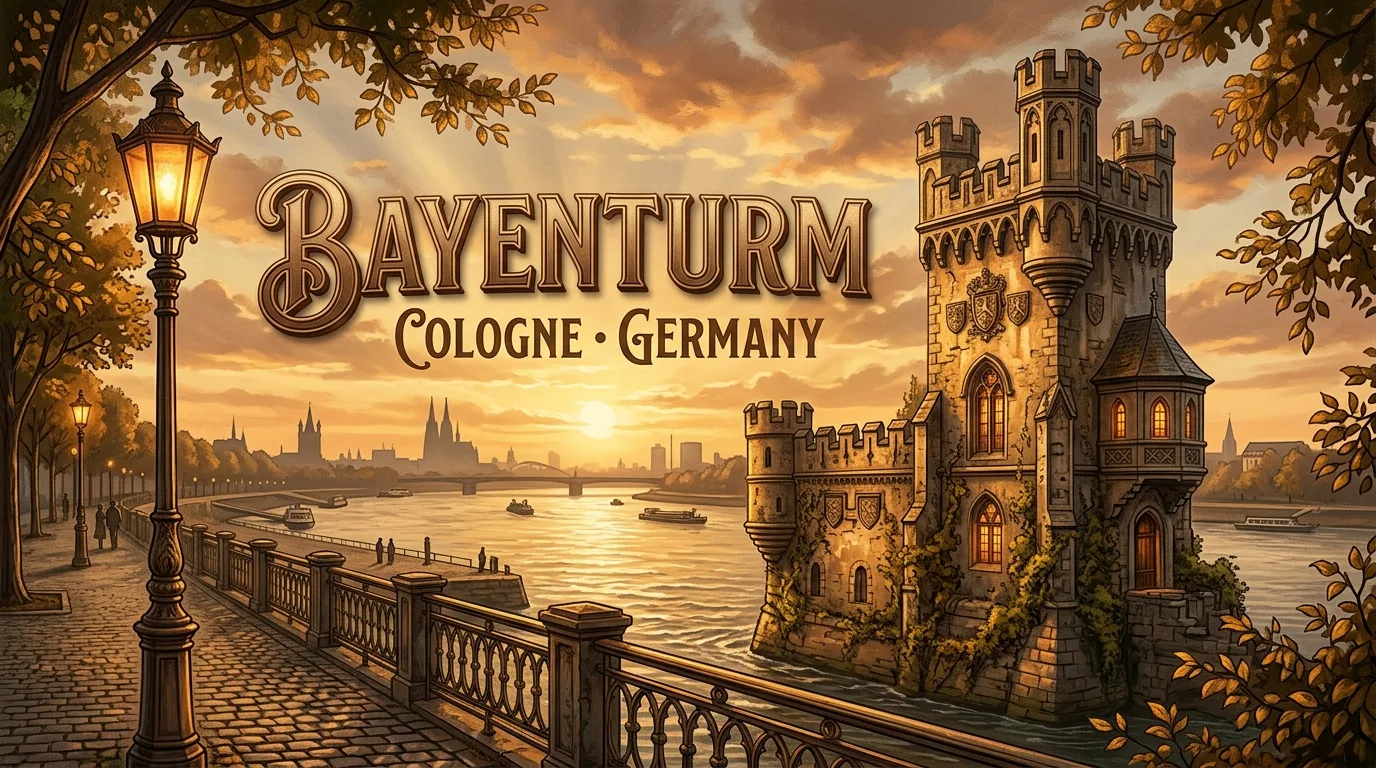
At the southern edge of the Rheinauhafen, where Cologne's old city wall once met the Rhine, a mighty stone tower still rises today, having witnessed centuries of power struggles, urban history, and social change: the Bayenturm. With its massive square base and characteristic octagonal upper storeys, it is one of Cologne's most striking surviving fortifications, clearly visible both from the opposite riverbank and from the modern Kranhäuser of the Rheinauhafen. While many other parts of Cologne's medieval city wall have disappeared over the centuries, the Bayenturm has not only survived but found a remarkable second life as a cultural institution - a rare combination of centuries-old defensive architecture and a very contemporary socio-political use.
History of Bayenturm
The Bayenturm was built around the year 1220 as the southern corner tower of Cologne's massive medieval city fortification, which at the time, stretching some eight kilometers, formed the largest city wall north of the Alps. It was first documented in 1250, but its strategic importance as a control point on the southern bank of the Rhine was central from the very beginning: from here, shipping traffic on the Rhine could be monitored and, if necessary, controlled, making the Bayenturm a key structure in the city's defensive strategy.
The Bayenturm became the site of one of the most memorable moments in Cologne's urban history on June 8, 1262, when rebellious citizens of Cologne seized the tower, breaking the centuries-long secular rule of the archbishop over the city. This event is considered one of the decisive steps on Cologne's path to becoming a free imperial city, and is still associated today with the local saying "Whoever holds the tower holds the power" - a phrase that aptly captures the building's symbolic importance for civic self-determination. Architecturally, the Bayenturm was expanded several times over the centuries: the original square base with three storeys and walls up to 2.50 meters thick was supplemented around the year 1325 with two octagonal upper storeys, giving the tower its characteristic, slightly asymmetrical silhouette that still distinguishes it clearly from the city's other defensive towers today.
With the loss of the city wall's military function amid modern urban development in the 19th and early 20th centuries, the Bayenturm likewise lost its original purpose. The bombing raids of the Second World War damaged large parts of Cologne's old town, yet the sturdy tower survived the destruction in its basic structure and could be preserved and restored in the postwar period. In the following decades, the Bayenturm served various purposes at different times before receiving, in August 1994, a new and defining role that continues to this day and has made the building known far beyond Cologne.
Highlights of Bayenturm
The most outstanding highlight of the Bayenturm is undoubtedly its impressive architecture: at a total height of roughly 35 meters including its battlements, it is one of the tallest surviving defensive towers of Cologne's medieval city wall. Particularly striking is the transition from the massive square base to the more delicate octagonal upper storeys, which vividly illustrates the structural development spanning more than a century. The walls, up to 2.50 meters thick in the lower section, still convey a direct impression of the defensive strength of medieval city fortifications and of the effort the citizens of Cologne invested in protecting their city.
Since August 1994, the Bayenturm has been home to the FrauenMediaTurm, a foundation established by journalist Alice Schwarzer, who also serves as its chairwoman, and regarded as a major feminist media and documentation archive in the German-speaking world. Inside the tower are housed more than 15,000 books and around 60,000 documents on the history of the women's movement, complemented by an extensive online database with roughly 42,000 entries, accessible to researchers, journalists, and interested visitors worldwide. This combination of medieval masonry and modern feminist knowledge culture makes the Bayenturm one of Cologne's most unusual and content-rich destinations.
Another highlight is the Bayenturm's location directly at the Rheinauhafen, where historic fabric and the spectacular modern architecture of the Kranhäuser meet in immediate proximity. The contrast between the nearly 800-year-old defensive tower and the glass high-rise structures of the 21st century makes this spot a particularly striking photo opportunity and a symbol of Cologne's architectural transformation across the centuries. The historical significance as the site of the 1262 uprising is also made tangible on-site through information panels and the architecture itself, allowing visitors to experience not just a building, but a concrete historical setting.
Opening Hours, Tickets & How to Get to Bayenturm
The Bayenturm is located at Am Bayenturm 2, 50678 Cologne, at the southern edge of the Rheinauhafen, just a few steps from the Rhine. The exterior of the tower can be viewed free of charge at any time, as it forms a freely accessible part of the cityscape. The library and archive of the FrauenMediaTurm inside are accessible Monday to Friday between 10 am and 5 pm, though generally only by prior appointment, since it functions as a research archive rather than a classic tourist attraction. For the general public, regular public tours are also offered, usually taking place on the fourth Wednesday of each month at 5 pm, at a very affordable admission of around 5 euros per person; advance registration by email is recommended, as spaces are limited.
Getting to the Bayenturm from central Cologne is straightforward. From the main train station or the cathedral, visitors can reach the Rheinauhafen and the Bayenturm with a pleasant walk of about 20 to 25 minutes along the Rhine riverside, passing the historic old town and the Fischmarkt. Alternatively, the bus lines and tram stops around Chlodwigplatz and Severinstraße are also convenient, from which the Bayenturm is likewise within a short walking distance. Parking is available in the car parks of the Rheinauhafen, though arriving on foot or by public transport is usually the more pleasant option given the central location.
Attractions Near Bayenturm
The Bayenturm's location directly at the Rheinauhafen makes it an ideal starting point for exploring one of Cologne's most modern yet history-rich districts. In the immediate vicinity rise the world-famous Kranhäuser, three striking modern office and residential buildings shaped like historic harbor cranes, which have become a symbol of the revitalized Rheinauhafen and form an appealing architectural contrast to the medieval tower. Just a few minutes' walk away, the Chocolate Museum invites a visit, presenting the history of chocolate from the cocoa bean to the finished praline in an engaging, family-friendly way.
Walking further from the Bayenturm along the Rhine toward the north, visitors quickly reach the historic old town with its colorful gabled houses, the Fischmarkt, and the striking church of Groß St. Martin with its distinctive four towers. The Severinsviertel, with its lively Severinstraße, numerous owner-run shops, and traditional breweries, is also within comfortable walking distance and makes for an ideal relaxed conclusion to the visit. Those interested in the medieval city wall can also seek out further surviving wall remnants and gate towers in Altstadt-Süd from here, gaining a more complete picture of Cologne's former city fortifications.
Where to stay in Cologne, Germany
Compare current hotel prices and find the right place to stay.